
Dingy Skipper
Erynnis tages
Description
How to identify
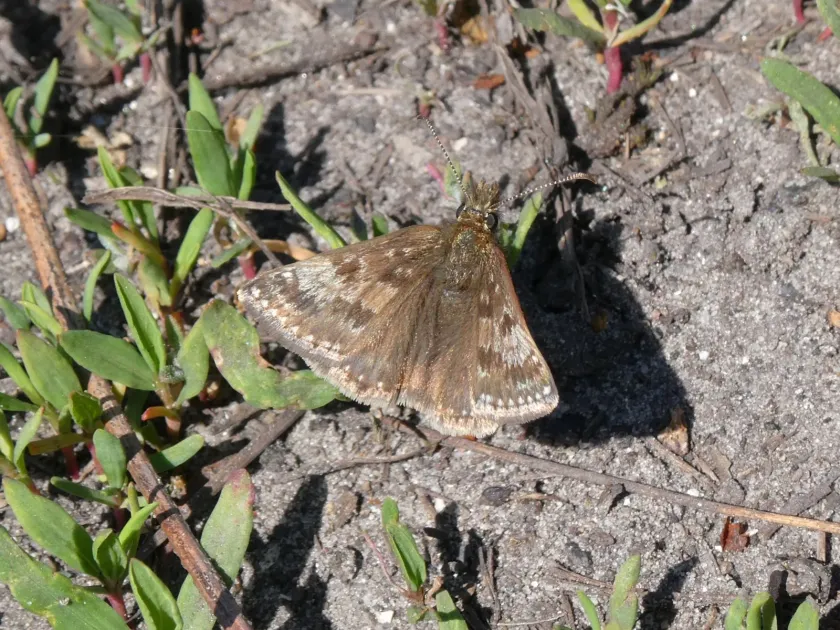
The Dingy Skipper (Erynnis tages) is a small butterfly species within the Hesperiidae family. Its wingspan typically ranges from 25 to 29 mm.
The coloration of the wings features a mottled pattern of grey, brown, and dark hues, providing excellent camouflage against soil and withered vegetation in its habitat.
The butterfly has a robust, hairy body. Its antennae have distinct clubbed tips that are slightly curved, which is a key identification feature for this specific butterfly species.
The larvae (caterpillars) are bright green in color with prominent yellowish longitudinal stripes along their sides, blending in perfectly with the foliage of their host plants.
The caterpillar's head is dark or black, contrasting with the light-colored body. They progress through several larval instars before eventually pupating into the adult stage.
What it damages
The caterpillars primarily feed on leguminous plants (Fabaceae), including Bird's-foot Trefoil, clover, vetch, and various other wild species common in grassland areas.
While mass outbreaks causing widespread crop destruction are rare, localized infestations can significantly reduce the biomass of forage crops in specific regions.
The damage is caused by larvae feeding on the leaf tissue, creating irregular holes or completely consuming the leaf margins, which stunts the plant's growth.
In agricultural settings, heavy infestation of fodder legumes can negatively impact hay quality and the overall yield of green manure or fodder production.
Adult butterflies feed on floral nectar and do not cause mechanical damage to crops, as their mouthparts are specialized for fluid intake rather than chewing foliage.
When it appears
The flight period for the adult butterflies typically occurs from April through June. Depending on regional climate, the species may produce one or two generations per year.
The species overwinters as a late-instar larva or pupa, protected within a silk-lined cocoon found in leaf litter or folded within host plant foliage.
Adults are most active during sunny, warm weather, often found in open sunny spots, forest edges, and grasslands rich in leguminous host plants.
Females deposit eggs individually on the underside of leaves. Larvae emerge after approximately 10 to 14 days to begin their intensive feeding cycle.
The complete life cycle, including the pupation phase, takes roughly two months, allowing the population to thrive before unfavorable climatic conditions arise.
Signs of infestation
The primary indicator of a Dingy Skipper infestation is the appearance of irregular, window-like holes in the leaves of legume host plants.
A notable larval behavior is the construction of protective shelters where caterpillars web leaves together to form tubes, hiding within them during the day.
When surveying fields, these folded leaves are easy to spot. Close inspection often reveals the presence of the caterpillar or its distinct fecal pellets (frass).
Extensive damage results in yellowing and premature drying of leaves, which can appear as patchy thinning of the vegetation across the affected area.
An abundance of adult butterflies during the legume flowering season serves as an early warning sign, necessitating close monitoring for developing larvae.
Control measures
The primary control strategy involves effective agronomic practices, including crop rotation and the regular mowing of weeds at field margins to disrupt larval habitats.
Biological control measures, such as the application of Bacillus thuringiensis-based products, are highly effective against early-instar larvae without harming beneficial insects.
If population levels exceed economic thresholds, the use of systemic or contact insecticides may be permitted, though targeted application is essential to preserve natural predators.
Conservation of natural enemies, such as ichneumonid wasps, plays a crucial role in regulating populations, making the careful use of broad-spectrum pesticides advisable.
- Regular inspection for webbed or folded leaves
- Strategic crop rotation and field sanitation
- Targeted biological insecticide application
- Monitoring adult flight using pheromone traps
Taxonomy
- Latin name
- Erynnis tages
- Order
- Lepidoptera (butterflies)
- Family
- Hesperiidae
- EPPO code
- EYNNTA
Discussion
No discussions yet — be the first.