

Pest · Coleoptera (beetles) · affects Fodder beet, Winter wheat, Field pea
Melon ladybird
Epilachna elaterii
Description
How to identify
The melon ladybird, scientifically known as Epilachna elaterii, is a beetle belonging to the Coccinellidae family. It is a specialized pest that is distinct from most predatory ladybirds because it feeds exclusively on plant tissue.
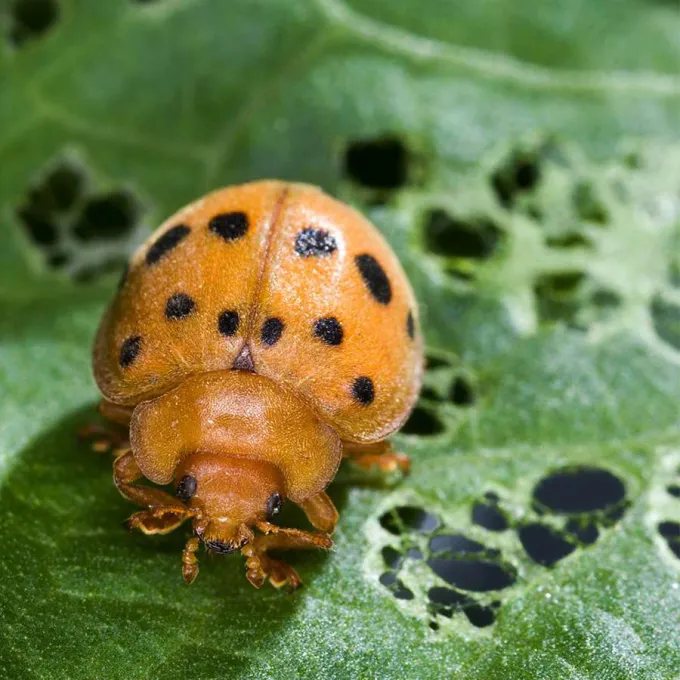
Adult beetles have a convex, oval-shaped body, usually measuring 6 to 8 mm in length. Their dorsal surface is covered with fine, dense hairs, giving them a dull appearance. The base color ranges from yellow to reddish-brown.
The most defining feature of these beetles is the arrangement of black spots on their elytra. Typically, they possess 12 or 14 spots, which can be somewhat variable in size but are generally arranged in distinct, symmetrical rows.
The eggs are laid in clusters, usually consisting of several dozen individual eggs. They are bright yellow or orange, elongated in shape, and are placed on the underside of leaves to provide protection from direct sunlight and predators.
Larvae are easily identifiable by their bright yellow color and the presence of branched, spine-like structures covering their bodies. These spines serve as a deterrent to birds and other insectivores. Pupae are typically found attached to the leaves or stems.
What it damages
The primary hosts for the melon ladybird are members of the Cucurbitaceae family. This includes commercially significant crops such as watermelons, melons, cucumbers, pumpkins, and squashes, all of which are highly susceptible to damage.
Wild relatives of cucurbit crops often act as secondary hosts. These plants maintain the population of the pest in the environment even after the primary crops have been harvested, facilitating the infestation of future fields.
The pest causes significant damage through both its larval and adult stages, as both feed on the foliage of the plants. They scrape the leaf surface, which interferes with the plant’s ability to perform photosynthesis efficiently.
Severe infestations lead to the rapid defoliation of the plant. As the leaves are destroyed, the plant struggles to transport necessary nutrients and water to the developing fruits, resulting in stunted growth, misshapen fruits, and lower sugar content.
In cases of unchecked growth, the melon ladybird can destroy the majority of the foliage on an entire field. This leads to weakened vines that are prone to secondary infections and often results in total failure of the harvest in affected sectors.
When it appears
Adult beetles emerge from their overwintering sites in the spring when temperatures consistently rise. They immediately seek out early-season cucurbit crops to initiate feeding and mating, marking the beginning of the infestation cycle.
The peak activity of the pest is observed during the hot summer months. High temperatures accelerate the metabolic rates of the beetles and larvae, leading to shorter life cycles and the rapid overlapping of generations throughout the season.
In warmer climates, the melon ladybird can produce multiple generations per year. By late summer, populations can become extremely dense, with eggs, larvae, and adults present on the same plant simultaneously.
As autumn approaches and temperatures begin to drop, the beetles cease their feeding activity. They search for protected environments, such as crop debris, leaf litter, or crevices in structures, where they enter diapause to survive the winter.
The total duration of the cycle is heavily influenced by regional climate. In cooler northern ranges, only one generation might complete its cycle, while southern regions face persistent pressure from multiple successive broods of the pest.
Signs of infestation
The most prominent sign of a melon ladybird infestation is the skeletonization of leaves. The beetles and larvae eat the soft green tissue of the leaf blade, leaving behind only the vascular network, which looks like a fine, transparent mesh.
- Characteristic skeletonized patches on the underside and upper surface of leaves.
- Presence of yellow, spiny larvae crawling on the underside of foliage.
- Clusters of bright orange-yellow eggs deposited in groups on leaf tissue.
- Wilting, yellowing, and necrotic spots on damaged leaves that eventually dry out.
- Reduced fruit size and poor quality due to the overall stress on the plant.
Infestations typically start from the lower, older leaves near the soil surface before spreading upward. A visual inspection of the underside of the leaves is usually sufficient to confirm the presence of eggs or larvae.
Beetles are easily spotted due to their color, but they often attempt to escape by dropping off the leaf if disturbed. Another defensive trait is the secretion of a yellowish, foul-smelling fluid, which is a chemical reaction used to deter threats.
Heavily damaged plants often display a marble-like appearance on their leaves due to the contrast between healthy tissue and the skeletonized necrotic patches. This significantly reduces the total surface area available for gas exchange and energy production.
Control measures
The first line of defense is cultural control. Removing and destroying all crop residues after harvest is crucial to eliminate overwintering sites. Deep plowing in the autumn helps to bury the beetles and significantly reduce the next year's population.
Crop rotation is essential for long-term management. Avoiding the cultivation of cucurbits in the same area for at least 3–4 years breaks the life cycle of the pest. Additionally, controlling wild weeds of the Cucurbitaceae family is vital.
Regular field scouting is highly recommended. For small plots or gardens, manual removal of eggs and larvae can be an effective way to keep the population under control without the need for chemical intervention.
Chemical control involving broad-spectrum insecticides or specific pest-targeted sprays may be necessary in large-scale commercial farming. Treatments should always follow local regulations, particularly regarding safety intervals before harvest.
Biological control, such as using entomopathogenic fungi, is gaining popularity as an environmentally friendly alternative. Integrating these methods helps maintain the population below the economic injury level while preserving beneficial pollinators in the field.
Content graph
Connections · Melon ladybird
Most often together:
Marketplace
Products · 3


Biology
Taxonomy
- Latin name
- Epilachna elaterii
- Order
- Coleoptera (beetles)
- Family
- Coccinellidae
- EPPO code
- EPILCH
Community
Discussion
No discussions yet — be the first.