
Thread-legged bug
Empicoris rubromaculatus
Description
How to identify
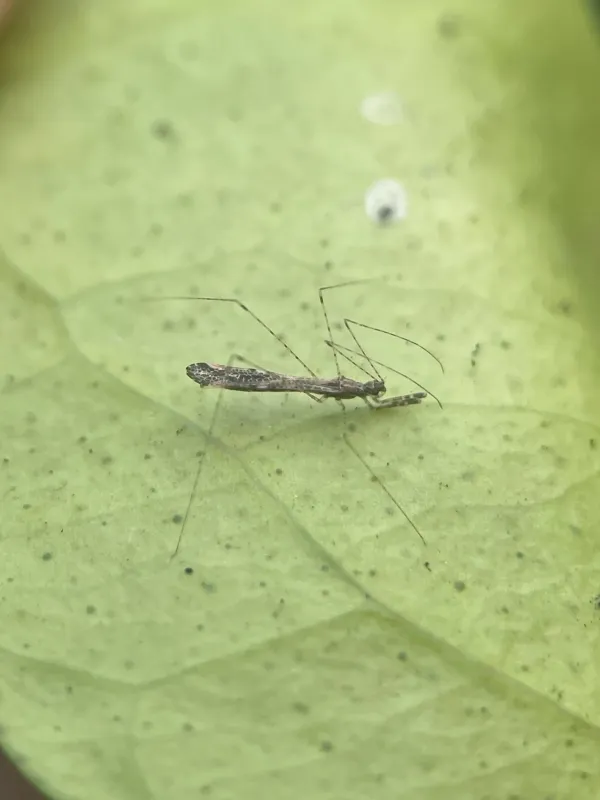
Empicoris rubromaculatus, commonly known as a type of thread-legged bug, belongs to the family Reduviidae, order Hemiptera. These insects are distinguished by their extremely slender bodies and long, delicate legs that resemble those of mosquitoes.
The adult bugs are typically 5–7 mm long and exhibit a pale brown or yellowish coloration with distinct reddish or dark markings on their pronotum and wings.
Their head is elongated, featuring a well-developed proboscis tucked beneath the thorax when not in use. The wings are transparent with prominent venation, often folded flat along the body.
Nymphs look like smaller, wingless versions of the adults. They move slowly along the stems and leaves, often remaining motionless to avoid detection.
They are highly adaptable insects, found in various environments ranging from natural habitats to greenhouses and agricultural fields where they find shelter and food.
What it damages
Although many thread-legged bugs are predators, Empicoris rubromaculatus can cause damage to plants by feeding on plant sap when alternative prey is scarce or during high population densities.
The damage occurs when the bug pierces plant tissue with its proboscis, injecting enzymes that lead to local tissue necrosis, chlorosis, and stunted growth.
Host plants often include ornamental species, greenhouse vegetables, and various shrubs that provide a stable, protected environment for the colony to thrive.
Feeding marks appear as tiny, pale spots on the leaves, which can expand and lead to foliage yellowing or premature leaf drop in severe cases.
The punctures made by the bugs also create entry points for secondary pathogens, such as fungi and bacteria, which can further jeopardize plant health.
When it appears
The activity of these bugs typically begins in mid-spring, as temperatures rise and the overwintering adults emerge to feed and begin the reproductive cycle.
Peak populations are usually observed during the height of the summer, coinciding with the rapid growth phase of most host plants in the garden or greenhouse.
Multiple generations can occur throughout the season depending on the regional climate, with warmer areas supporting more reproductive cycles.
As autumn approaches and temperatures decline, the bugs seek sheltered sites such as dry plant debris, bark crevices, or structural gaps to enter diapause.
Consistent high humidity and stable temperatures within greenhouses provide an ideal, extended breeding season for this pest throughout the year.
Signs of infestation
The most reliable way to identify an infestation is through visual inspection, as the bugs often remain motionless on the undersides of leaves or along stems.
The initial signs are subtle, appearing as small, pinpoint chlorotic spots on the leaf surface where the bug has inserted its mouthparts.
- Chlorotic spotting on leaves that may lead to yellowing.
- Deformed growth in succulent terminal shoots.
- Presence of discarded nymphal skins (exuviae) left on plant surfaces.
- Localized wilting of stems during periods of high pest density.
Observant gardeners may also notice tiny dark specks, which are insect excrement, left on the leaf surfaces near where the bugs congregate.
Control measures
Cultural practices form the first line of defense, including the thorough removal of weeds and debris where the bugs could potentially hide or overwinter.
In greenhouses, the use of sticky yellow or blue traps is an effective monitoring and control tool, as it captures active adults and reduces their breeding potential.
Biological control using entomopathogenic fungi can be highly effective in reducing population numbers without harming beneficial pollinators in the area.
If chemical intervention is necessary, opt for selective insecticides that target sucking pests, while strictly following safety labels and harvest intervals.
Proper fall sanitation, including the burning or deep burying of plant waste, is essential to minimize the number of overwintering sites available to the pest.
Taxonomy
- Latin name
- Empicoris rubromaculatus
- Order
- Hemiptera (bugs, aphids, leafhoppers)
- Family
- Reduviidae
- EPPO code
- EMPIRU
Discussion
No discussions yet — be the first.