
Thread-legged bug
Empicoris culiciformis
Description
How to identify
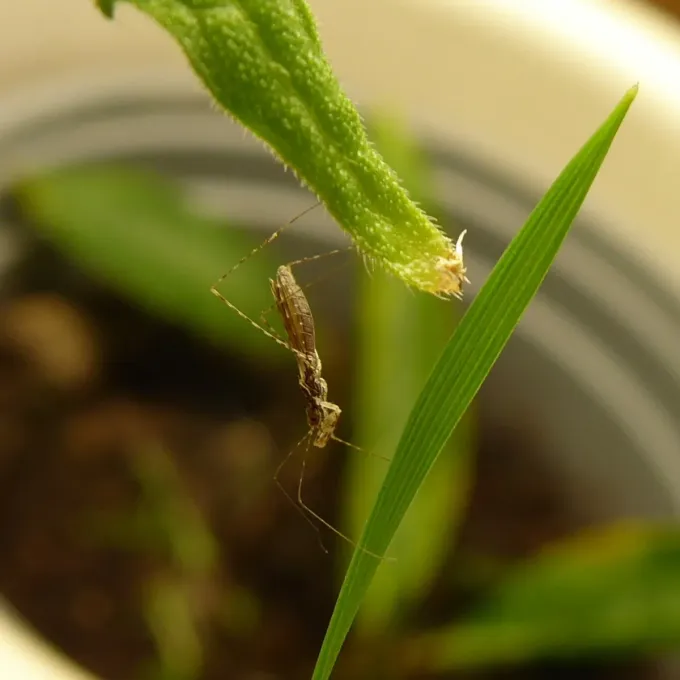
The thread-legged bug (Empicoris culiciformis) belongs to the assassin bug family (Reduviidae), known for its striking physical resemblance to a crane fly or mosquito.
The insect possesses a very slender, elongated body measuring approximately 4 to 6 millimeters in length, which allows for perfect camouflage on plant stems.
Its forelegs are specialized for grasping prey, a characteristic feature that distinguishes this species as a predator within its ecosystem.
The coloration ranges from light brown to blackish, providing an effective cover against the background of tree bark or dried foliage.
Nymphs of this species undergo several developmental stages, during which they gradually increase in size while maintaining the slender body shape characteristic of the adults.
What it damages
Although Empicoris culiciformis is primarily a predator, it can occasionally cause damage to plant tissues if the prey population is insufficient.
These bugs inhabit fruit trees, shrubs, and various field crops, where they actively search for smaller, soft-bodied organisms to feed on.
The main prey for these insects includes aphids, mites, and various larvae, making them beneficial in controlling more serious agricultural pests.
Damage to plants typically occurs when the bugs pierce the epidermis of leaves or stems in search of juices to supplement their diet during food scarcity.
In most commercial farming scenarios, the bug is considered a natural regulator rather than a significant threat to crop productivity.
When it appears
The biological activity of the thread-legged bug begins in early spring as temperatures rise, signaling the end of their winter diapause.
Population levels reach their annual peak during the summer months when the availability of aphids and other small prey items is at its highest.
Reproduction occurs continuously throughout the warm season, with eggs deposited in hidden crevices such as bark cracks or leaf axils.
As autumn approaches, the bugs begin to search for overwintering sites, often moving into organic mulch, tree hollows, or adjacent structures.
The lifecycle duration and the speed of development are closely linked to the local climate and the abundance of available food sources in the vicinity.
Signs of infestation
Detecting the presence of this insect can be difficult due to its small size and tendency to remain hidden on the undersides of leaves or within bark.
One of the primary signs of their activity is the presence of empty, desiccated exoskeletons of aphids left behind after a feeding event.
Sticky traps placed in orchards or gardens often capture these bugs, allowing for accurate monitoring of their population dynamics.
In cases of high density, minute puncture marks on the leaves may become visible, indicating that the bugs have switched to plant tissue feeding.
- Observation of discarded prey skins.
- Captured specimens on yellow or clear sticky traps.
- Slight necrosis on the epidermis of young green shoots.
Control measures
In most agricultural settings, no direct control measures are required because the bug serves as a natural predator of common crop pests.
If population levels become problematic in a greenhouse or nursery, biological control methods are preferred over broad-spectrum insecticides.
Sanitation practices, such as removing debris and cleaning old tree bark, can effectively reduce the number of overwintering sites.
The use of selective pesticides is highly recommended to protect the population of this beneficial assassin bug while targeting specific crop pests.
Monitoring the population density is essential to ensure that control actions are taken only when the insect begins to negatively impact crop health.
Taxonomy
- Latin name
- Empicoris culiciformis
- Order
- Hemiptera (bugs, aphids, leafhoppers)
- Family
- Reduviidae
- EPPO code
- EMPICU
Discussion
No discussions yet — be the first.