
Egrets
Egretta
Description
How to identify
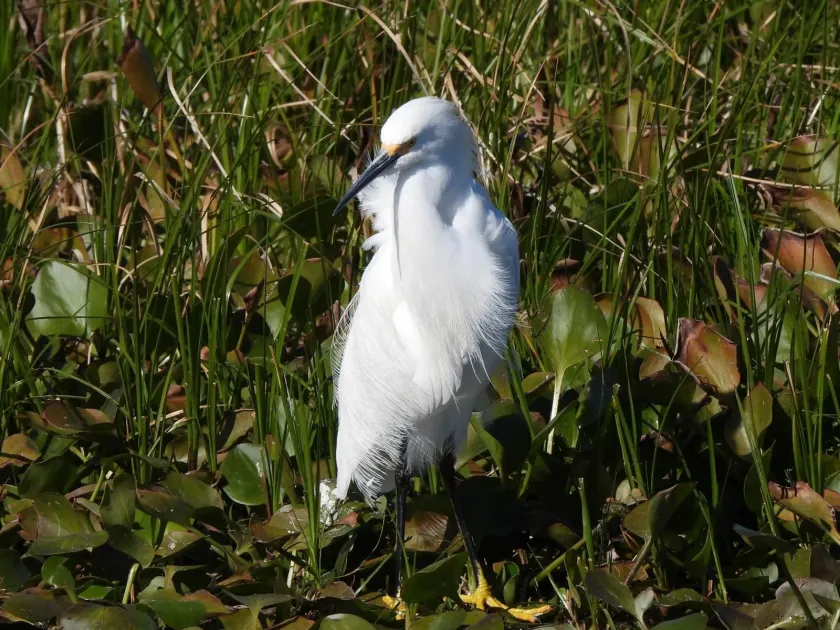
Egrets (genus Egretta) belong to the Pelecaniformes order and the Ardeidae family. These are large wading birds recognized by their long necks, sharp beaks, and slender legs adapted for shallow water foraging.
Physically, egrets are characterized by their striking white plumage and the ability to move silently through water, making them highly efficient predators in wetland environments.
Their biology is inextricably linked to aquatic habitats, where they seek out fish, amphibians, and large invertebrates that serve as their primary food source.
Egrets are often colonial nesters, which leads to localized high concentrations of individuals in areas near agricultural water bodies, increasing the pressure on local resources.
They possess high mobility and adaptability, allowing them to shift their feeding grounds rapidly if a particular agricultural site proves to be a profitable foraging area.
What it damages
In agriculture, egrets cause significant damage primarily to rice production and commercial aquaculture by disrupting the environment and feeding on stock.
In fish farms, egrets pose a massive threat to fingerlings and juvenile fish, which are easily captured in shallow rearing ponds, leading to heavy economic losses for producers.
The birds can act as biological vectors for various parasites and diseases, contaminating water and spreading pathogens between ponds, which stresses the fish population.
Rice fields suffer from physical destruction as the birds trample seedlings while stalking prey, and they may also damage irrigation infrastructure like levees.
The constant presence of predatory birds causes stress in fish stocks, reducing their feeding efficiency and overall weight gain, negatively affecting the final harvest quality.
When it appears
The period of greatest impact coincides with the spring flooding of rice fields and the intensive stocking of fry in commercial aquaculture ponds.
During the summer months, as chicks in nesting colonies grow, the adult birds increase their foraging frequency, resulting in intensified pressure on agricultural sites.
Autumn migration periods may lead to sudden, large-scale arrivals of egrets that utilize ponds as stopover points, further depleting fish stocks before departure.
Daily foraging habits are highly predictable, with peaks during dawn and dusk; farmers should be particularly vigilant during these transition times of the day.
The overall seasonal duration of the threat spans from initial crop planting or pond filling until the harvest, requiring sustained monitoring and protection strategies.
Signs of infestation
Visible identification of egrets is the most direct sign, as they are often seen standing motionless or slowly wading in fields and ponds during the early hours.
In rice fields, the presence is signaled by patches of flattened or missing seedlings and damaged mud walls that separate the irrigation channels.
In aquaculture, signs include torn protective netting, scarred or injured fish that survived an attack, and a noticeable decrease in fish activity in shallow areas.
Guano deposits on pond edges, structures, or nearby trees are clear indicators that the birds have established these locations as frequent foraging or resting spots.
The absence of small fish in the peripheral zones of a pond, combined with an evasive swimming behavior of the remaining fish, often indicates the presence of a predator.
Control measures
Visual deterrents such as reflective tapes, spinning mirrors, and predator decoys can be effective if rotated frequently to prevent the birds from habituating.
Physical barriers, such as overhead netting or perimeter fencing, are the most reliable methods to completely exclude egrets from high-value fish nursery ponds.
Bioacoustic deterrents, which play back alarm calls or raptor sounds at random intervals, are commonly used to frighten the birds away from the vicinity.
Maintaining clear pond banks and reducing vegetation around water edges helps minimize the cover that egrets use for ambush hunting.
Since many egret species are protected by local and international wildlife laws, control measures must focus on non-lethal deterrents rather than eradication.
Taxonomy
- Latin name
- Egretta
- Family
- Ardeidae
- EPPO code
- EGRESP
Discussion
No discussions yet — be the first.