
Great egret
Ardea alba
Description
How to identify
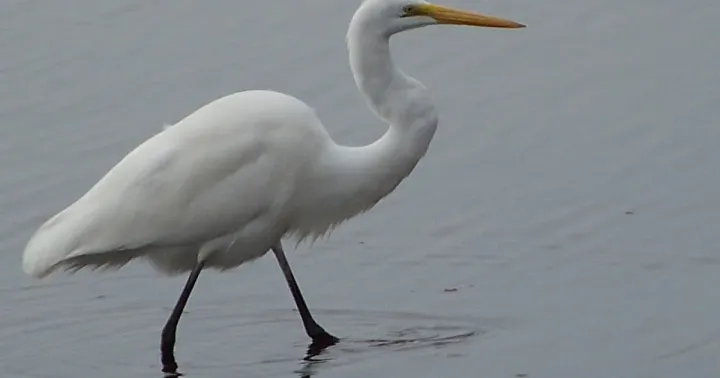
The Great egret (Ardea alba) is a large aquatic bird belonging to the order Pelecaniformes and the family Ardeidae. It is characterized by its entirely white plumage.
Standing about one meter tall with a wingspan of up to 170 cm, this bird features a long, S-shaped neck and a sharp yellow bill used for rapid strikes.
These birds are known for their patient hunting style, standing motionless in shallow water to ambush fish, crustaceans, and amphibians.
They are highly adaptable and thrive in various environments including wetlands, marshes, and man-made aquatic facilities.
During the breeding season, they may display long, delicate nuptial plumes on their back, making them easily distinguishable from other egret species.
What it damages
The Great egret is considered a significant pest in commercial aquaculture, causing substantial economic losses in fish farming operations.
The primary damage occurs through the predation of juvenile fish, which reduces the overall yield and profit of fish hatcheries and breeding ponds.
Beyond direct consumption, the birds frequently injure larger fish during failed hunting attempts, leaving wounds that become vulnerable to bacterial and fungal infections.
A single egret can consume a significant amount of biomass daily, and a flock can devastate a small pond's fish population in just a few days.
Furthermore, these birds contribute to the spread of parasites and pathogens between different water bodies, posing a biological risk to stock health.
When it appears
The threat level increases significantly during the spring and summer months when fish growth is at its peak and demand for food by adult birds is high.
Nesting season demands high protein intake for the birds and their offspring, leading to increased hunting frequency in surrounding areas.
Autumn remains a high-risk period, especially when ponds are drained for harvesting, leaving fish vulnerable in very shallow water.
Daily, the birds are most active during the early morning and late afternoon hours, coinciding with the peak feeding periods of many fish species.
In migratory ranges, the impact is seasonal, while in warmer climates, the predation risk remains constant throughout the entire year.
Control measures
Effective management involves a combination of physical barriers, such as bird netting, to prevent direct access to the water surface.
Deterrent systems including motion-activated sprinklers, propane cannons, or laser devices have proven effective in discouraging egrets from landing.
Habitat modification, such as steepening the pond banks, prevents the egret from standing in shallow water and effectively removes its preferred hunting zone.
The use of floating decoys that mimic natural predators like herons or owls can create a sense of insecurity, prompting the birds to find safer feeding grounds.
- Installation of pond netting.
- Use of acoustic scare devices.
- Implementation of visual deterrents.
- Steep bank design to deter wading.
Taxonomy
- Latin name
- Ardea alba
- Family
- Ardeidae
- EPPO code
- ARDEAL
Discussion
No discussions yet — be the first.