
Bittern
Botaurus
Description
How to identify
The Bittern (genus Botaurus) is a secretive wetland bird belonging to the heron family, known for its exceptional camouflage in reed beds.
It features a stout, compact body, short neck when in flight, and a sharp, powerful bill specialized for hunting aquatic prey.
Primarily crepuscular or nocturnal, these birds are rarely seen in open fields, preferring to stay hidden within thick vegetation near water.
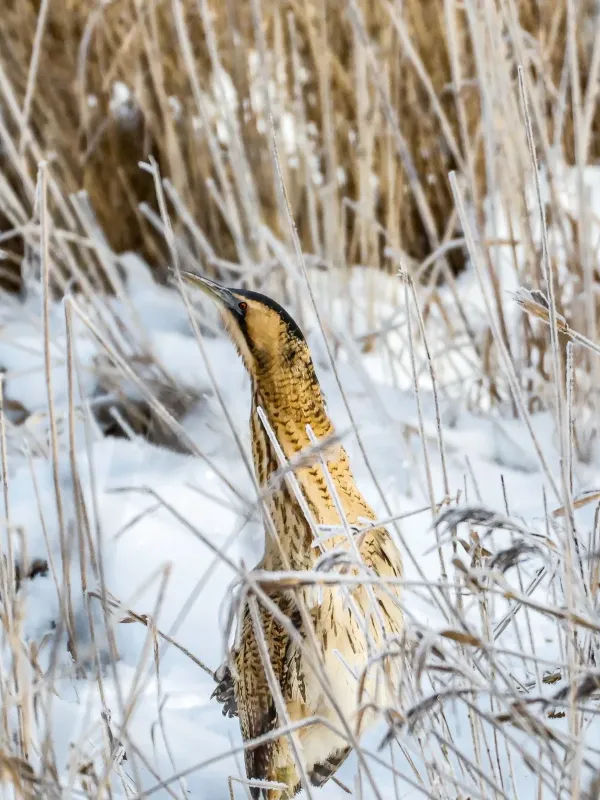
When threatened, they often stand perfectly still with their bills pointed upwards to blend seamlessly with surrounding reeds.
From an agronomical perspective, the bittern is considered a predator rather than a plant pest, playing a role in local ecosystems.
What it damages
Bitterns do not cause direct damage to cultivated crops, as they are carnivores, feeding primarily on fish, amphibians, and insects.
Potential economic impact is limited to fish farming or aquaculture, where they may consume young fish stocks in ponds or canals.
There is no evidence of these birds causing harm to grains, vegetables, or fruits, making them largely irrelevant to standard crop protection.
Their nesting habits might occasionally impact minor irrigation structures, but this is negligible compared to other agricultural challenges.
The presence of bitterns on a farm is generally viewed as neutral, and they may actually help manage rodent populations near wet areas.
When it appears
The bittern is most active during the spring and summer breeding season, when they establish and defend their territories.
During the nesting phase, birds concentrate in areas with dense vegetation near wetlands or managed water irrigation channels.
In autumn, as daylight decreases and temperatures drop, they often migrate towards milder climates to find suitable open water.
Winter activity is typically low or non-existent in regions where ponds and channels freeze over during the colder months.
Seasonal patterns are dictated by water availability, which is why they are rarely encountered in fields during the drier harvest months.
Signs of infestation
The most distinct sign of a bittern's presence is its booming call, a low-frequency sound that carries long distances in the quiet of dusk.
Tracks left in the mud along irrigation ditches or water sources serve as a clear identification mark for those familiar with herons.
Evidence of feeding, such as remains of fish skeletons or scales, can often be found near their favorite hunting spots at the water edge.
Nesting sites appear as flat, trampled areas within dense reed beds, often woven together with dried stalks for stability.
Bird droppings found on permanent structures like sluice gates or wooden posts indicate frequenting of specific points along the canals.
Control measures
As the bittern is often a protected species under wildlife conservation acts, extermination or harmful methods are strictly prohibited.
Managing the bird's impact in aquaculture involves the use of non-lethal deterrents such as scarecrows or reflective tapes around pond edges.
Controlling the vegetation along drainage channels by trimming or regular mowing makes the environment less suitable for nesting.
Installing netting over sensitive fish-rearing areas provides a physical barrier that prevents hunting access without disturbing the birds.
Bioacoustic deterrents, which play back non-threatening signals to discourage settling, are an effective and legal way to manage their presence.
Taxonomy
- Latin name
- Botaurus
- Family
- Ardeidae
- EPPO code
- BOTUSP
Discussion
No discussions yet — be the first.