
Cattle egret
Bubulcus ibis
Description
How to identify
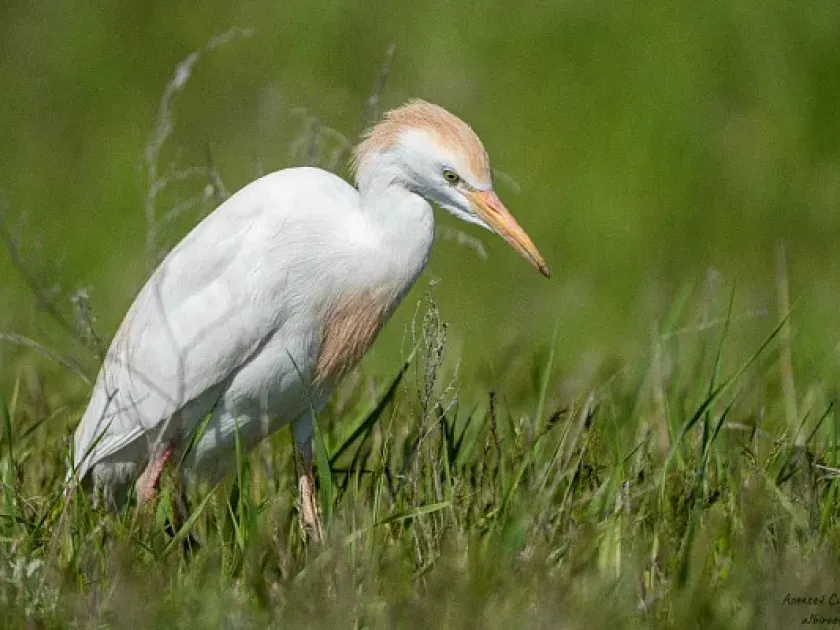
The Cattle Egret (Bubulcus ibis) belongs to the order Pelecaniformes and the family Ardeidae. It is a small, stocky white heron, distinct from others due to its shorter, thick yellow bill and sturdy legs.
During the breeding season, adults develop buff-colored plumes on their heads, breasts, and backs, which makes them easy to distinguish from other egret species in the field.
A key biological trait of this species is its habit of following livestock or agricultural machinery to feed on insects stirred up by movement or cultivation activities.
They nest in large colonies, often choosing trees or dense shrubs near water bodies or irrigation systems, which places them in direct proximity to commercial crop fields.
The species has demonstrated remarkable adaptability to human-altered landscapes, leading to its widespread presence in modern agricultural regions across the globe.
What it damages
In agricultural settings, the Cattle Egret can act as a pest, especially in intensive rice production and high-value vegetable farming areas where soil cultivation is frequent.
The primary damage is mechanical; their constant foraging in fields can flatten young rice seedlings and vegetable sprouts, leading to gaps in crop stands that require replanting.
Frequent movement by large flocks leads to soil compaction, which inhibits root development and disrupts water management in flooded paddy fields.
Damage also occurs when the egrets forage aggressively for soil invertebrates, potentially dislodging or injuring the root systems of young, shallow-rooted plants.
Furthermore, their presence in irrigation canals can affect water hygiene, while droppings left behind may contaminate the soil and foliage, impacting the sanitary conditions of the crops.
When it appears
Cattle egret activity on farmland is closely linked to the crop cycle, particularly during land preparation, sowing, and irrigation phases when soil-dwelling insects are most available.
They are most visible during the early stages of plant growth, as they exploit the disturbance caused by tractors and irrigation tools to find easy food sources.
Seasonal abundance is highest during the breeding and chick-rearing months, which often coincide with the peak agricultural season in temperate and tropical zones.
Once the crops grow high enough to create dense cover, the attractiveness of the field for ground-foraging egrets significantly decreases.
Monitoring seasonal patterns is crucial for agronomists, as it allows for the implementation of protective measures before the flock establishes a foraging routine on the farm.
Signs of infestation
The most obvious sign of Cattle Egret presence is the observation of white birds walking through rows of crops or following machinery during field operations.
Physical evidence of damage includes flattened, broken, or uprooted seedlings that cannot be attributed to standard machine malfunction or disease patterns.
Distinctive three-toed tracks in the mud along irrigation ditches and between crop rows are clear indicators that the flock is using the field as a regular feeding site.
Droppings on leaves, soil, and machinery are clear biological markers, often accompanied by the presence of disturbed soil surfaces where the birds have probed for prey.
In areas where they roost, plants may show signs of burn or stunted growth due to the high nutrient concentration in the guano deposited by large congregations.
Control measures
Control strategies should focus on non-lethal, deterrent-based management, acknowledging the role these birds play in natural pest control outside of the critical cultivation windows.
Bio-acoustic deterrents, such as the broadcasting of predator calls or distress signals, are effective for protecting larger fields from established bird flocks.
Visual repellents like reflective tape, predator decoys, and wind-powered spinners work well, provided their positions are rotated frequently to prevent the birds from habituating.
Physical barriers, such as agricultural netting, are highly effective for protecting specific high-value vegetable crops from bird trampling and feeding damage.
Integrated farm management, including the careful timing of field cultivation and irrigation, helps limit the availability of prey during the most vulnerable periods for crop establishment.
Taxonomy
- Latin name
- Bubulcus ibis
- Family
- Ardeidae
- EPPO code
- BUBUIB
Discussion
No discussions yet — be the first.