
Great blue heron
Ardea herodias
Description
How to identify
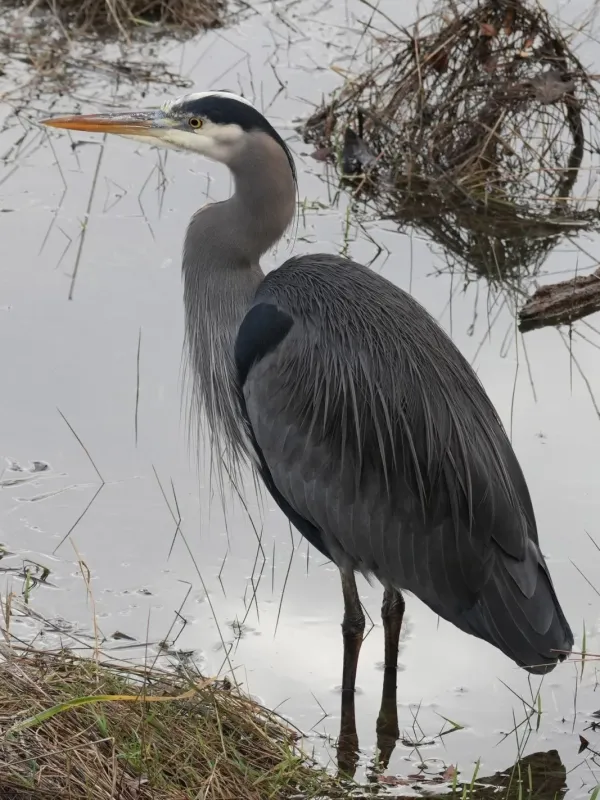
The Great blue heron (Ardea herodias) is a large wading bird belonging to the order Pelecaniformes and the family Ardeidae. Standing over four feet tall, it is the largest heron in North America.
Its plumage is a mix of slate-grey and blue tones, providing excellent camouflage against aquatic vegetation. The head is adorned with dark plumes and a sharp, yellow, dagger-like bill.
The bird has a long, S-shaped neck which it uses to strike rapidly at prey. Its legs are long and thin, allowing it to navigate shallow waters with minimal disturbance to the environment.
It is primarily a solitary hunter, though it can be seen in groups in communal nesting areas. Identifying them is often easier by their loud, guttural squawks, which are commonly heard during takeoff.
In agricultural settings, they are often observed standing perfectly still for long periods, waiting for an opportune moment to strike at moving prey in fish ponds.
What it damages
The Great blue heron is a significant pest in aquaculture, particularly in facilities rearing juvenile fish. Their presence can lead to substantial financial losses due to the consumption of high-value stock.
Beyond consuming fish, they cause indirect damage by wounding fish that they fail to swallow. These injuries often become infected, leading to secondary disease outbreaks among the fish population.
Herons act as vectors for various parasites, including trematodes. By defecating into the water, they introduce parasite larvae into the pond ecosystem, which then infect the fish population.
Constant predation pressure causes high levels of stress in fish, leading to decreased feed conversion ratios and stunted growth, which severely impacts the profitability of the farming operation.
Herons can destroy up to a large percentage of a pond's biomass in a short period, especially in systems with low water levels where fish are easily accessible to predators.
When it appears
The period of highest risk occurs during the spring and summer months when fish are most active and likely to occupy the shallow zones of the ponds.
During the spring breeding season, the metabolic demands of the birds increase significantly to support nesting, resulting in more frequent and aggressive foraging behavior at fish farms.
In the summer, as water temperatures rise, fish often gather in shallower areas to feed or seek oxygen, making them more visible and vulnerable to heron strikes.
The autumn season, particularly during harvest or pond-draining operations, attracts herons from the surrounding areas as the concentration of fish becomes very high, providing an easy feast.
The risk decreases during winter months in northern regions as the ponds freeze over and the birds migrate southward, although in warmer climates, the threat remains year-round.
Signs of infestation
The most reliable sign of a heron visit is the presence of distinctive, large three-toed tracks in the soft mud along the pond's edge.
Observation of fish showing visible injuries, such as deep puncture marks on their sides or back, confirms that a wading predator has been attacking the stock.
The presence of white fecal droppings on rocks, docks, or posts around the pond indicates that the bird uses these locations as regular vantage points for surveillance.
Noticeable changes in fish behavior, such as excessive shyness or reluctance to approach the shoreline, suggest that the population is under constant observation by a predator.
Hearing a loud, harsh squawk when nearing the pond area is a strong indicator that a heron has been disturbed while hunting and is taking flight.
Control measures
Physical exclusion remains the most effective control method. Installing bird netting over ponds or specialized netting over individual raceways prevents the bird from accessing the fish.
Implementing motion-activated deterrents, such as sprinklers or sonic devices that emit predator calls, can be successful if the birds are frequently disturbed.
Maintaining steep pond banks with a drop-off greater than two feet prevents the heron from standing in the water, forcing it to find a more accessible hunting ground.
Using visual deterrents like statues of raptors or shiny, reflective streamers must be rotated frequently to prevent the birds from habituating to them.
- Installation of monofilament line grids over the pond surface.
- Regular cleaning of the pond perimeter to reduce hiding spots.
- Use of acoustic scare devices at dawn and dusk.
Taxonomy
- Latin name
- Ardea herodias
- Family
- Ardeidae
- EPPO code
- ARDEHE
Discussion
No discussions yet — be the first.