
Great bittern
Botaurus stellaris
Description
How to identify
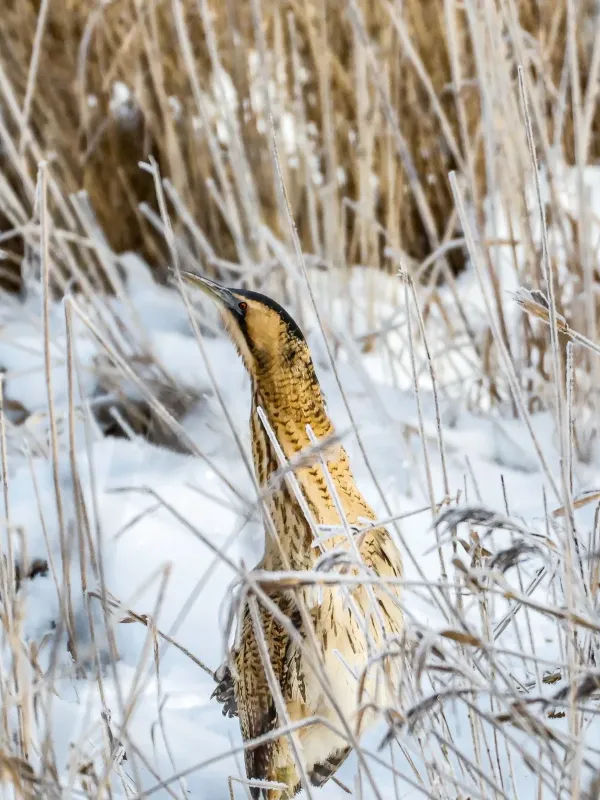
The Great bittern (lat. Botaurus stellaris) is a large bird species within the heron family, order Pelecaniformes. It is well-known for its cryptic nature and effective camouflage.
The bird has a stocky physique, a long neck, and a sharp, powerful beak. Its plumage, marked with brown and buff patterns, allows it to blend perfectly into reeds and dry marsh vegetation.
Males produce a distinct, low-frequency booming call during the mating season, often described as sounding like a bull, which is the most reliable way to identify their presence.
Their flight appears heavy and labored with legs hanging down, a characteristic trait that distinguishes them from other herons. They spend most of their time walking through thick vegetation.
They typically inhabit standing or slow-moving water bodies filled with reeds, cattails, or bulrushes, including those near irrigation or fish farm systems.
What it damages
While the Great bittern is not a crop pest in the traditional sense, its activities can cause economic challenges in aquaculture operations or specialized wetland farms.
As a carnivorous bird, it feeds primarily on fish, amphibians, and insects. In commercial fish ponds, a significant population can lead to the loss of young fish fry.
The birds may cause minor damage to crops through trampling while foraging or nesting in riparian zones adjacent to fields, though this impact is usually localized.
Nesting behavior in drainage canals or irrigation systems can occasionally obstruct technical maintenance, as the birds create floating platforms that may clog small water channels.
Overall, they serve as part of the ecosystem, potentially controlling rodent populations in wet field borders, balancing the slight nuisance they may cause in other areas.
When it appears
The Great bittern is most active during the breeding season, typically from April through July. During this time, they are highly territorial and vocal.
The autumn migration period occurs between September and October, during which birds may be seen traversing open areas while moving toward their wintering grounds.
In winter, they reside in ice-free wetlands. In regions with freezing climates, they migrate, meaning they have virtually no interaction with agricultural sites during the winter months.
Their life cycle is highly dependent on water levels and vegetation growth, making spring a critical time for their nesting success in marshy agricultural landscapes.
Disturbance during the early spring period, when vegetation is still sparse, can cause birds to abandon nesting sites and relocate, potentially shifting their presence to new areas.
Signs of infestation
The primary indicator of a Great bittern's presence is the characteristic booming call, which can be heard across large distances, particularly during dawn or dusk.
Footprints in soft mud or trampled vegetation along canal banks serve as physical evidence of a bird's regular movement throughout the area.
On fish farms, the presence of partially consumed fish remains near the water's edge often suggests hunting activity by a Great bittern or similar avian predator.
Confirmed sightings of nests, which are messy platforms built of reeds and located just above the water level, provide definitive proof of a local breeding population.
Droppings found on elevated stumps or logs near feeding zones are another useful sign for agronomists and site managers to track the bird's activity.
Control measures
The Great bittern is often a protected species; therefore, control efforts must be strictly limited to non-lethal, humane deterrents to avoid legal or environmental issues.
Visual deterrents such as reflective strips, bird decoys, or ultrasonic devices can be effective in discouraging birds from entering sensitive fish farming zones.
Audio deterrents, specifically those playing distress signals or predator calls, are useful in shifting the birds away from specific agricultural installations.
Maintaining clear canal banks by regular clearing of excessive reeds makes the site less attractive for nesting, naturally encouraging birds to move to more suitable wetlands.
Establishing protected buffer zones away from critical aquaculture units is the most professional and ecologically sound approach to managing conflict between farming and wildlife.
Taxonomy
- Latin name
- Botaurus stellaris
- Family
- Ardeidae
- EPPO code
- BOTUST
Discussion
No discussions yet — be the first.