
Eacles moths
Eacles
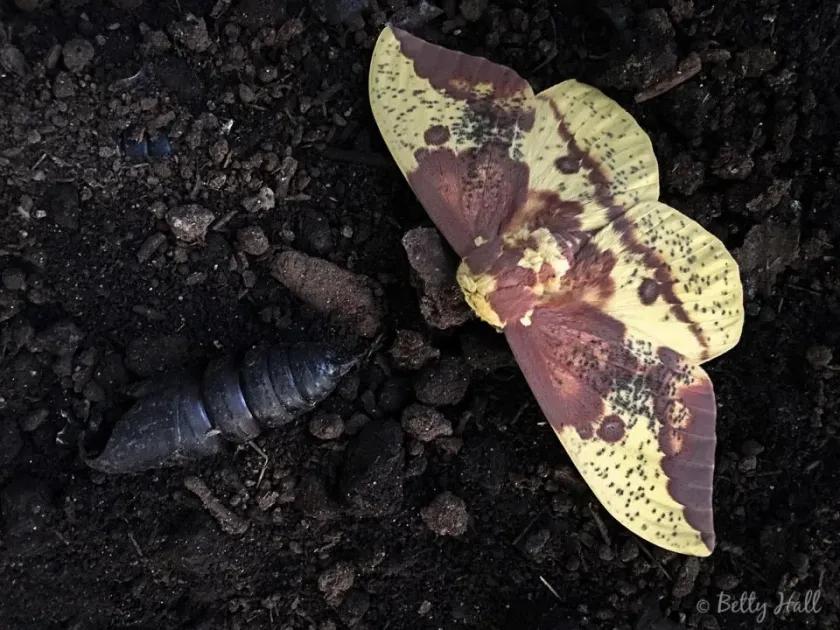
Description
How to identify
The genus Eacles belongs to the Saturniidae family, order Lepidoptera. These moths are recognized by their large wingspans and often vivid coloration patterns, including shades of yellow and brown.
Adult moths possess vestigial mouthparts and do not feed, dedicating their brief adult lifespan entirely to reproduction and laying eggs for the next generation.
The larvae, or caterpillars, are the active feeding stage. They typically grow to a significant size and may possess various tubercles or spines for defense.
Pupation occurs in a hardened, dark-colored chrysalis, usually found within soil or leaf litter, providing protection throughout the overwintering period.
Identification at the species level requires expert analysis of wing patterns and morphological traits, as members of the genus can appear quite similar to the untrained eye.
What it damages
Eacles larvae are polyphagous and are known to feed on a variety of deciduous trees, including oak, maple, and walnut, which are common in both forests and gardens.
The primary damage is caused by the caterpillars consuming massive amounts of foliage, which can lead to significant defoliation of host trees.
Reduced leaf surface area hinders photosynthesis, weakening the tree and making it more susceptible to environmental stress, drought, and other secondary diseases.
Young trees are particularly vulnerable, as extensive foliage loss can exhaust the plant's nutrient reserves and lead to stunted growth or branch dieback.
In commercial nurseries or forestry settings, outbreaks can lead to substantial economic losses due to the degradation of tree health and wood quality.
When it appears
The life cycle of Eacles moths is highly seasonal and synchronized with the availability of fresh foliage on their host trees.
Adult flight typically occurs during the warmer summer months, after which females lay eggs on the undersides of host plant leaves.
Larval emergence is timed to coincide with the flush of new foliage, ensuring that young caterpillars have immediate access to high-quality food sources.
Larval feeding lasts for several weeks, during which they undergo multiple instars, drastically increasing their body mass before preparing to pupate.
The winter is passed in the pupal stage, which remains dormant in the soil or ground cover, waiting for the spring warmth to initiate the next cycle.
Signs of infestation
The most noticeable sign of an Eacles infestation is the presence of partially consumed or skeletonized leaves in the tree canopy.
Frass, or caterpillar droppings, often accumulates on the ground beneath infested trees, appearing as dark, granular deposits in the leaf litter.
Despite their size, caterpillars can be hard to spot due to their protective coloration that mimics the texture and color of the leaves or twigs.
During heavy outbreaks, the sound of thousands of larvae feeding on foliage can often be heard, and the thinning of the canopy becomes visually apparent.
In severe cases, small branches may appear entirely stripped of leaves, and the overall tree may look stressed or unhealthy despite adequate watering.
Control measures
Monitoring using light traps is essential to detect the onset of moth flight, allowing for timely planning of potential management interventions.
Biological control agents, particularly formulations of Bacillus thuringiensis, are effective against young larvae and represent an environmentally sound approach.
Hand-picking caterpillars is feasible for small trees or isolated garden specimens and helps to keep populations at a manageable level.
Chemical control should be reserved for severe outbreaks where other methods are insufficient, following local regulations to minimize impact on beneficial insects.
- Promote tree vigor through proper irrigation, mulching, and nutrient management.
- Encourage local populations of birds and parasitic wasps that predate on caterpillars.
- Remove heavily infested branches early in the season if the infestation is localized to specific parts of the tree.
Taxonomy
- Latin name
- Eacles
- Order
- Lepidoptera (butterflies)
- Family
- Saturniidae
- EPPO code
- EACLSP
Discussion
No discussions yet — be the first.