
Common robber fly
Dysmachus trigonus
Description
How to identify
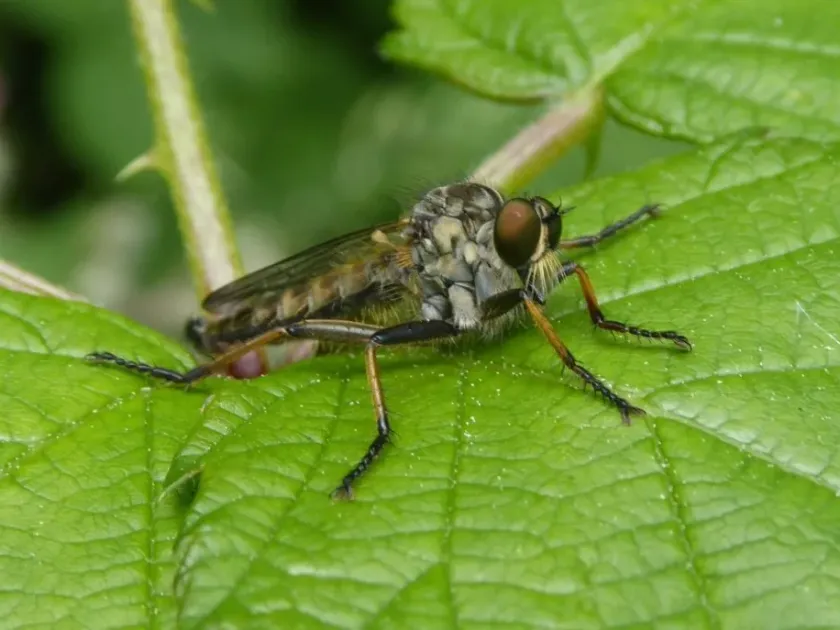
The common robber fly (Dysmachus trigonus) belongs to the order Diptera and the family Asilidae. These are robust, predatory flies that exhibit aggressive behavior, often resembling bees or wasps due to their dense hair and body shape.
Adults are typically grayish-brown with significant hairiness. They possess a strong, piercing proboscis used to inject toxic saliva into their prey, which paralyzes the target almost instantly.
Their wings are clear and well-developed, enabling swift aerial attacks. Adults measure between 10 and 15 mm in length and feature sturdy, clawed legs designed to grip prey tightly during mid-air capture.
Larvae develop in the soil or decaying organic matter. They are cylindrical, white or cream-colored, and possess a hardened head capsule, making them well-adapted for movement through soil profiles.
The life cycle follows complete metamorphosis: egg, larva (multiple stages), pupa, and adult, each stage being adapted to the specific conditions of their habitat.
What it damages
Robber flies are primary predators, meaning they feed on other insects. Their main negative impact in agriculture is the predation of beneficial insects, especially pollinators like bees and wild bumblebees.
On farms with crops dependent on insect pollination, such as sunflowers, rapeseed, or buckwheat, a high population of robber flies can lead to reduced yields due to the depletion of the pollinator population.
They also target parasitic wasps, which are natural enemies of various agricultural pests, thereby disrupting the ecological balance and biological control systems on the field.
While primarily predators, larvae in the soil may occasionally feed on young plant roots if their preferred prey is scarce, causing minor localized damage to seedling stands.
The economic impact is most significant in areas specializing in seed production, where the presence of these flies can lead to insufficient fruit or seed set.
When it appears
Adult activity peaks during the summer months, specifically June and July. During this time, they are highly active, hunting for prey and seeking mates across open fields and hedgerows.
They prefer sun-drenched, open areas where they can wait on plant stems for passing insects. Their agility allows them to intercept targets in flight with high precision.
Females lay eggs in the surface layers of the soil or in cracks, ensuring the larvae have access to organic matter and moisture upon hatching.
The larval stage is long and resilient, often overwintering deep within the soil to protect themselves from environmental extremes and low temperatures.
Emergence occurs in late spring as the soil warms, signaling the beginning of a new generation of adults that quickly establish their hunting territories.
Signs of infestation
Presence of robber flies is easily detected by their distinct buzzing sound and their habit of suddenly darting from plant stems when approached.
- A noticeable decline in pollinator activity in flowering fields.
- Presence of dried insect carcasses (bees, smaller flies) found on the foliage.
- Evidence of root damage in seedling fields where high larvae density is suspected.
- Poor fruit development or low seed yield in areas with high predator activity.
Monitoring is best conducted during sunny, warm weather when the flies are most visible and actively patrolling for prey around field edges.
Control measures
Control measures must be carefully balanced to avoid harming beneficial insects. Routine chemical usage is generally discouraged as it exacerbates the loss of natural pollinators.
Deep soil tillage after harvest is the most effective mechanical control method, as it disrupts larvae habitats and destroys them before they can pupate.
Maintaining a distance between beehives and high-activity robber fly zones helps protect pollinator colonies during the critical peak months of June and July.
Biological control using entomopathogenic fungi or nematodes offers a sustainable alternative to chemical insecticides for reducing larval populations in the soil.
If chemical intervention is unavoidable, applications should be strictly timed for late evening or night to minimize direct contact with bees and other beneficial species.
Taxonomy
- Latin name
- Dysmachus trigonus
- Order
- Diptera (flies)
- Family
- Asilidae
- EPPO code
- DYSHTR
Discussion
No discussions yet — be the first.