
Robber fly
Dysmachus
Description
How to identify
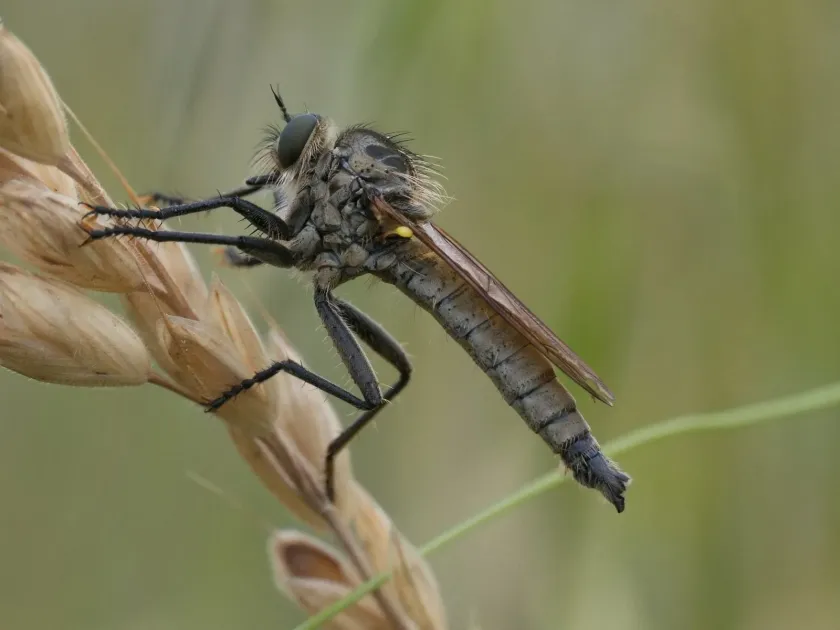
The genus Dysmachus, commonly known as a type of robber fly, belongs to the Diptera order and the Asilidae family. They are characterized by a robust body, often covered in dense bristles, and a rigid, piercing proboscis.
These flies are easily recognized by their predatory behavior and their ability to capture other insects mid-flight. Their head is highly mobile and equipped with large, complex eyes for excellent vision.
The adult Dysmachus typically features a gray or brownish coloration, allowing it to camouflage effectively while waiting on vegetation to ambush prey.
Their larvae are subterranean or dwell in decaying organic matter, possessing strong mouthparts suitable for a predatory lifestyle within the soil.
As agile aerial hunters, they use their sharp, hooked claws to secure a tight grip on their captured prey, preventing escape during flight.
What it damages
Robber flies of the Dysmachus genus are not plant pests. They do not consume leaves, stems, roots, or any other plant tissue, making them harmless to agricultural crops.
They are strictly carnivorous predators that feed exclusively on other insects. Their diet includes a wide range of small arthropods, effectively acting as natural population regulators.
In most agricultural settings, they are considered beneficial because they prey on various pests that might otherwise damage crops or ornamental plants.
While they are generalist predators, they do not target specific crops, as their hunting strategy depends on the availability of flying insects in the vicinity.
There is no economic damage associated with their presence; on the contrary, they contribute to the biodiversity and natural pest management of an ecosystem.
When it appears
Adult robber flies are most active during the peak of the summer, generally from June through August, when their prey is most abundant in the field.
They prefer sunny, open areas like field edges, meadows, and forest paths where they can easily spot passing insects from their vantage points.
The life cycle involves a multi-stage development process, where larvae spend significant time in the soil or decaying organic matter before pupating.
As temperatures begin to drop in the autumn, adult flies die off, and the species persists through the winter in its larval stage deep within the ground.
The emergence of a new generation occurs during the subsequent summer, ensuring that the predator population remains consistent across growing seasons.
Control measures
No pest control measures are required for Dysmachus, as they are not detrimental to agriculture. Attempting to eradicate them is counterproductive and environmentally harmful.
The indiscriminate use of insecticides can kill these beneficial predators, which may lead to the resurgence of genuine agricultural pests that were previously kept in check.
Maintaining a healthy, pesticide-free environment allows these natural regulators to thrive and assist in the biological control of other insect populations.
For beekeepers, if robber flies are present near hives, they may take individual bees, but this is usually a natural occurrence that does not threaten the colony's overall health.
Protecting their habitats, such as keeping some areas of the field or border margins undisturbed, helps foster a robust population of these helpful predatory flies.
Taxonomy
- Latin name
- Dysmachus
- Order
- Diptera (flies)
- Family
- Asilidae
- EPPO code
- DYSHSP
Discussion
No discussions yet — be the first.