
Oak gall wasp
Dryocosmus decidua
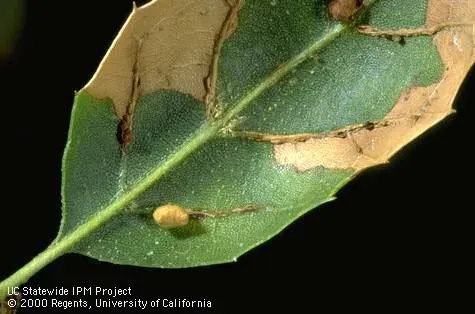
Description
How to identify
The oak gall wasp is a small insect belonging to the family Cynipidae, notorious for causing the formation of abnormal plant growths known as galls.
Adult wasps are extremely small, often measuring only a few millimeters in length, and are usually dark-colored, making them difficult to spot in the foliage.
The life cycle involves an alternation of generations, where distinct reproductive strategies are employed depending on the environmental conditions.
The larvae are entirely dependent on the host plant, inducing the tree to create specialized tissues that serve as both food and a protective shelter.
These insects are highly specialized, meaning each species of gall wasp typically targets specific species of oak trees.
What it damages
The primary hosts are various species of oak, which can be severely affected in terms of their growth and overall vigor when infestation is high.
Damage occurs primarily on buds, young leaves, and succulent shoots, disrupting the tree’s photosynthetic capacity and nutrient transport.
Heavy infestations can lead to premature leaf drop and the stunting of branch growth, which can significantly weaken the tree's immune system.
In forest nurseries, high levels of gall formation can render young saplings unsellable due to their deformed appearance and reduced growth rates.
Chronic infestation over several years may cause a decline in tree health, making the oaks more susceptible to secondary pests and fungal infections.
When it appears
The emergence of the adult wasp is synchronized with the bud burst of oak trees in the spring, which provides the necessary tissue for egg-laying.
Once eggs are deposited in the leaf or shoot tissue, the gall-forming process begins, continuing throughout the late spring and summer months.
Larval development takes place within the gall, where the insect matures while feeding on the rich plant cells produced inside the enclosure.
By late summer or autumn, the adults emerge to mate and complete their cycle, often overwintering as larvae within fallen galls on the ground.
Temperature and humidity play a crucial role in the timing of emergence and the survival rate of the larvae during the winter dormant phase.
Signs of infestation
The most obvious sign of infestation is the development of distinct, often spherical or irregular growths on the underside of leaves or on stems.
These galls often change color as they mature, starting as light green or yellow and eventually turning brown or red as the larva prepares to emerge.
Significant defoliation during the growing season is a clear indicator of heavy pest pressure, often visible before the galls become fully apparent.
Deformed, thickened, or twisted shoots are common symptoms that indicate the presence of larvae inside the developing plant tissues.
Tiny exit holes on the surface of the galls reveal that the adult wasps have completed their metamorphosis and have already left the host.
Control measures
Mechanical removal and destruction of fallen leaves and infested twigs is the most practical method for managing populations in small areas.
Pruning out and incinerating infected branches during the dormant winter season can significantly reduce the potential population for the following year.
Chemical controls, such as systemic insecticides, may be used in nursery settings but must be timed precisely to match the emergence of adult wasps.
Encouraging biodiversity and the presence of natural enemies, such as parasitoid wasps, is an effective long-term biological control strategy.
- Implement regular visual inspections of oak crowns.
- Maintain tree vigor with proper watering and fertilization.
- Dispose of all infested organic matter properly.
Taxonomy
- Latin name
- Dryocosmus decidua
- Order
- Hymenoptera
- Family
- Cynipidae
- EPPO code
- DRYCDE
Discussion
No discussions yet — be the first.