
Pileated Woodpecker
Dryocopus pileatus
Description
How to identify
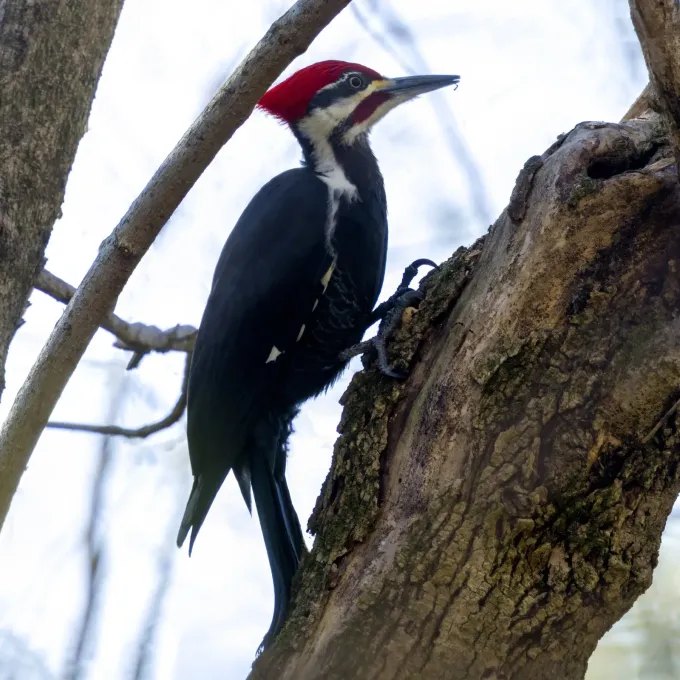
The Pileated Woodpecker (Dryocopus pileatus) is a prominent member of the Picidae family and Piciformes order, recognized as one of the largest woodpeckers in North America.
These birds are characterized by their striking appearance: predominantly black plumage with a bold white stripe down the neck and a vibrant red crest on the head.
With an average wingspan of up to 30 inches, they are powerful birds capable of exerting significant force when hammering into wood to forage or build nesting cavities.
They are primarily forest-dwelling birds but will readily venture into semi-urban areas or orchards if there is a sufficient supply of dead or diseased wood containing insects.
They exhibit strong territorial behavior and are active throughout the year, meaning their impact on specific trees can be consistent and cumulative over several seasons.
What it damages
The Pileated Woodpecker causes damage by excavating deep, rectangular, or irregular holes in tree trunks to reach wood-boring larvae, particularly those of beetles.
These excavations often penetrate deep into the sapwood and heartwood, which compromises the structural integrity of the tree and exposes it to decay-causing fungi and moisture.
In orchards and timber plantations, repeated excavation can weaken trees to the point of structural failure during high winds, leading to significant economic loss.
While they often target trees already stressed by drought, disease, or insect infestations, their heavy work can hasten the death of marginally healthy specimens.
The loss of protective bark and the disruption of vascular tissues limit the tree's ability to transport nutrients, often resulting in crown dieback and long-term decline.
Signs of infestation
The most distinctive sign of a Pileated Woodpecker is the presence of deep, large, rectangular cavities carved into the trunks of mature trees.
Large wood chips and debris found at the base of the tree are clear indicators that a woodpecker has been aggressively foraging in the area recently.
Vertical lines of drilling or series of holes in a specific area of the bark suggest a systematic search for larvae living within the wood layers.
Large, circular nesting holes located higher up on the tree trunk are characteristic signs of their permanent occupancy during the breeding season.
Audible signals, such as loud, rhythmic drumming on resonant surfaces, often coincide with the visible physical damage observed on the bark.
Control measures
Managing Pileated Woodpecker damage requires non-lethal deterrent methods, as these birds are often protected by environmental regulations due to their ecological value.
Visual repellents like shiny reflective tape, motion-activated ultrasonic devices, or hawk decoys can effectively deter woodpeckers from landing on sensitive trees.
Wrapping the trunks of vulnerable or highly valuable trees with hardware cloth or metal mesh provides a physical barrier that prevents the bird from accessing the bark.
Proactive tree health management, including the control of wood-boring insects with appropriate insecticides, reduces the food source that attracts the woodpeckers.
Maintaining a clean garden by removing dead wood and pruning damaged branches minimizes potential nesting and foraging sites, reducing the likelihood of bird colonization.
Taxonomy
- Latin name
- Dryocopus pileatus
- Family
- Picidae
- EPPO code
- DRYKPI
Discussion
No discussions yet — be the first.