
Black Woodpecker
Dryocopus martius
Description
How to identify
The Black Woodpecker (Dryocopus martius) is the largest woodpecker species in Europe, belonging to the Picidae family within the order Piciformes.
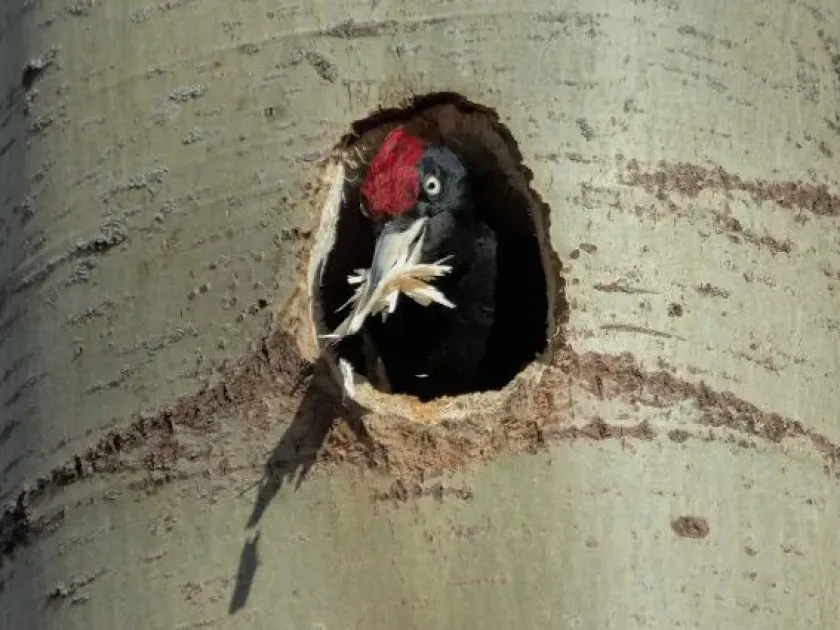
The bird is easily recognizable by its entirely black plumage with a slight gloss, and in males, a prominent red crest that covers the entire crown.
Its bill is exceptionally strong and chisel-like, evolved specifically for excavating deep into the hardwood of trees to reach larvae or create nesting cavities.
With a body length of up to 50 cm and a wingspan that can exceed 80 cm, this bird is a dominant presence in old-growth and coniferous forests.
These birds are non-migratory and territorial, often maintaining the same area for their entire lifespan, which influences local forest health dynamics.
What it damages
The Black Woodpecker primarily targets coniferous and deciduous trees, including spruce, pine, beech, and aspen, causing structural damage.
While foraging for wood-boring larvae (xylophagous insects), the woodpecker creates large, deep, funnel-shaped holes that penetrate the heartwood of the tree.
These excavations significantly compromise the structural integrity of the tree, creating entry points for fungal decay and secondary wood-boring pests.
In high-value timber stands, the activity of these birds can lead to significant economic loss as the timber becomes unsuitable for commercial processing.
While the woodpecker is often considered a forest guardian, in high density, it can weaken healthy trees to the point of windthrow or premature senescence.
When it appears
The Black Woodpecker is active year-round, as it does not migrate and must forage for food through all four seasons, including winter.
Late winter and early spring represent the peak period of activity, as birds intensify their foraging efforts while preparing for the breeding season.
Nesting season, which begins in early spring, involves the creation of new cavities or the extensive modification of existing ones, causing localized damage.
During the summer months, while the birds forage for larvae, their activity shifts slightly as more insects become available in the tree canopy.
Autumn is a period of consolidation where the woodpecker prepares for winter by excavating older or decaying wood to find dormant insect populations.
Signs of infestation
The primary sign of infestation is the presence of large, rectangular or oval holes found on the main trunks of trees, often at significant heights.
Large accumulations of fresh, coarse wood chips at the base of a tree serve as an immediate indicator that a woodpecker has been working there recently.
Vertical lines of drilling holes indicate methodical exploration of the trunk for larvae, signaling that the tree is already infested with primary pests.
The loud, resonant drumming sound produced by the woodpecker is a distinctive auditory marker that indicates its presence in a specific forest tract.
Visible abandoned nest cavities, which are surprisingly spacious, serve as a long-term indicator of the species' historical presence in the area.
Control measures
Management of the Black Woodpecker is rarely about eradication, as the bird plays a crucial role in regulating populations of forest-damaging insects.
Forest managers focus on silvicultural practices, such as removing weakened or dying trees, to reduce the overall availability of host sites for pests.
Maintaining a healthy, balanced forest ecosystem helps prevent the hyper-concentration of woodpeckers in specific areas, thereby mitigating severe damage.
In forest nurseries or plantations with high-value young trees, protective netting or physical barriers can be installed to prevent accidental damage.
The core strategy is monitoring the health of the wood-boring insect population, as the woodpecker's presence is often a symptom of underlying pest issues.
Taxonomy
- Latin name
- Dryocopus martius
- Family
- Picidae
- EPPO code
- DRYKMA
Discussion
No discussions yet — be the first.