

Description
How to identify
The pine sawfly (Diprion pini) is a species of hymenopteran insect belonging to the family Diprionidae, known for being a major pest of coniferous forests.
Adult females are approximately 8–10 mm long with a stout body, typically yellow-brown, while males are slightly smaller and darker with feathery antennae.
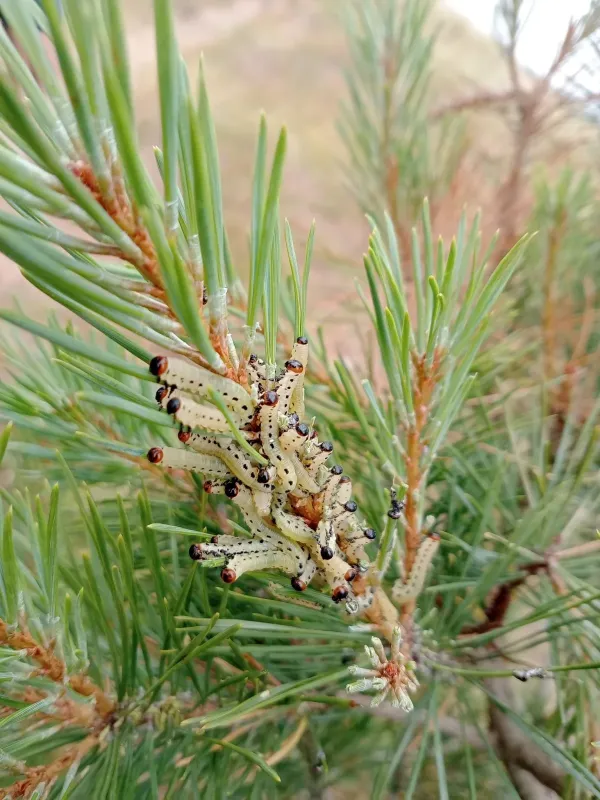
The larvae, often called false caterpillars, have a gray-green body with a dark dorsal stripe and a shiny black head, reaching up to 25 mm when mature.
Eggs are inserted into the needles of the host pine tree, creating visible yellow-brown spots arranged in neat rows along the foliage.
The insect typically overwinters as a prepupa inside a resilient, oval-shaped papery cocoon located either in the leaf litter or on the tree branches.
What it damages
The primary host for this species is the Scots pine, although it frequently attacks other pine varieties within its geographic range.
Young larvae feed gregariously on the margins of needles, causing skeletonization that makes the foliage appear withered and discolored.
Older larvae consume the entire needle, leaving only the central vascular bundle, which leads to significant aesthetic and physiological damage to the tree.
Severe infestations result in extensive defoliation, which can weaken the trees and make them susceptible to secondary attacks by bark beetles and pathogens.
Repeated defoliation cycles over several seasons may eventually lead to the mortality of young trees and canopy dieback in mature forests.
When it appears
Adults emerge from their cocoons in the spring, typically when temperatures consistently remain above 10°C, to begin the mating and oviposition process.
Larval activity of the first generation occurs primarily from May through June, coinciding with the rapid growth of young pine shoots.
A second generation often appears during mid-summer, extending the period of potential damage throughout July and August in warmer climates.
Developmental rates are heavily influenced by weather conditions, with warm, dry springs often leading to accelerated life cycles and larger population outbreaks.
By late autumn, the final generation larvae spin their cocoons, entering a state of diapause to survive the winter months until the next season.
Signs of infestation
The earliest signs of infestation are the notched appearance of pine needles where eggs have been deposited by female sawflies.
When disturbed, the larvae exhibit a distinctive defensive display, raising their heads and tails simultaneously in a distinct "S" shape.
Large accumulations of larval excrement, which resemble tiny dark grains, are often found on the forest floor beneath heavily infested trees.
Thinning of the canopy and visible browning of the upper branches are clear indicators that a colony is currently feeding and damaging the tree.
- Notched, yellowing needles.
- Visible defoliation on branches.
- S-shaped defensive posture of larvae.
- Accumulation of frass (droppings) on the ground.
- Oval-shaped cocoons in bark crevices.
Control measures
Biological control using specific entomopathogenic viruses or bacterial sprays is highly effective and environmentally friendly for managing large populations.
Chemical control using systemic insecticides is recommended in nursery settings or areas of high value when population thresholds are exceeded.
Promoting local biodiversity, especially by providing nesting sites for insectivorous birds and maintaining ant colonies, helps regulate sawfly populations naturally.
Monitoring using pheromone traps is essential for tracking adult flight patterns and determining the optimal timing for intervention measures.
In cases of light infestation, physical removal and destruction of egg-bearing needles or small larval clusters can prevent the spread to adjacent trees.
Content graph
Connections · Pine sawfly
Most often together:
Marketplace
Products · 2

Biology
Taxonomy
- Latin name
- Diprion pini
- Order
- Hymenoptera
- Family
- Diprionidae
- EPPO code
- DIPRPI
Community
Discussion
No discussions yet — be the first.