
European pine sawfly
Diprion similis
Description
How to identify
The European pine sawfly (Diprion similis) is a member of the Diprionidae family within the Hymenoptera order. The adult female is roughly 8–10 mm long with a yellowish-brown abdomen, while males are slightly smaller and darker.
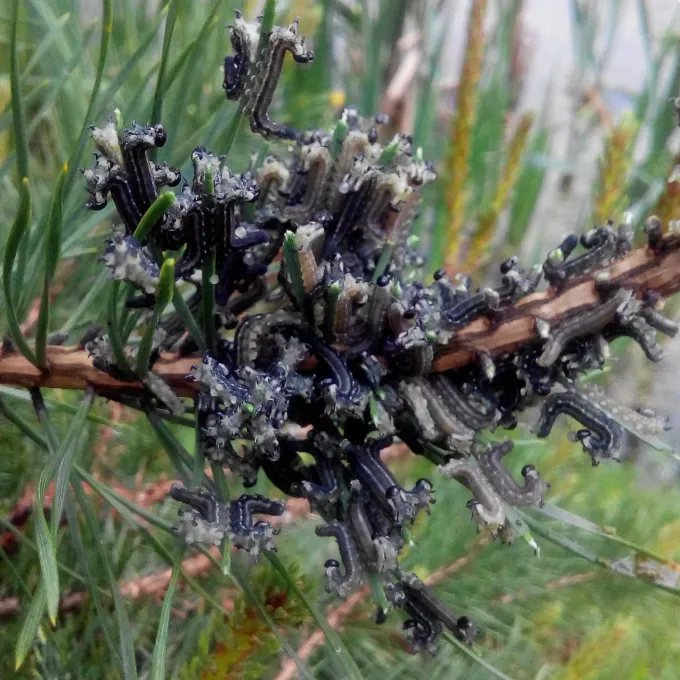
Larvae are the most recognizable stage of this pest. They resemble caterpillars but can be distinguished by their 8 pairs of prolegs and distinct color pattern: a dark, greenish-gray body with a black stripe along the back and yellow side markings.
The insect typically overwinters as a prepupa inside a tough, papery cocoon. These cocoons are often found hidden in bark crevices, on twigs, or within the leaf litter beneath the host tree.
Females use a specialized, saw-like ovipositor to insert eggs into the pine needles. This unique method protects the eggs from predators and environmental stressors during the incubation period.
Development involves complete metamorphosis: egg, larva, pupa, and adult. Depending on environmental conditions, the insect can produce one or two generations per year.
What it damages
This pest primarily attacks the Eastern white pine and Scots pine, but it can infest various other species within the Pinus genus, causing widespread concern in forestry.
Young larvae feed gregariously, initially consuming only the outer edges of the needles, which creates a skeletonized appearance. As they mature, they consume the entire needle down to the sheath.
Severe defoliation reduces the tree's photosynthetic capacity, leading to significant growth loss, canopy thinning, and long-term physiological stress on the host.
Young trees in nurseries or newly planted areas are particularly vulnerable. A single heavy infestation can kill a young tree, leading to complete economic loss for the plantation.
Stressed trees are significantly more susceptible to secondary attacks by bark beetles and wood-boring insects, which can ultimately lead to the death of mature stands.
When it appears
Adult activity typically begins in late spring, as temperatures rise and pine buds begin to open, signaling the onset of the first generation's life cycle.
The larvae are most active during the early summer months. Feeding damage is most noticeable in June and again in late summer if a second generation emerges.
By late summer, the final larval stage seeks a protected site to spin its cocoon, remaining there in diapause or pupating to emerge as the next generation or overwinter.
Climatic factors such as early spring warmth can trigger earlier emergence, while extended hot summers often lead to higher survival rates for the second generation.
Monitoring for adult swarms should occur during the spring months to predict potential larval outbreaks and apply timely control measures.
Signs of infestation
The first sign of infestation is the presence of small, pale-colored spots or resin droplets on the needles where females have laid their eggs.
Colonies of larvae feeding in groups are a distinct indicator. When disturbed, these larvae often exhibit a defensive behavior, arching their heads and tails simultaneously.
Thinning of the canopy is a major visual symptom. As needles are consumed, the branches appear increasingly bare, particularly in the upper portions of the tree.
Frass (larval droppings) accumulates on the foliage and branches below the feeding site, resembling small dark pellets, which is a clear sign of an active colony.
Discolored, withered needles that are partially eaten represent the ongoing feeding activity of the larvae, indicating that the infestation is currently in progress.
Control measures
Chemical control is effective when using systemic insecticides, applied early in the larval stage to minimize damage before significant defoliation occurs.
Biological control, including the use of Nucleopolyhedrovirus (NPV) or Bacillus thuringiensis (Bt), is a preferred strategy in urban areas to maintain environmental balance.
Preserving natural predators is essential. Parasitic wasps and predatory beetles significantly help suppress populations, making the protection of their habitat a priority in integrated pest management.
For smaller ornamental pines, manual removal of larval clusters or the destruction of cocoons during the dormant season is a safe and effective physical control measure.
- Use pheromone traps for early detection.
- Encourage bird nesting to naturally reduce larval counts.
- Implement diverse planting to prevent large-scale outbreaks.
Taxonomy
- Latin name
- Diprion similis
- Order
- Hymenoptera
- Family
- Diprionidae
- EPPO code
- DIPRSI
Discussion
No discussions yet — be the first.