
Japanese pine sawfly
Diprion nipponicus
Description
How to identify
The Japanese pine sawfly (Diprion nipponicus) belongs to the order Hymenoptera and the family Diprionidae. The adult sawfly is a small insect, often resembling a wasp or bee, with specialized ovipositors.
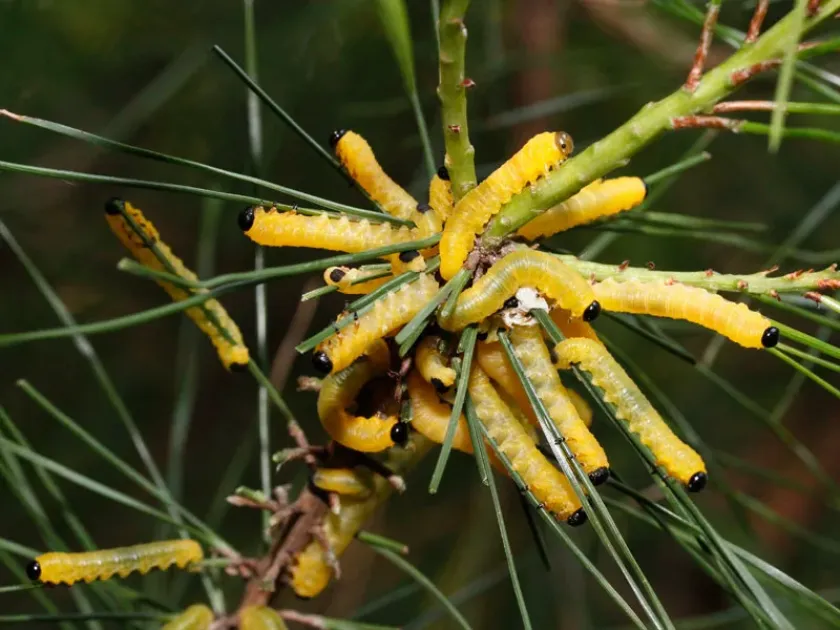
The larvae, known as false caterpillars, are the primary stage responsible for vegetation damage. They typically feature a distinct head capsule and a body pattern that provides camouflage among pine needles.
The lifecycle consists of eggs, larvae, pupae, and adults. The pupal stage occurs inside a tough, protective cocoon often situated in the forest floor litter beneath the host tree.
Unlike some other species, Diprion nipponicus specifically targets pine trees, showing a high degree of host specificity in its reproductive and feeding habits.
Young larvae are gregarious, feeding in groups, which makes initial infestations localized and easier to spot if regular inspections are conducted.
What it damages
The primary hosts of the Japanese pine sawfly are various species of pine trees. The larvae feed on the needles, causing significant physiological stress to the host tree.
Early-instar larvae consume the outer tissue of the needles, whereas older larvae may consume the entire needle. This leads to severe needle loss and reduced photosynthetic capacity.
Defoliation weakens the tree's health, making it more susceptible to opportunistic secondary pests like bark beetles, which can ultimately kill the infested tree.
For ornamental and urban landscapes, the aesthetic damage caused by needle loss is a significant concern, often requiring immediate management to preserve the plant's value.
Repeated yearly infestations can lead to stunted growth, branch dieback, and in extreme cases, the total mortality of younger or less vigorous trees.
When it appears
Adult sawflies typically emerge in late spring or early summer to initiate the mating process and locate suitable host trees for oviposition.
Eggs are inserted into pine needles, and after an incubation period, larvae emerge to begin their feeding cycle, usually peaking in mid-summer.
The larval feeding phase is the most active and damaging period. During this time, they grow rapidly and move throughout the canopy to find fresh foliage.
As autumn approaches, mature larvae migrate to the ground to pupate in the soil or needle litter, entering a dormant phase to survive the winter months.
The number of generations per year is climate-dependent, but in most temperate regions, the species completes one full generation, necessitating well-timed control.
Signs of infestation
The most visible sign of infestation is needles that appear partially eaten, often displaying a skeletonized or notched appearance along their edges.
Frass (larval droppings) appearing as small, dark pellets on the needles or caught in spiderwebs on the branches indicates active feeding overhead.
Larvae are known for their defensive behavior, where they rhythmically raise their head and tail ends when disturbed, creating a synchronized movement.
- Yellowing and browning of needles followed by premature needle drop.
- Presence of small, brown, barrel-shaped cocoons in the soil or leaf litter.
- Row-like slits on the needles where eggs have been deposited.
Close inspection of the branches in early summer may reveal clusters of young larvae, which are the most susceptible to treatment during this stage.
Control measures
Biological control is highly recommended, including the application of Bacillus thuringiensis sprays, which specifically target sawfly larvae without harming beneficial insects.
Chemical control involving systemic or contact insecticides is effective if applied during the early larval stages when the insects are most vulnerable.
Cultural practices, such as removing infested branches in localized cases or cleaning up the leaf litter beneath trees, can destroy cocoons and reduce the overwintering population.
Encouraging biodiversity by providing habitats for birds and predatory insects helps to maintain a natural balance and suppresses sawfly outbreaks over time.
Consistent monitoring and early detection are key to preventing large-scale defoliation, ensuring the health and longevity of pine plantations or garden trees.
Taxonomy
- Latin name
- Diprion nipponicus
- Order
- Hymenoptera
- Family
- Diprionidae
- EPPO code
- DIPRNI
Discussion
No discussions yet — be the first.