
European spruce sawfly
Gilpinia hercyniae
Description
How to identify
The European spruce sawfly (lat. Gilpinia hercyniae) belongs to the order Hymenoptera and the family Diprionidae. Adult females are small, fly-like insects with a robust body structure typical of the sawfly family.
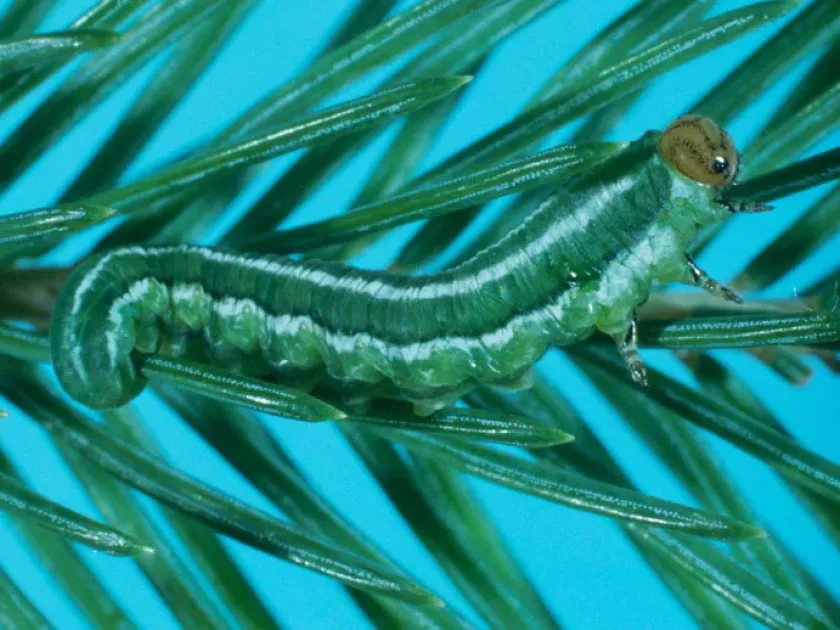
The larvae are the primary stage of concern. They are often mistaken for moth caterpillars but can be distinguished by their number of abdominal prolegs. Their green coloration provides excellent camouflage against spruce needles.
The female possesses a saw-like ovipositor, which is used to make precise incisions in the needles to deposit eggs. This is a specialized adaptation that ensures the eggs are protected during development.
This species is a specialized pest primarily targeting spruce trees. Its presence is most frequently documented in spruce forests, where it can cause significant ecological impacts if not regulated.
Pupation occurs within durable cocoons, which are often spun in the leaf litter or hidden on the tree branches, providing the insect with protection against predators and extreme winter temperatures.
What it damages
The host range of this sawfly is restricted to species of the genus Picea, with the Norway spruce being the most common target. The insect's biology is entirely synchronized with the spruce tree.
Larvae are active defoliators. Younger larvae typically skeletonize needles by feeding on the outer tissue, while older larvae consume the entire needle, leaving only the stem or causing them to drop.
Severe infestations result in heavy defoliation of the crown. This reduces the photosynthetic capacity of the tree, leading to significant stress and a decline in overall tree vigor.
Persistent attacks over several consecutive seasons can lead to the dieback of the leader and upper branches, eventually weakening the tree to the point of structural failure or death.
Trees weakened by sawfly defoliation are highly susceptible to secondary attacks from bark beetles and wood-boring insects, which can accelerate the mortality of infested stands.
When it appears
The life cycle begins with the emergence of adult sawflies in late spring or early summer, synchronized with the onset of warmer weather and the availability of fresh needles.
After mating, females lay eggs inside the needles. The incubation period typically lasts about two weeks, after which the young larvae emerge to begin their feeding cycle.
The first larval generation is usually most active in early summer. Feeding continues for several weeks, during which the larvae grow rapidly and cause the most visible damage to the foliage.
In regions with longer growing seasons, the species may undergo two generations per year, with the second generation extending the feeding period into the early autumn months.
Winter is spent as a prepupa within a cocoon. These cocoons are resilient, hidden in the duff or bark crevices, ensuring the survival of the population until the following spring season.
Signs of infestation
The most immediate indicator of an infestation is the presence of frass (larval excrement) accumulating on the ground or on the lower branches of the tree, appearing as small, dark pellets.
Visual inspection of the crown often reveals thinning foliage. Yellowing or browning of needles, followed by premature needle drop, is a clear sign that larvae are active.
Larvae can be found by inspecting branches, particularly during the day. When disturbed, they often exhibit a defensive behavior, curling the posterior portion of their body in an S-shape.
Look for subtle, longitudinal scarring on the needles. These are the egg-laying sites created by the female, which can be identified upon close examination with a magnifying glass.
A noticeable reduction in annual twig elongation and a general lackluster appearance of the tree are signs that the infestation has reached a significant level of impact.
Control measures
For ornamental spruce in home gardens, manual removal of larval clusters can be an effective control method if the infestation is caught early and the tree is small.
Biological control methods, including the application of nucleopolyhedroviruses or Bacillus thuringiensis, are highly effective and environmentally safe ways to manage populations without harming beneficial insects.
In large-scale or severe infestations, chemical control using systemic or contact insecticides may be necessary. These should be applied during the early larval development stage for maximum effect.
- Monitor tree health regularly throughout the spring and summer.
- Use pheromone traps to track population density.
- Maintain tree vigor through proper watering and fertilization.
Encouraging the presence of natural enemies, such as parasitic wasps and predatory birds, can help maintain sawfly populations below the threshold of economic damage.
Taxonomy
- Latin name
- Gilpinia hercyniae
- Order
- Hymenoptera
- Family
- Diprionidae
- EPPO code
- GILPPO
Discussion
No discussions yet — be the first.