
Yellowish pine sawfly
Gilpinia pallida
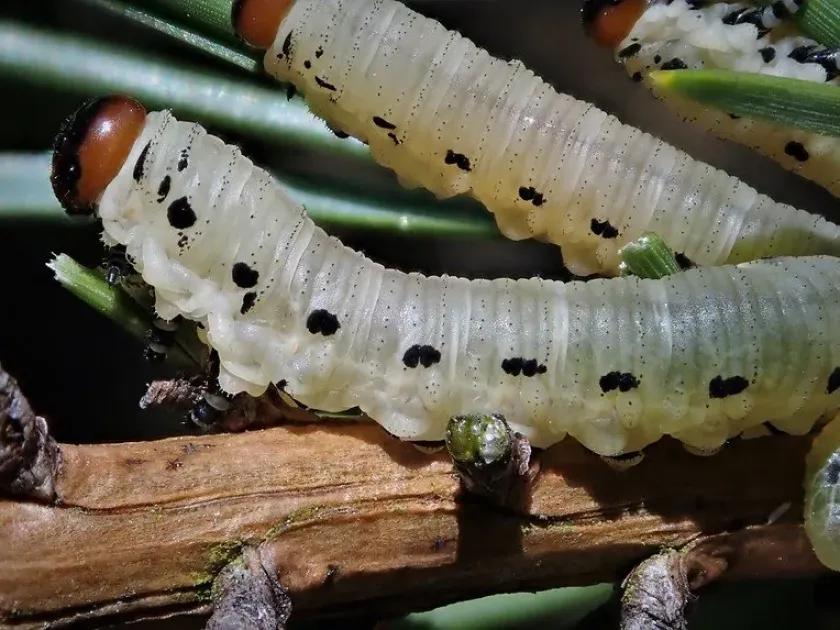
Description
How to identify
The Yellowish pine sawfly (Gilpinia pallida) is a member of the Diprionidae family within the order Hymenoptera. Despite their name, they are not flies but relatives of wasps and bees, characterized by a complex life cycle.
Adult insects are small, with a wingspan of about 10-15 mm. Females possess a specialized serrated ovipositor, which they use to cut slits into the pine needles where they deposit their eggs.
The larval stage is the primary cause of concern for foresters and gardeners. Larvae are caterpillar-like in appearance, typically light green or yellowish with stripes, which helps them blend into the pine canopy.
The life cycle involves complete metamorphosis: egg, larva, prepupa (in a cocoon), and adult. They typically overwinter as prepupae within a cocoon located in the soil or forest litter beneath the host tree.
Development is highly synchronized with host plant phenology, ensuring that larvae hatch just as the pine trees provide sufficient food resources for their rapid growth and development.
What it damages
Larvae feed exclusively on the needles of various pine species. They are voracious eaters, often stripping entire branches of their needles, which leads to significant defoliation of the tree.
The loss of needles prevents the tree from performing photosynthesis, which weakens the tree's health and reduces its annual growth rate. Severe infestations can cause the death of young saplings.
Weakened trees are highly susceptible to secondary attacks from wood-boring insects like bark beetles. This combination of stressors can lead to the rapid decline and mortality of mature trees in a stand.
In ornamental landscapes, the presence of these sawflies ruins the aesthetic appearance of pine trees, making them look sparse and unhealthy due to the visible gaps in the foliage.
Outbreaks can occur over several years, affecting large forest areas. The cumulative effect of repeated defoliation can alter the forest ecosystem balance and decrease timber production value.
When it appears
Adult sawflies emerge in the spring once the soil temperature is high enough. This period marks the start of the reproductive phase, during which mating and egg-laying occur.
Larvae usually hatch during late spring or early summer. This is the period when they are most active and visible on the tree, consuming large quantities of foliage to fuel their growth.
By late summer, the larvae reach their final stage of development, descend to the ground, and spin cocoons. This cocooning phase is designed to protect them from harsh weather conditions during autumn and winter.
In warmer climates, some populations may undergo a partial second generation, but typically, there is one major generation per year, making the late spring and summer months critical for monitoring.
Planning protection measures should be aligned with the larval development stages, as younger larvae are much more susceptible to control measures than the older, final-instar larvae.
Signs of infestation
The most obvious sign of an infestation is the presence of gregarious larvae feeding in groups on the pine branches. They tend to stick together, leaving bare patches where they have fed.
Look for needles that have been partially eaten, starting from the edges and leaving only the central vascular structure. These damaged needles eventually turn yellow or reddish-brown.
Accumulation of frass (larval excrement) beneath the tree or on lower branches is a strong indicator of an active colony above. These small, dark pellets often carpet the ground under heavily infested trees.
In cases of severe infestation, the needles may appear ragged or stripped entirely. Checking the ground cover for discarded larval skins or cocoons can confirm the presence of the pest species.
Increased activity of insectivorous birds in a specific part of the forest is often a natural sign that a colony of sawfly larvae is present and being predated upon.
Control measures
Chemical control involving systemic insecticides is effective when applied during the early larval stages. Proper timing is crucial to minimize the damage before the larvae become too mature.
Biological control methods, such as using biopesticides based on specific bacteria or viruses, are preferred in eco-sensitive areas as they target the sawfly without harming beneficial insects.
Physical removal is a viable strategy for small trees or isolated garden plantings. Shaking the larvae off the branches onto a cloth and disposing of them can significantly reduce the local population.
Encouraging biodiversity in and around the pine stand by planting native flowers attracts natural predators, such as parasitic wasps and predatory beetles, which help keep sawfly numbers down.
Cultural practices, such as maintaining optimal soil health and ensuring trees are not overcrowded, help build the tree's natural resistance to pests, preventing small infestations from becoming outbreaks.
Taxonomy
- Latin name
- Gilpinia pallida
- Order
- Hymenoptera
- Family
- Diprionidae
- EPPO code
- GILPPA
Discussion
No discussions yet — be the first.