
Pine sawfly
Gilpinia
Description
How to identify
Gilpinia is a genus of sawflies belonging to the Diprionidae family within the order Hymenoptera. Although they resemble common flies, they possess specific morphological characteristics, such as the attachment of the abdomen to the thorax, typical of sawflies.
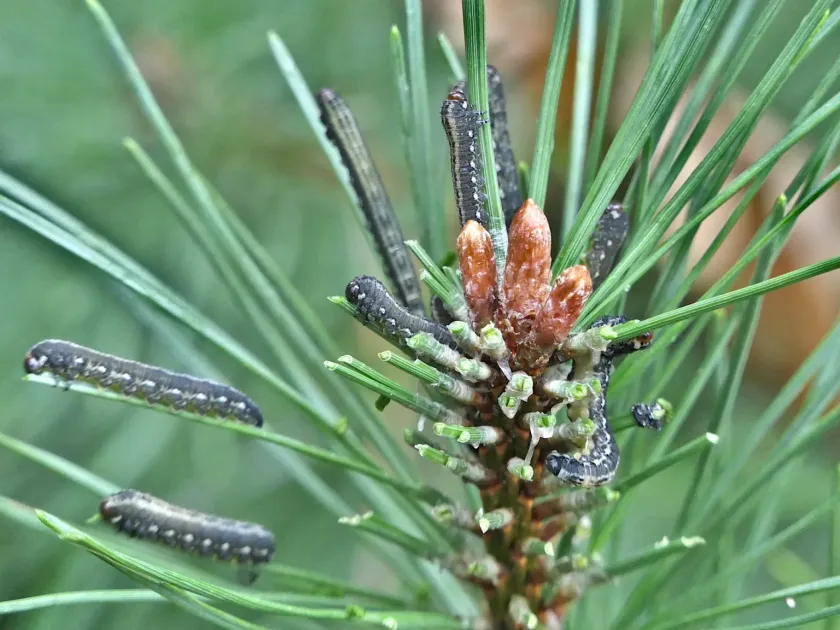
The larvae of the Gilpinia genus are frequently mistaken for lepidopteran caterpillars. However, a key identification feature is the presence of more than five pairs of prolegs, which differentiates them from most moth larvae that are common on trees.
Pupation typically occurs within robust, leathery cocoons that are golden-brown or dark in color. These cocoons are often found in the leaf litter beneath the host tree, but in some species, they can be attached directly to the pine needles or branches.
The life cycle involves four distinct stages: egg, larva, pupa, and adult. Many species exhibit diapause, where the prepupal stage can remain inside the cocoon for multiple seasons, allowing the population to survive unfavorable environmental conditions.
Identifying the exact species often requires professional entomological examination; however, the typical "sawing" marks on needles made by females during oviposition are a distinct diagnostic sign of Gilpinia presence.
What it damages
The primary hosts for Gilpinia are conifers, with pine trees (Pinus spp.) being the most affected. They can cause significant damage in forest stands, nurseries, and ornamental landscapes.
The larvae are responsible for the damage, as they feed gregariously on pine needles. While they show a preference for older foliage, during outbreaks, they will consume current-year needles, leading to severe defoliation of the tree.
Heavy infestation weakens the trees, making them susceptible to secondary attacks from bark beetles and wood-boring insects. This cumulative stress often results in the death of the tree, especially in already weakened stands.
Economic damage includes a reduction in wood growth, loss of aesthetic value in parks, and high costs associated with pest control and tree removal in commercial forest plantations.
In cases of total defoliation, the tree's energy reserves are depleted, preventing it from recovering in the following growing season and significantly increasing the mortality rate of the stand.
When it appears
The timing of Gilpinia activity is highly dependent on climate and regional temperature patterns. Adults typically emerge during the warm spring months to begin the cycle of egg-laying.
Larval feeding peaks during early to mid-summer. This is the period when damage becomes most visible, as the needles turn yellow and dry up due to the intense feeding activity of the larvae.
Depending on the species, there may be one or two generations per year. Bivoltine species can continue to cause damage late into the summer and early autumn, further stressing the trees before dormancy.
The onset of pupation varies; some larvae finish feeding and spin cocoons in the soil, while others might remain active depending on the local weather conditions and species-specific biological triggers.
Integrated pest management programs rely on monitoring adult flight times using traps to predict potential larval outbreaks and apply control measures before significant damage occurs.
Signs of infestation
The earliest sign of Gilpinia infestation is the appearance of distinct, serrated rows of slits on the pine needles, which are created by the female sawfly when she lays her eggs.
The presence of larvae feeding in groups is a highly visible sign. When disturbed, these larvae often perform a characteristic "defensive" behavior, lifting their heads and tails in unison to deter predators.
Frass (larval excrement) accumulation on the ground or in the lower branches is a reliable indicator of high population density. The frass usually appears as small, dark, granular pellets.
Needle damage initially looks like edges being eaten, eventually leaving behind only the central vein. These damaged needles quickly turn yellow or reddish-brown, creating a patchy appearance on the tree canopy.
Finding cocoons in the leaf litter at the base of the tree or tucked into the bark crevices confirms the identity of the pest and provides an estimate of the local population density for the next year.
Control measures
Biological control is highly effective for Gilpinia. The use of specific viral pesticides (such as nucleopolyhedrovirus) or bacterial agents like Bacillus thuringiensis can control populations without harming beneficial insects.
Chemical control measures should be timed with the early larval instars when they are most vulnerable. Systemic insecticides can be applied if the infestation is severe and threatens the survival of valuable trees.
Cultural practices include the removal and destruction of needles and litter beneath infested trees during the winter to eliminate dormant cocoons and reduce the emergence rate of adults in the spring.
Promoting natural enemies is essential for long-term management. Birds, parasitic wasps, and predaceous beetles play a vital role in keeping Gilpinia populations below the economic threshold in healthy ecosystems.
- Monitor adult flight with pheromone or sticky traps.
- Manually remove and destroy infested branches with larvae.
- Apply biological insecticides at the first sign of larval emergence.
- Clear leaf litter in nurseries to destroy overwintering cocoons.
- Enhance habitat for natural predators like birds and parasitic wasps.
Taxonomy
- Latin name
- Gilpinia
- Order
- Hymenoptera
- Family
- Diprionidae
- EPPO code
- GILPSP
Discussion
No discussions yet — be the first.