
European pine sawfly
Gilpinia frutetorum
Description
How to identify
The European pine sawfly (Gilpinia frutetorum) is a member of the Diprionidae family within the order Hymenoptera. Despite their fly-like appearance, they are distinct due to their specific wing structure and reproductive biology.
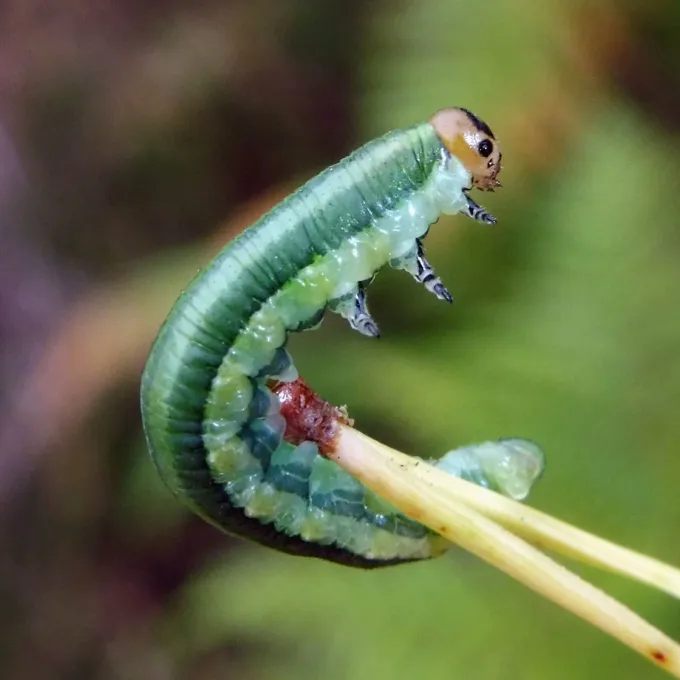
Larvae, commonly referred to as false caterpillars, grow up to 25 mm in length. They are characterized by a greenish body with a darker head and three longitudinal pale stripes along their back for camouflage.
The life cycle encompasses four main stages: egg, larva, pupa, and adult. Depending on the geographical region and climate, the species may complete one or two generations per year.
They overwinter primarily as prepupae inside dense, tough cocoons. These are typically located in the forest floor litter or sheltered in bark crevices near the base of the host tree.
Adult emergence occurs in the spring after the pupation phase. Females use their saw-like ovipositors to insert eggs into the pine needles, marking the beginning of a new infestation cycle.
What it damages
This pest specializes in feeding on various pine species, including Scots pine, mountain pine, and eastern white pine. The larval stage is responsible for all structural damage to the trees.
Early-stage larvae primarily consume older needles from previous years. This feeding pattern is a key diagnostic feature, as they often avoid the current year's growth during their initial development.
As the larvae mature, they consume needles more aggressively, often stripping entire branches of their foliage. This causes severe defoliation, leading to significant stress for the host tree.
Persistent defoliation weakens the tree's immune system, making it highly susceptible to secondary attacks from bark beetles and wood borers, which often leads to the tree's eventual mortality.
Both young pine plantations and mature stands can suffer economic losses, with reduced timber increment and aesthetic degradation being the primary outcomes of large-scale infestations.
When it appears
Adult activity usually begins in late spring or early summer, depending on temperature. This is the period when mating occurs and the female selects optimal sites for egg-laying.
Larvae hatch within two weeks of oviposition. During this phase, they are gregarious, feeding in groups, which makes them highly visible during inspection of the tree canopy.
The peak damaging period for most regions is between June and July. This is when the larvae reach their largest size and consume the most foliage, requiring immediate management attention.
In warmer climates, a second generation may occur in late summer. This requires a second wave of monitoring to ensure the health of the trees heading into the autumn months.
By late August or early September, the larvae cease feeding and drop to the ground to pupate in the soil litter, preparing for the dormant overwintering phase.
Signs of infestation
The most prominent sign is the thinning or complete absence of needles on certain branches. In severe cases, the branches look bare, with only the distal buds remaining intact.
When disturbed, the larvae exhibit a communal defensive behavior, arching their heads and tails in a synchronized movement, which is a classic indicator of a sawfly infestation.
Accumulated larval excrement, appearing as small, dark granular pellets, is often found on the forest floor beneath the infested branches, signaling high larval density in the canopy.
Premature needle yellowing and subsequent shedding occur as the larvae sever the needles at the base. This gives the tree a sparse and sickly appearance within a short timeframe.
Finding empty, brownish cocoons in the leaf litter at the base of the tree is a strong indicator of past or present activity, providing a basis for planning long-term control strategies.
Control measures
Biological control methods, such as the use of nucleopolyhedroviruses (NPV) or bacterial sprays like Bacillus thuringiensis, are highly effective against early larval stages while remaining safe for non-target species.
In large-scale forest management, the use of registered systemic insecticides is considered an option if monitoring thresholds indicate a high risk of significant defoliation and tree mortality.
Cultural practices, such as disturbing the soil surface beneath the trees in late autumn, can destroy the overwintering cocoons and significantly reduce the emergence of the next generation.
Promoting a healthy environment for natural predators, including parasitic wasps and insectivorous birds, serves as a sustainable and long-term strategy for managing sawfly populations.
- Regular monitoring of pine foliage density
- Hand-picking larvae from small ornamental trees
- Application of biorational insecticides
- Sanitation pruning of severely infested branches
Taxonomy
- Latin name
- Gilpinia frutetorum
- Order
- Hymenoptera
- Family
- Diprionidae
- EPPO code
- GILPFR
Discussion
No discussions yet — be the first.