

Description
How to identify
The European pine sawfly (scientific name: Diprion pini) is a member of the Diprionidae family, known as a significant defoliator of pine species across Europe and Asia.
Adults are small, stout-bodied insects; females have a brownish-yellow color with a serrated ovipositor, while males are black with feathery antennae.
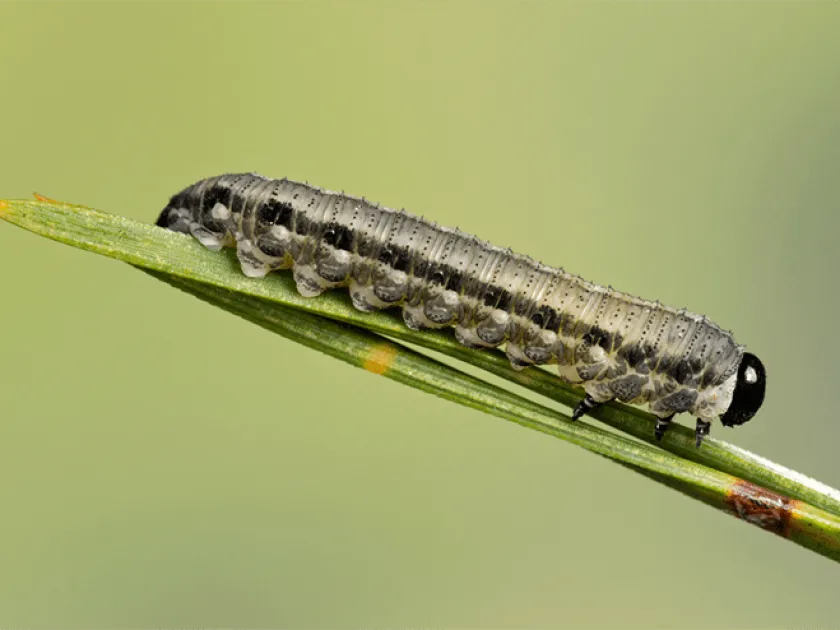
The larvae, often called false caterpillars, are distinct due to their 22 legs and can grow up to 25 mm in length during their development stages.
Their bodies are typically greenish-grey with a dark dorsal stripe and a shiny black head, making them easily identifiable during mass outbreaks.
The insect undergoes a complete metamorphosis, often exhibiting a diapause phase that ensures survival during harsh winters or unfavorable environmental conditions.
What it damages
The primary host for this pest is the Scots pine (Pinus sylvestris), although it can occasionally infest other coniferous trees like spruce or cedar.
Young larvae initially graze on the surface of the needles, while older larvae consume the entire needle down to the sheath, leading to severe defoliation.
Heavy infestations can strip a tree of its needles in a single season, significantly reducing the tree's vigor and its ability to store necessary nutrients.
Weakened trees suffer from growth suppression and become highly susceptible to secondary attacks from bark beetles and wood-boring insects.
Repeated defoliation over consecutive years often results in the death of entire stands, causing substantial economic losses in timber production.
When it appears
The flight period for adults typically occurs during the spring months, specifically from April to May, depending on the local spring temperatures.
Females lay their eggs in slits cut into the needles, with multiple eggs usually arranged in a row within a single needle bundle.
Larvae emerge in late spring or early summer, feeding gregariously in groups to increase their efficiency in consuming the foliage of the host tree.
The insect typically completes one or two generations per year, with the final generation overwintering as prepupae inside cocoons in the soil litter.
Warm and dry weather conditions during the larval development phase often contribute to faster maturation and potential population explosions.
Signs of infestation
The most common sign of infestation is the presence of frass (dark granular excrement) falling from the canopy onto the forest floor or surrounding vegetation.
Observation of the needles reveals them being eaten "like a comb," leaving behind only the vascular bundles or partially chewed fragments.
Colonies of larvae are highly visible on the branches, often assuming a characteristic S-shaped position when disturbed by predators or wind.
Rapid browning and thinning of the tree crown during mid-summer are clear indicators that a colony is actively consuming the foliage.
- Partial or total needle loss.
- Accumulation of larval excrement under the tree.
- Presence of golden-brown cocoons on branches or in litter.
Control measures
Monitoring using pheromone traps is a critical step in integrated pest management, allowing managers to time interventions before damage becomes severe.
Biological control agents, including specific nuclear polyhedrosis viruses (NPV) and bacterial preparations, are effective and eco-friendly options for large-scale treatment.
Chemical insecticides are used primarily when larval populations exceed economic thresholds and threaten the survival of young plantations.
Promoting a healthy ecosystem that supports natural predators, such as insectivorous birds, ants, and parasitic wasps, is essential for long-term population suppression.
Silvicultural practices, including proper site selection and maintaining mixed-species stands, help reduce the risk of massive sawfly outbreaks.
Content graph
Connections · European pine sawfly
Most often together:
Marketplace
Products · 1
Biology
Taxonomy
- Latin name
- Diprion nemorum
- Order
- Hymenoptera
- Family
- Diprionidae
- EPPO code
- DIPRNE
Community
Discussion
No discussions yet — be the first.