
Dicerca horni
Dicerca horni
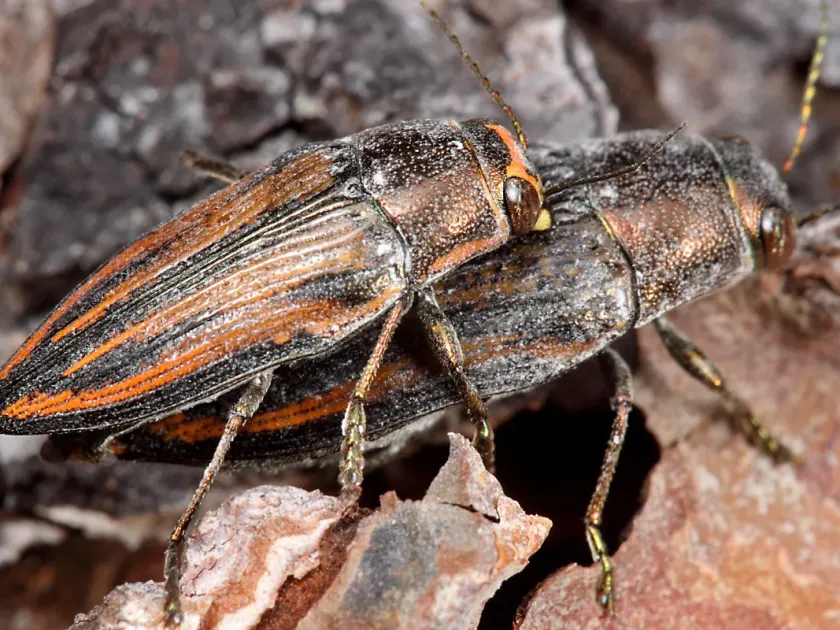
Description
How to identify
Dicerca horni is a member of the Buprestidae family, commonly known as metallic wood-boring beetles. The adult beetles are medium-sized with an elongated, flattened shape and a characteristic metallic sheen on their elytra.
The exoskeleton is highly sclerotized, typically appearing in dark bronze or brownish hues. The surface of the elytra features a rough, sculpted texture, which serves as effective camouflage against the bark of host trees.
The larvae are legless, white, and possess a broad prothorax that conceals the head capsule. They are specialized to tunnel within the woody tissue, where they spend most of their developmental phase.
The life cycle is closely tied to the health status of the host plant. Adult beetles are diurnal, often seeking out sun-warmed areas of the tree trunk for basking and mating.
This species is a xylophage, undergoing several larval instars before pupating inside the trunk or larger branches, ultimately emerging as adults through characteristic exit holes.
What it damages
Dicerca horni primarily attacks various woody species, with a particular preference for stone fruit trees. Mature trees that are already under physiological stress are the most susceptible to infestation.
The damage is primarily caused by the larvae, which bore galleries beneath the bark, disrupting the vascular system and the transport of essential nutrients and water.
Infested branches typically show signs of dieback, with leaves turning yellow and dropping prematurely. In severe cases, the infestation can lead to the total death of large structural limbs or the entire tree.
Larval activity creates entry points for secondary pathogens, including wood-decay fungi and various types of tree cankers. The structural integrity of the wood is compromised, making branches prone to breakage.
The pest often exploits pre-existing wounds, such as sunscald or mechanical injuries, highlighting the importance of bark maintenance in orchard management.
When it appears
Adult emergence typically begins in late spring or early summer when ambient temperatures become consistently warm. Their activity remains sustained throughout the summer months.
Mating and oviposition occur on the bark surface, often targeting crevices or damaged areas. A single female is capable of laying numerous eggs throughout the active season.
Larval development is a prolonged process, often taking one or more years depending on environmental conditions and the specific physiological state of the host tree.
Pupation usually occurs in late winter or early spring within a specially constructed chamber inside the wood. Following metamorphosis, the adult bores an exit hole to emerge.
For population monitoring, the use of pheromone or light traps during the peak adult activity period is recommended to detect the onset of an infestation early.
Signs of infestation
The most reliable indicator of an infestation is the presence of oval-shaped exit holes on the bark, created by emerging adult beetles.
The accumulation of fine wood shavings or "frass" at the base of the tree or in branch crotches is a clear signal of active larval tunneling within the wood.
Localized dieback of the crown, often accompanied by bark cracking or sunken lesions, is a typical visual symptom of larval-damaged tissue.
In many stone fruit species, such as cherries or plums, infestation by Dicerca horni may be accompanied by noticeable gummosis at the site of larval penetration.
- Localized branch dieback.
- Oval-shaped exit holes on bark.
- Frass accumulation near the trunk.
- Bark cracks and structural damage.
Control measures
The most effective strategy is the maintenance of optimal orchard health. Vigorous, well-watered, and well-fed trees are significantly more resistant to borer attacks.
Rigorous sanitation is essential; all dead, damaged, or infested wood should be pruned out and destroyed by burning immediately to eliminate larval reservoirs.
Protecting the trunks from sunscald by using white trunk paint or protective wraps helps prevent females from laying eggs on vulnerable sections of the bark.
In cases of confirmed infestation, systemic insecticides can be utilized to reach larvae tunneling within the woody tissues, though timing and application methods are critical.
Consistent monitoring of tree hydration and soil nutrient levels is vital, as water-stressed trees are much more attractive to colonization by this wood-boring pest.
Taxonomy
- Latin name
- Dicerca horni
- Order
- Coleoptera (beetles)
- Family
- Buprestidae
- EPPO code
- DICCHO
Discussion
No discussions yet — be the first.