
Birch jewel beetle
Dicerca berolinensis
Description
How to identify
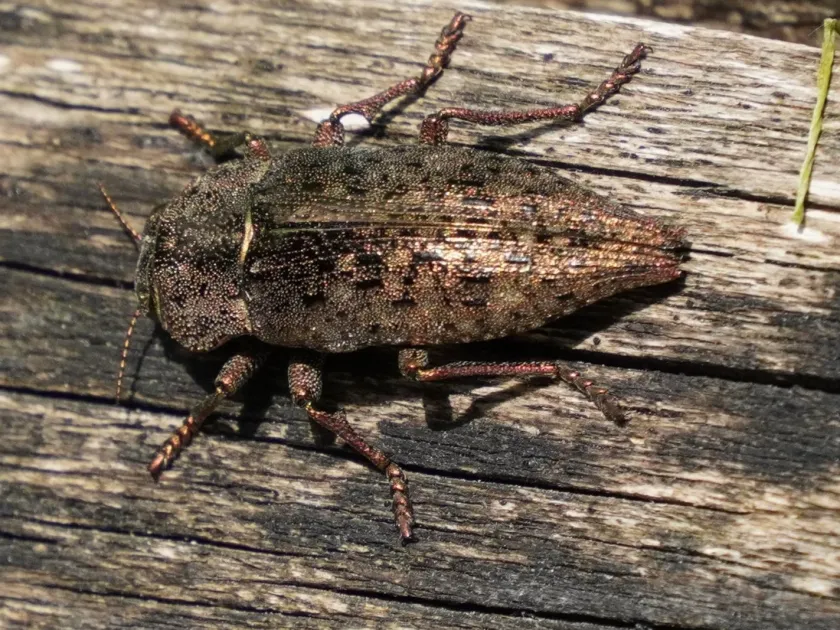
The birch jewel beetle (Dicerca berolinensis) is a large wood-boring beetle belonging to the Buprestidae family, typically measuring 15 to 25 mm in length.
The adult insect has an elongated, flattened body with a distinctive metallic sheen, usually ranging from bronze to dark copper or brown.
The wing covers (elytra) feature a rough, sculpted surface with numerous small pits, which is a key diagnostic feature for this specific species.
Larvae are legless, white, and possess a characteristic expanded thorax, a common anatomical feature among wood-boring jewel beetles.
Pupation takes place deep within the wood, where the beetle constructs a special chamber before emerging as an adult through a small exit hole.
What it damages
The primary hosts for this beetle are birch trees (Betula species), although it can occasionally attack other deciduous trees in the surrounding area.
It predominantly targets trees that are already stressed, diseased, or suffering from environmental factors, though healthy trees may be attacked in high-density populations.
Larvae feed in the subcortical layers, creating extensive, winding galleries that disrupt the vascular tissue and nutrient flow of the host tree.
Severe infestations often lead to crown dieback, thinning foliage, and the eventual death of the tree if the larval galleries girdle the trunk.
Beyond the biological damage, the wood quality is significantly degraded by the larval tunneling, rendering it useless for timber production.
When it appears
Adult beetles typically emerge in late spring or early summer, depending on the local climate and temperature rising to appropriate levels.
During the active season, adults are often seen feeding on the bark of young twigs and foliage before moving on to mating and oviposition.
Females lay eggs in the crevices of the bark, specifically choosing sites that provide adequate protection for the hatching larvae to bore into the wood.
The larval development cycle is quite long, often spanning several years, meaning that damage can accumulate over time without being immediately visible.
Late spring and summer are the most critical times for observation, as the emergence of adults and new infestation signs become most apparent.
Signs of infestation
The most reliable indicator of an infestation is the presence of characteristic oval-shaped exit holes scattered across the trunk of the tree.
Frass (a mixture of fine sawdust and excrement) accumulating in bark fissures is a strong sign that larvae are active within the wood.
Crown dieback, starting from the top or specific large branches, is often a secondary symptom of the tree's impaired ability to transport nutrients.
Removing a patch of loose bark can reveal the flattened, labyrinthine larval galleries that are tightly packed with wooden debris.
Early discoloration of leaves and a general lack of vigor compared to surrounding trees are also significant warning signs of a beetle infestation.
Control measures
The most effective management strategy is the sanitation of the forest or garden through the timely removal and destruction of heavily infested trees.
Preventative measures include the removal of deadwood, fallen timber, and logging debris, which serve as primary breeding grounds for the species.
Improving overall tree health through adequate irrigation and fertilization helps the tree resist initial beetle attacks more effectively.
For high-value ornamental trees, systemic insecticide treatments applied at the time of adult emergence can help prevent new egg-laying cycles.
Pheromone traps are increasingly used to monitor beetle population levels and to reduce the number of adults in specific, vulnerable areas.
Taxonomy
- Latin name
- Dicerca berolinensis
- Order
- Coleoptera (beetles)
- Family
- Buprestidae
- EPPO code
- DICCBE
Discussion
No discussions yet — be the first.