
Alder buprestid
Dicerca alni
Description
How to identify
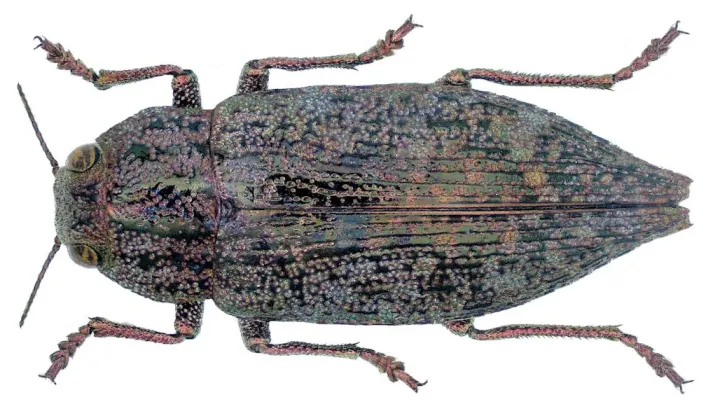
The Alder buprestid (Dicerca alni) belongs to the family Buprestidae, commonly known as jewel beetles. It is a wood-boring insect characterized by its elongated, flattened, and metallic-colored body.
Adult beetles typically feature a bronze or copper-brown coloration with a metallic sheen, and their elytra have a rough, pitted surface that provides excellent camouflage on tree bark.
The larvae are legless and pale-colored with a flattened, enlarged thorax, which is a hallmark of the Buprestidae family, allowing them to navigate efficiently through wood.
These insects are primarily active during sunny days, as they rely on warmth to fuel their reproductive and feeding activities on the surface of tree trunks and branches.
Identification is often confirmed by observing their exit holes, which are distinctively oval-shaped and clearly indicate the presence of this specific wood-boring species.
What it damages
While the beetle prefers alder trees as its primary host, it is opportunistic and can infest other deciduous species that are already weakened by environmental stress or injury.
Damage is caused by both adults, which graze on the bark of young shoots, and larvae, which create extensive galleries beneath the bark and within the sapwood.
These larval tunnels disrupt the tree's vascular system, hindering the transport of water and nutrients, which eventually leads to the dieback of branches and crown sections.
If an infestation becomes severe, the collective damage from the larval galleries can girdle the tree, resulting in its total decline and eventual death over several seasons.
The primary concern is the infestation of trees already stressed by drought or disease, as these provide a stable environment for the beetle to complete its life cycle.
When it appears
Adult beetles typically emerge in late spring, with the peak flight period occurring throughout the summer months, particularly in June and July.
Females deposit eggs directly into fissures in the bark or existing wounds, where the larvae will eventually bore into the tree to begin their development.
The larval stage is characterized by a prolonged development period, which can span from one to two years depending on the environmental conditions and host vitality.
Pupation takes place inside a specialized chamber constructed within the wood, where the beetle undergoes metamorphosis before chewing its way out as an adult.
Monitoring for the emergence of the new generation is critical during the summer, as this represents the most active phase of the beetle's life cycle in the ecosystem.
Signs of infestation
The most reliable sign of an infestation is the appearance of oval-shaped exit holes on the bark, left behind by adults after they emerge from the wood.
Visible symptoms also include the premature yellowing of leaves and the dieback of specific branches, often occurring in the upper canopy first.
Scraping away the bark in affected areas often reveals complex, winding galleries packed with frass, confirming the presence of larval activity inside the tree.
The presence of adult beetles on the bark during sunny weather serves as a clear indication that the tree is currently being targeted for egg-laying.
- Oval-shaped holes in the bark.
- Premature yellowing and leaf drop.
- Withered branches in the crown.
- Fine wood dust or frass at the base of the trunk.
Control measures
Management focuses on sanitation, which involves the removal and destruction of heavily infested or dying trees to reduce the overall population of the pest.
Improving tree health through proper irrigation and soil care is a proactive measure that prevents trees from becoming attractive hosts for wood-borers.
Insecticidal treatments applied to the trunk during the peak flight period can help protect high-value trees, though timing is essential for effective results.
Preventing physical damage to the trunk during maintenance activities is crucial, as any wounds serve as primary entry points for egg-laying females.
Encouraging the presence of natural predators, such as woodpeckers and parasitic wasps, can provide biological control in larger wooded areas and gardens.
Taxonomy
- Latin name
- Dicerca alni
- Order
- Coleoptera (beetles)
- Family
- Buprestidae
- EPPO code
- DICCAL
Discussion
No discussions yet — be the first.