
Dicerca
Dicerca
Description
How to identify
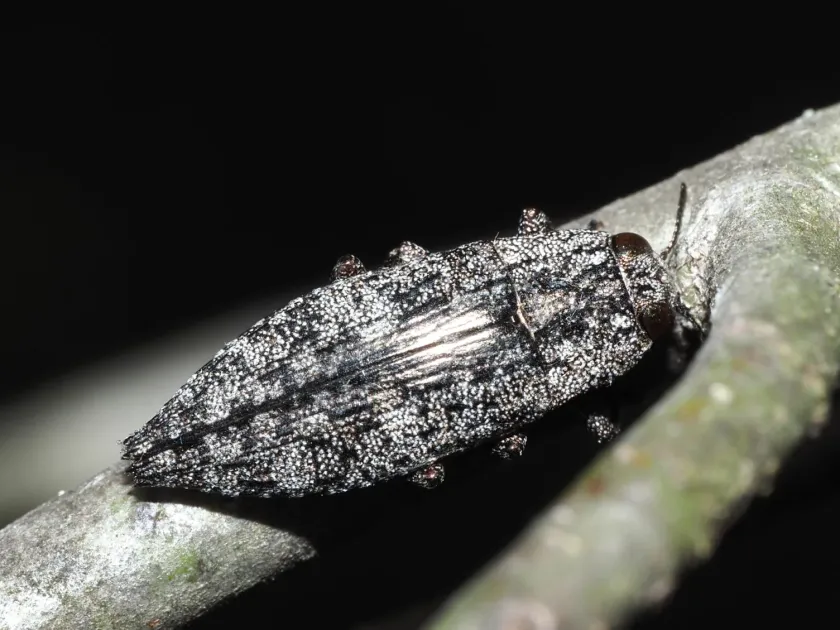
The genus Dicerca belongs to the family Buprestidae, commonly known as metallic wood-boring beetles. These beetles are medium to large in size and are distinguished by an elongated, flattened body with a characteristic metallic sheen, often bronzed or copper-colored.
Adults possess very hard wing covers (elytra) with a rugged, sculptural surface and pointed tips at the end of the abdomen. Their life cycle is intrinsically linked to stressed or declining trees.
The larvae are legless, whitish grubs with an expanded thoracic segment where a powerful head with strong mandibles is located. They lead a cryptic life, developing deep within the bark or wood.
Identifying adult beetles is often difficult due to their excellent camouflage; when threatened, they press tightly against the bark, mimicking a twig or an irregularity in the tree trunk.
The biological cycle involves a prolonged larval phase that can extend over several years, depending on environmental conditions and the condition of the host wood.
What it damages
Dicerca beetles are considered dangerous secondary pests, primarily attacking broad-leaved trees, including fruit crops such as apples, pears, cherries, and plums.
In natural habitats, they frequently infest weakened or dying trees in forests, including oaks, birches, and poplars, accelerating the decay of the wood.
The primary damage is caused by the larvae, which tunnel winding galleries through the phloem and cambium. This disrupts the tree's nutrient transport, leading to stunted growth and the gradual drying of branches.
Under heavy infestation, the pest can effectively girdle the trunk with its tunnels, inevitably leading to the death of the entire plant within a few seasons if no control measures are taken.
The damaged wood becomes a prime entry point for fungal infections and other pathogens, which significantly compromises the overall health of the orchard.
When it appears
Adult flight activity typically begins in late spring or early summer, coinciding with the flowering and active growing season of fruit trees.
During this period, adults engage in supplemental feeding by nibbling on leaf edges or young shoots, though this causes minimal damage compared to the activity of the larvae.
Females lay eggs in bark crevices, particularly near sunscalds or mechanical wounds, selecting the most vulnerable specimens to ensure the survival of their offspring.
Larvae remain active throughout the warmer months, tunneling through the wood where they eventually overwinter until the pupation phase.
The developmental cycle is slow and often spans two to three years, allowing the pest to remain hidden while systematically destroying the inner tissues of the tree trunk.
Signs of infestation
The first visible sign of a Dicerca infestation is the emergence of oval-shaped exit holes on the bark through which mature beetles have exited.
On affected trunk areas, one often observes gumming or deep fissures in the bark, where larvae are actively destroying the cambial layer.
A characteristic symptom is the premature yellowing and dropping of leaves on specific branches, which gradually lose turgor and become necrotic.
With a careful inspection, one can find distinct "boring tracks" or traces of larval activity if the loose or dead bark on the trunk and primary branches is carefully removed.
Overall tree vitality declines, the crown becomes sparse, and the wood in the areas of larval galleries becomes decayed and prone to mechanical breakage.
Control measures
The foundation of Dicerca control is maintaining good horticultural practices, including proper irrigation, fertilization, and protecting trunks from sunscald using whitewash.
Annual sanitary pruning is a critical measure: removing and immediately burning all drying or heavily infested branches where larvae might be present.
If isolated larval galleries are found, one can perform surgical excision of the damaged bark area followed by disinfection of the wound with a horticultural sealant.
The use of chemical protection is justified during the adult flight period; systemic or contact insecticides can be applied as crown sprays to manage adult populations.
It is essential to encourage natural enemies of the pest, such as insectivorous birds, which actively predate on both adult beetles and larvae.
Taxonomy
- Latin name
- Dicerca
- Order
- Coleoptera (beetles)
- Family
- Buprestidae
- EPPO code
- DICCSP
Discussion
No discussions yet — be the first.