
Blackberry gall wasp
Diastrophus nebulosus
Description
How to identify
The blackberry gall wasp (Diastrophus nebulosus) is a small insect belonging to the order Hymenoptera and the family Cynipidae. The adult is a tiny wasp, roughly 3–4 mm long, with a dark-colored body.
The lifecycle of this pest is intimately linked to the formation of specific growths on host plants. The insect undergoes a complex metamorphosis, with the larval stage spent protected within the plant's tissues.
Adult females possess an ovipositor adapted for piercing the young stems of blackberry plants, where they deposit their eggs. Once hatched, the larvae secrete substances that trigger abnormal plant tissue growth.
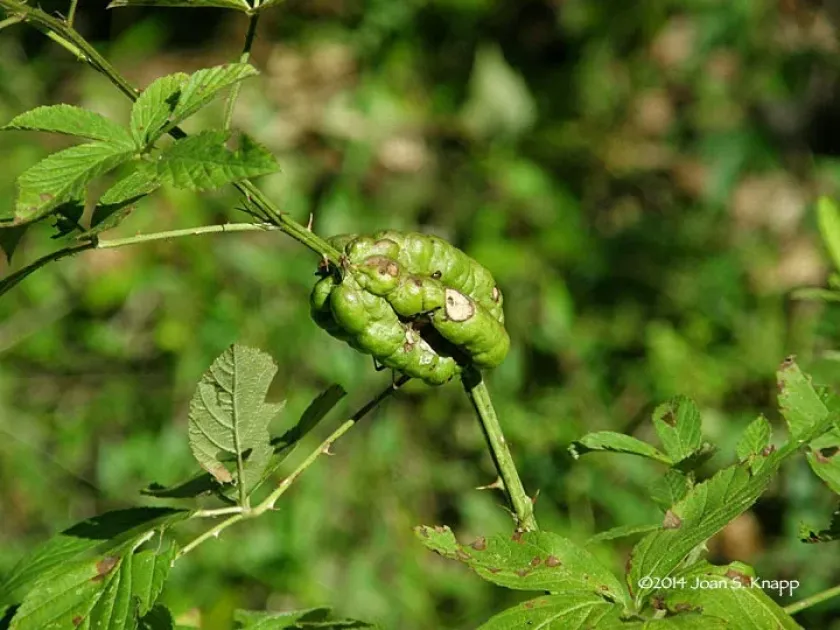
This biological interaction leads to the formation of galls—swellings within which the larvae feed, develop, and overwinter. These galls can reach significant sizes, becoming a clear indicator of the pest's presence.
Adult emergence typically occurs in the spring when they exit the galls through small exit holes they have chewed, ready to mate and locate new sites for egg-laying.
What it damages
The primary host is the blackberry, although the pest can also be found on raspberries and other plants of the Rubus genus. Damage mainly affects young, current-year canes, which directly impacts the plant's overall development.
Economic damage occurs due to the disruption of sap flow within the stem. Galls create constrictions that impede nutrient transport to the upper parts of the plant, leading to stunted growth and reduced fruit yield.
Severe infestations can result in the dieback of individual canes, especially if galls are located near growing tips. This is particularly critical for young plants, which may suffer significant growth delays.
Damaged stems lose structural integrity and are prone to breaking under wind pressure or the weight of fruit. Furthermore, the gall tissue often becomes a site for secondary fungal or bacterial infections.
Berries produced on heavily infested canes are often small and of poor quality, as the plant redirects energy away from fruit production to support the pathological tissue growth.
Signs of infestation
The primary sign of infestation is the presence of characteristic swellings known as galls. These appear as elongated, often bumpy growths on blackberry stems, ranging from 2 to 10 centimeters in length.
Gall coloration varies from light green to reddish-brown, depending on the pest's development stage and the age of the gall. As the larvae mature, these growths become harder and increasingly woody.
Careful inspection of canes during late summer and autumn is recommended, as galls are most visible when the foliage thins or when the canes reach their full size. They often appear as unnatural, thickened segments of the stem.
In the spring, you may observe tiny exit holes on the surface of older galls. These indicate that the adult wasp has successfully completed its lifecycle and emerged from its nursery.
If you identify these symptoms in your garden, it is a clear signal that immediate sanitary pruning is required to prevent the population from spreading in the following season.
Control measures
Sanitary pruning is the most effective management strategy. Identified galls must be cut out along with a portion of the stem, 5–10 cm below the affected area, and then immediately burned.
Do not leave pruned canes on the ground, as larvae inside the galls can complete their development even after the stem has been removed from the plant. Burning is the only reliable method for destruction.
General horticultural practices, including maintaining soil health and providing balanced nutrition, help improve the plant's overall resilience against gall wasp infestation.
Chemical control is notoriously difficult because the larvae are sequestered within the woody galls, shielded from external contact. Pesticide application is only effective during the short window of adult emergence.
Use preventive sprays with systemic insecticides in early spring, targeting the time of mass insect emergence to prevent them from successfully laying eggs on new, developing shoots.
Taxonomy
- Latin name
- Diastrophus nebulosus
- Order
- Hymenoptera
- Family
- Cynipidae
- EPPO code
- DISRNE
Discussion
No discussions yet — be the first.