
Spittlebug of the genus Deois
Deois
Description
How to identify
Insects of the Deois genus belong to the Cercopidae family within the Hemiptera order. They are well-known agricultural pests characterized by the production of a foamy, saliva-like substance used to protect their nymphs from predators and desiccation.
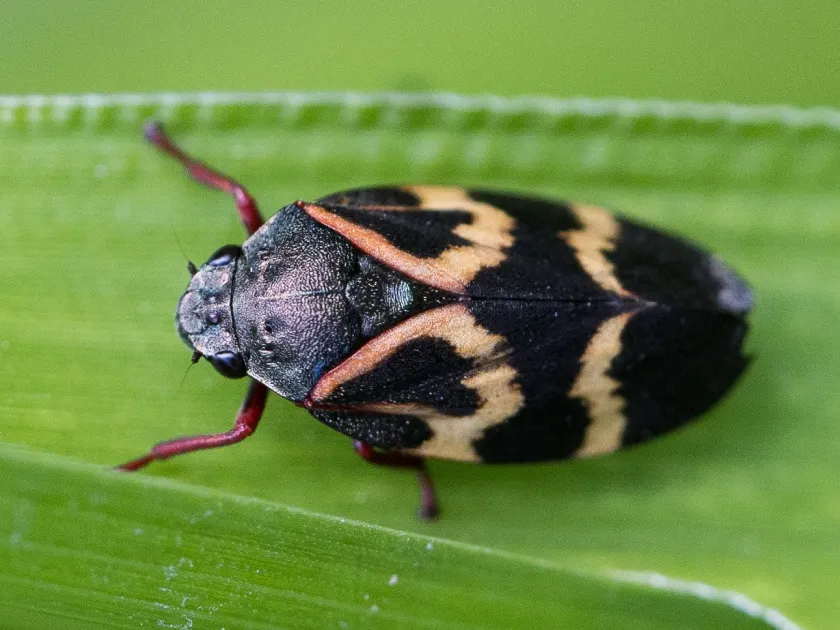
Adult specimens typically exhibit a dark, often nearly black coloration, frequently adorned with contrasting stripes or spots on their wings. They possess powerful jumping legs, which makes them difficult to observe and count accurately in open fields.
The nymphs live in a sheltered environment near the base of the plant, constantly submerged within a protective foam cocoon. This substance is generated by feeding on plant sap and subsequent aeration of anal secretions.
The biological cycle of these insects is deeply influenced by tropical and subtropical climatic patterns. Eggs exhibit remarkable resistance to drought, allowing the population to survive underground during harsh dry seasons.
While definitive species identification requires morphological examination of male genitalia, agricultural professionals can rely on the presence of characteristic foam on plant stems as a primary indicator for management.
What it damages
Primary crops susceptible to Deois infestation include perennial forage grasses and pasture species, most notably Brachiaria, which is critical for livestock grazing systems.
Damage is caused by both adults and nymphs, which feed on the plant's xylem sap. This intensive feeding disrupts the plant's hydraulic system, leading to stunted growth, reduced biomass, and diminished nutritional value.
Massive infestations often lead to complete pasture death. Fields affected by high populations of spittlebugs lose their ability to recover, forcing producers to replace the forage stand entirely.
In addition to direct physiological harm, the feeding sites created by the insects serve as entry points for secondary pathogens, such as fungi and bacteria, which rapidly accelerate the necrosis of leaf tissues.
The economic injury level is reached very rapidly due to the high density of nymphal colonies, making early field monitoring essential for maintaining pasture productivity.
When it appears
The emergence of these insects is typically tied to the onset of warm temperatures and the beginning of the rainy season. Adequate soil moisture is the primary trigger for the hatching of overwintered eggs.
Population peaks usually occur during the middle of the growing season, when the herbaceous vegetation is succulent and provides an optimal food source for both nymphs and adults.
Under favorable climatic conditions, Deois can complete several generations within a single season. This multivoltine behavior leads to an exponential increase in pest pressure throughout the summer months.
Soil temperature significantly regulates the duration of the egg incubation period. When soil temperatures remain consistently above 25 degrees Celsius, the developmental rate increases, leading to rapid population surges.
Seasonal monitoring should begin with the first rains, focusing on areas with dense canopy cover where humidity remains high and the foam is harder to detect.
Signs of infestation
The most prominent sign of infestation is the appearance of white, frothy masses near the base of the plant, in leaf axils, or on the soil surface surrounding the stems.
Visual signs of damage include the progressive yellowing of leaf tips, which eventually turn brown and wither due to the interference with water transport within the plant.
Overall pasture health declines, with fields showing signs of stress. In cases of severe infestation, large patches of the pasture will exhibit a greyish-brown color, indicating total loss of vigor.
- Presence of white spittle masses at the plant base.
- Chlorosis and curling of the leaves starting from the tips.
- Presence of jumping adults when disturbing the vegetation.
- Significant reduction in pasture height compared to unaffected zones.
Upon closer inspection, one can find the nymph hiding inside the foam; the nymph's body is typically soft and yellowish-green, providing clear evidence of an active colony.
Control measures
Effective management of Deois requires an integrated approach that combines improved agronomic practices with the strategic application of selective insecticides.
Key cultural practices include maintaining appropriate pasture height and rotating grazing areas. Overgrazing creates a humid microclimate that favors spittlebug proliferation; therefore, managing grazing pressure is vital.
Chemical control strategies often utilize systemic insecticides. Applications are most effective when timed during the peak nymphal development stage, prior to maturation into the adult phase.
Biological control methods, such as the application of entomopathogenic fungi like Metarhizium anisopliae, have shown significant success in suppressing populations, especially in high-humidity environments.
Utilizing monitoring tools such as yellow sticky traps helps determine the exact timing for intervention, ensuring that control measures are as efficient as possible while minimizing environmental impact.
Taxonomy
- Latin name
- Deois
- Order
- Hemiptera (bugs, aphids, leafhoppers)
- Family
- Cercopidae
- EPPO code
- DEOISP
Discussion
No discussions yet — be the first.