
Delphax pulchellus
Delphax pulchellus
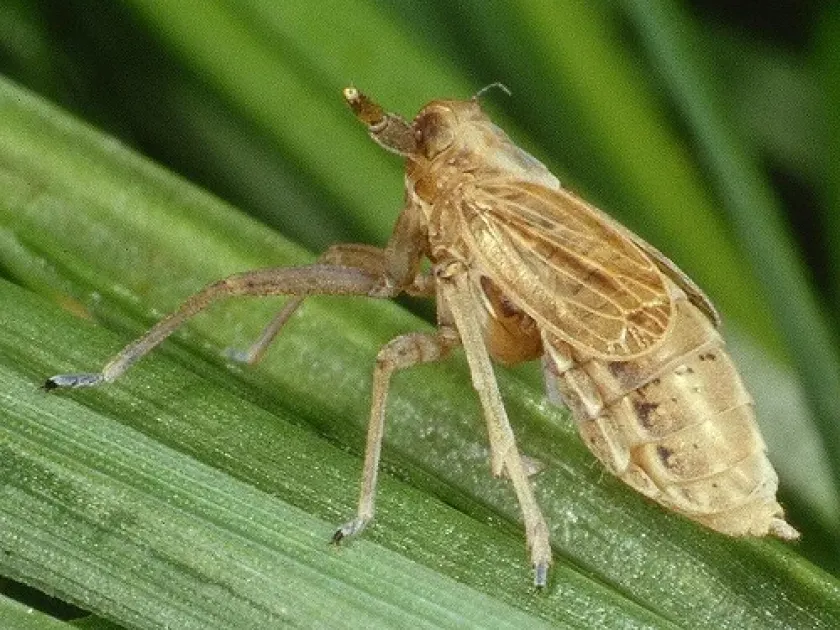
Description
How to identify
Delphax pulchellus belongs to the Delphacidae family, a group of planthoppers within the order Hemiptera. These insects are characterized by a prominent keel on the frons of the head, a diagnostic feature for the family.
Adult individuals are typically small in size. The species exhibits wing dimorphism, with both brachypterous (short-winged) and macropterous (long-winged) forms frequently observed in field populations.
The coloration of these insects ranges from light yellow to brownish, providing effective camouflage against the background of the host vegetation.
Nymphs resemble the adults morphologically but are smaller and possess underdeveloped wing pads. They undergo gradual metamorphosis through several successive instars.
Due to their high mobility and tendency to jump or hide upon disturbance, accurate identification and counting often require the use of sweep nets and specialized entomological equipment.
What it damages
This species is a specialized phytophagous insect that feeds primarily on the phloem sap of monocotyledonous plants, particularly grasses. While they favor wild grasses, they can readily infest cereal crops.
Both adults and nymphs cause damage by piercing plant tissues with their stylets and extracting cell sap. This feeding activity disrupts the plant's metabolic processes and reduces overall vigor.
Feeding sites often show necrotic spots, which can interfere with photosynthesis and weaken the plant's turgor. Heavy infestations may result in stunted growth and development of the host plant.
Furthermore, these planthoppers are known to be potential vectors for various plant viruses and phytoplasmas, which often poses a greater threat to crop yield than direct feeding damage.
Severe infestations manifest as the yellowing and wilting of foliage, leading to reduced grain yield and a decrease in the quality of the agricultural product.
When it appears
The lifecycle of Delphax pulchellus is closely linked to the phenology of graminaceous hosts. Activity commences in spring as temperatures rise, triggering the emergence of nymphs from overwintering eggs.
The species typically completes multiple generations within a single growing season, with population peaks often occurring during mid-summer when environmental conditions are optimal.
Overwintering occurs primarily in the egg stage. Eggs are laid within the plant tissues of the host, which provides the developing embryos with protection against harsh winter temperatures.
Mass emergence of adults usually coincides with the active growth phases of cereal crops, allowing the pest to maximize resource utilization for the success of subsequent generations.
Environmental factors, such as humidity levels and the absence of extreme heat, significantly influence population dynamics and the speed of development for each instar stage.
Signs of infestation
The earliest indicator of infestation is the appearance of small, pale feeding punctures on the leaves, which may merge over time to create chlorotic areas.
Upon inspecting the underside of leaves or leaf sheaths, one can often find clusters of nymphs or adults, which exhibit negative phototaxis and attempt to hide quickly.
The accumulation of honeydew on the foliage often promotes the growth of sooty mold, a fungus that forms a dark coating and inhibits gas exchange in the plant.
Distortion, curling of young leaves, and premature yellowing of older foliage are reliable signs of high-intensity feeding by the pest population.
Field infestation levels are typically assessed using sweep net sampling, a standard method for estimating population density and evaluating the necessity of protective measures.
Control measures
Integrated pest management begins with cultural control, such as the removal of weeds and grasses along field margins that serve as reservoirs for the pest population.
Implementing crop rotation and maintaining spatial isolation between cereal fields and perennial forage grasses can significantly reduce the risk of infestation by Delphax species.
Chemical control with systemic or contact insecticides is recommended only when population densities exceed the economic threshold, ensuring a sustainable approach to agroecosystem management.
Biological control plays a vital role in suppressing populations. Encouraging natural enemies, such as predatory bugs, spiders, and parasitic wasps that target eggs, is essential for sustainable management.
Regular monitoring with yellow sticky traps provides an early warning system for adult migration, allowing farmers to take timely action before significant damage occurs to the crop.
Taxonomy
- Latin name
- Delphax pulchellus
- Order
- Hemiptera (bugs, aphids, leafhoppers)
- Family
- Delphacidae
- EPPO code
- DLPXPU
Discussion
No discussions yet — be the first.