
Delphacid
Delphax
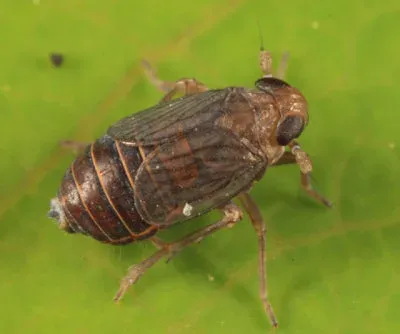
Description
How to identify
Delphacidae are a family of insects in the order Hemiptera, commonly known as planthoppers, characterized by their jumping ability and specific body morphology.
The most diagnostic feature of this family is a large, triangular, spur-like structure located at the apex of the hind tibiae.
Adult insects are typically small, measuring between 2 and 5 mm, and often display a range of colors from pale yellow to dark brown or black.
The life cycle encompasses eggs, five nymphal instars, and the adult stage, with most species overwintering as nymphs in debris or soil.
These insects prefer humid environments with dense vegetation, making them common inhabitants of both wild grasslands and commercial cereal fields.
What it damages
Delphacids cause direct injury to cereal crops such as wheat, barley, rye, and maize by piercing plant tissues and extracting essential phloem sap.
Beyond direct physical damage, these insects serve as primary vectors for various plant viruses, leading to serious systemic diseases in crops.
Feeding injury results in leaf yellowing, stunting of growth, and reduced tillering, which directly translates into significant yield losses.
Heavy infestations can lead to complete plant failure in the seedling stage, causing gaps and reduced crop stands across the field.
The presence of these pests often exacerbates the impact of environmental stressors, further weakening the health and resilience of the cereal plants.
When it appears
Adult emergence typically begins in early spring, triggered by rising temperatures and the renewal of growth in host plants.
Population peaks are generally observed in early summer, coinciding with the rapid vegetative development of grain crops.
Multiple generations can occur throughout the growing season, posing a continuous threat to fields from the seedling phase to maturity.
As winter approaches, adults migrate to perennial grasses or winter crops, seeking shelter in plant residues to survive the cold months.
Environmental conditions significantly influence their population density, with cool and moist weather conditions favoring rapid multiplication.
Signs of infestation
Early symptoms of an infestation include chlorotic spots on the leaves, which often expand into patches or streaks of discolored tissue.
Stunting and malformation of the shoots, especially when combined with reduced intermodal growth, are key indicators of feeding or viral infection.
Farmers can identify the pest by lightly shaking the plants, which usually causes the small adults to jump or fly off the vegetation.
The accumulation of honeydew on the leaves and stems often accompanies large populations, creating a sticky surface that may support sooty mold growth.
Poor ear development and high rates of empty grains are late-season signs that the crop was severely impacted by planthoppers.
Control measures
Deep plowing or autumn cultivation is a highly effective method to bury plant residues and eliminate the overwintering sites of the nymphs.
Weed management, particularly focusing on the removal of wild grasses surrounding the fields, is crucial to limit the migration of the pest.
Adjusting planting dates to avoid the peak periods of adult migration ensures that seedlings are less susceptible during their most vulnerable stage.
Systemic insecticides should be applied as a last resort, specifically when monitoring indicates that pest numbers exceed established economic thresholds.
Selecting tolerant or resistant crop varieties is the most sustainable approach to minimize yield loss and reduce dependence on chemical control methods.
Taxonomy
- Latin name
- Delphax
- Order
- Hemiptera (bugs, aphids, leafhoppers)
- Family
- Delphacidae
- EPPO code
- DLPXSP
Discussion
No discussions yet — be the first.