
Small elephant hawkmoth
Deilephila porcellus
Description
How to identify
The small elephant hawkmoth (Deilephila porcellus) is a moth species in the family Sphingidae. It is distinct from its larger relative, the common elephant hawkmoth, due to its smaller size and specific wing patterns.
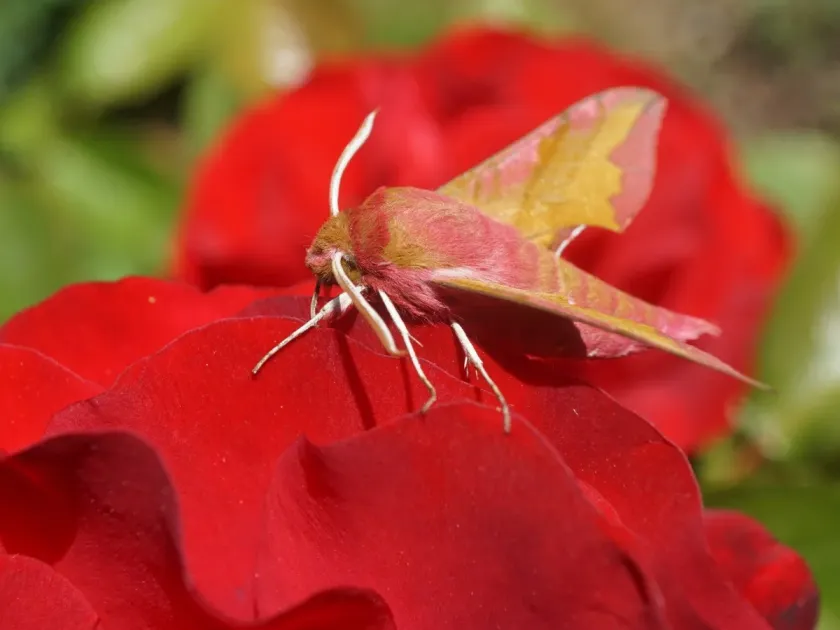
Adult moths have a wingspan of approximately 45-60 mm. They are characterized by a vibrant pink and yellow-olive colouration, which provides effective camouflage when resting on flowers or foliage during the day.
The larvae are typical hawkmoth caterpillars. A defining feature is the absence of a long tail horn on the final abdominal segment, which instead possesses a small, rough tubercle or bump.
Caterpillars display large "eye-spots" on their thoracic segments. When threatened, they retract their heads, inflating the thorax to resemble a snake, which serves as an effective deterrent against predators.
The pupal stage occurs in the soil, within a loose silk cocoon. This stage is adapted for overwintering, allowing the species to survive low temperatures before emerging in late spring.
What it damages
The primary damage is caused by the larval stage, which feeds voraciously on the foliage of host plants to accumulate energy for metamorphosis.
Common host plants include species from the Onagraceae family, most notably willowherbs (Epilobium) and bedstraws (Galium). In garden settings, they can occasionally impact decorative shrubs.
Caterpillars feed along the edges of the leaves, consuming the leaf tissue and leaving behind only the tougher midribs and primary veins, leading to significant defoliation.
Heavy infestations can lead to a drastic reduction in the plant's photosynthetic capability, weakening the root system and affecting the plant's growth for the subsequent season.
While usually not a major economic pest in large-scale agriculture, their localized impact on vulnerable or small plants can be devastating if left uncontrolled.
When it appears
Adult moths are typically active from late May through July, depending on the latitude and local climate conditions. They are nocturnal and attracted to light sources.
The larval stage occurs throughout the summer months. Caterpillars hatch shortly after egg-laying and proceed through five instars, growing rapidly during June, July, and August.
By late August or early September, the fully grown caterpillars burrow into the top layer of soil or leaf litter to pupate, marking the end of the active feeding season.
Most populations are univoltine, producing a single generation per year, though warmer climates may allow for a partial second generation under favourable conditions.
Early season scouting for eggs on the underside of host plant leaves is essential to prevent large-scale larval outbreaks later in the summer.
Signs of infestation
The most immediate sign of presence is the appearance of jagged leaf margins or completely stripped branches where caterpillars have been feeding.
Droppings (frass), appearing as dark, barrel-shaped pellets on the ground or leaves, are a clear indicator of larval activity in the immediate vicinity of the host plant.
Visual inspection of the lower leaf surfaces during the day often reveals the presence of larvae, as they spend daylight hours resting to avoid avian predators.
Rapid thinning of the foliage on susceptible plants like willowherbs or bedstraws, even if the culprits are not immediately seen, is a strong diagnostic sign of hawkmoth presence.
The unique "eye-spots" on the caterpillars make them easier to spot once they have reached a larger size, usually during the third or fourth instar.
Control measures
Cultural control is the most effective approach for gardeners, involving the manual removal of host weeds like willowherb or bedstraw from the vicinity of valued plants.
Tilling the soil around the base of host plants in the autumn or early spring can help expose and destroy overwintering pupae, breaking the life cycle of the moth.
Hand-picking larvae in the early morning or evening when they are most active is highly effective for smaller garden patches and prevents chemical residues on plants.
Biological control methods, such as the application of Bacillus thuringiensis sprays, are highly effective against lepidopteran larvae while remaining safe for non-target beneficial insects.
If chemical intervention is necessary, opt for selective, low-persistence insecticides and apply them according to local regulations, focusing on the specific areas where feeding is observed.
Taxonomy
- Latin name
- Deilephila porcellus
- Order
- Lepidoptera (butterflies)
- Family
- Sphingidae
- EPPO code
- DEILPO
Discussion
No discussions yet — be the first.