
Small Elephant Hawk-moth
Deilephila elpenor
Description
How to identify
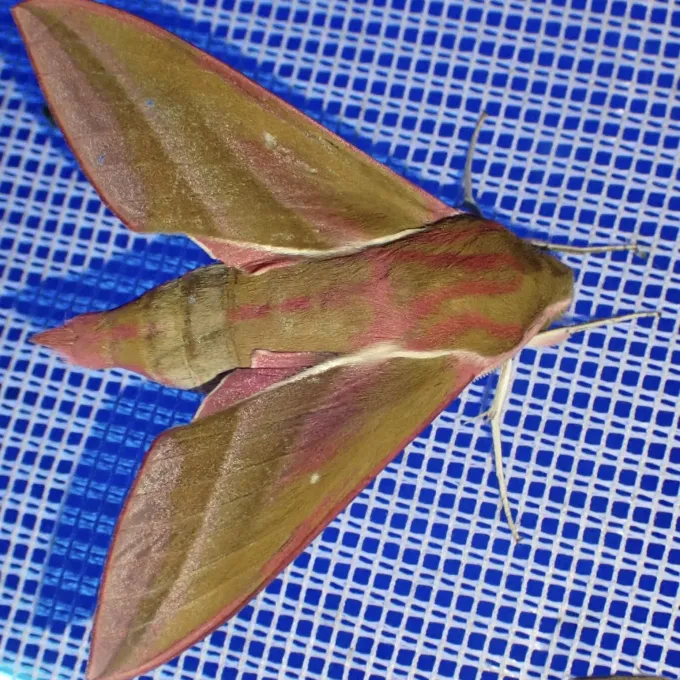
The Small Elephant Hawk-moth (Deilephila elpenor) belongs to the family Sphingidae and is a well-known Lepidoptera species often found in gardens and vineyards.
Adult moths are characterized by their olive-pink coloration and a wingspan of approximately 60-70 mm, making them quite distinctive nocturnal flyers.
The larvae are large, reaching up to 8 cm in length, and are easily identified by the eye-like spots on their thorax, which they use to mimic a snake.
These caterpillars come in green or brownish color morphs, providing excellent camouflage against the foliage of their host plants.
The pupa is dark brown and typically overwinters in the soil, protected by a loose cocoon of spun silk and leaves.
What it damages
While their primary host plants are willowherbs (Epilobium), these larvae are frequently cited as pests on grapevines and garden ornamentals like fuchsias.
The caterpillars feed on the leaves of the host plant, and in cases of high population density, they can cause severe defoliation of the vines.
Significant damage to the foliage affects the plant's photosynthetic capacity, which can hinder proper vine development and fruit ripening.
Young plants and nursery stock are at particular risk, as the loss of leaf mass can lead to stunted growth and reduced survival rates during winter.
Though not always a major economic threat, their high consumption rate makes them a pest that requires monitoring in domestic and professional vineyards.
When it appears
The flight period for adult moths generally occurs from late May through July, depending on the climatic conditions and geographic region.
Eggs are laid individually on the undersides of host plant leaves, where the emerging larvae begin feeding immediately upon hatching.
Caterpillars are active throughout the summer months, with peak feeding activity usually observed from July through August.
After reaching full maturity by late summer, the caterpillars descend to the ground to pupate in the soil before winter arrives.
Monitoring for egg clusters and small larvae should start in early summer to prevent widespread damage later in the season.
Signs of infestation
The presence of this pest is primarily indicated by jagged or completely eaten leaf edges on grapevines or surrounding vegetation.
Large, pellet-like frass (excrement) found on the soil or leaves beneath the plant is a clear sign that larvae are currently feeding in the area.
Direct inspection of the foliage, especially on the underside of leaves or along the main stems, often reveals the caterpillars resting during the day.
In cases of heavy infestation, the defoliation is highly visible, with large sections of the vine canopy looking skeletonized or stripped bare.
Gardeners may also spot the shed skins of the larvae left on the leaves after they have undergone molting during their growth stages.
Control measures
Hand-picking the caterpillars in the evening or at night is the most effective and eco-friendly control method for small-scale infestations.
Tilling or hoeing the soil around the base of vines in autumn helps to disturb and destroy the pupae, reducing the next year's population.
If the infestation is severe, application of appropriate insecticides is an option, provided they are safe for use on food-producing crops.
Biological controls, such as using preparations containing Bacillus thuringiensis, are highly effective against younger larval stages.
- Regular monitoring of foliage during the summer months.
- Removing host weeds from the vicinity of the vineyard.
- Encouraging natural predators like birds and parasitic wasps.
Taxonomy
- Latin name
- Deilephila elpenor
- Order
- Lepidoptera (butterflies)
- Family
- Sphingidae
- EPPO code
- DEILEL
Discussion
No discussions yet — be the first.