
Yellow-necked caterpillar
Datana ministra
Description
How to identify
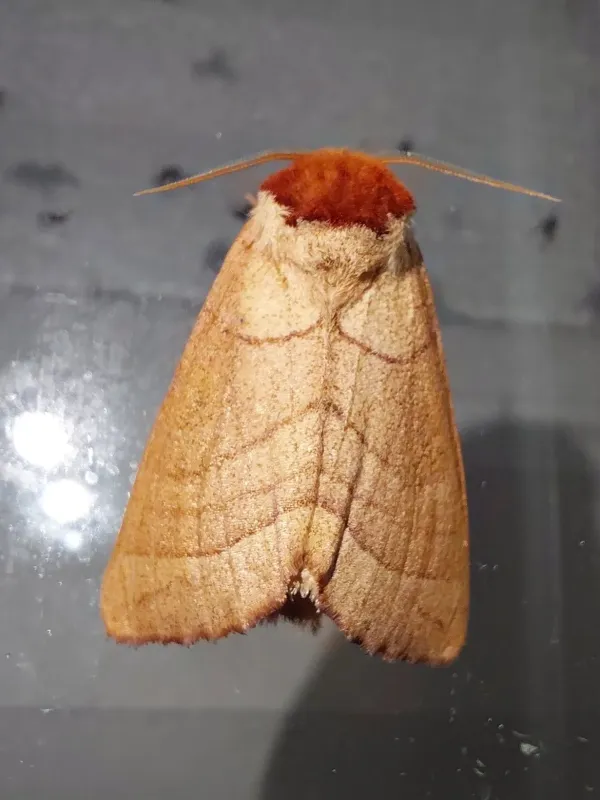
The yellow-necked caterpillar (Datana ministra) belongs to the family Notodontidae within the order Lepidoptera. The adult moth has a wingspan of 40–50 mm, with brownish forewings featuring wavy, darker transverse lines and lighter, plain hindwings.
Larvae are highly distinctive, growing up to 50 mm in length. They are characterized by a black body with bright yellow longitudinal stripes and a distinct yellow patch just behind the head, which gives them their common name. They are sparsely covered with soft white hairs.
These insects undergo one generation per year. They overwinter in the pupal stage, burrowing deep into the soil beneath host trees. Adult moths emerge in early summer to mate and lay large clusters of eggs on the undersides of leaves.
Young larvae are gregarious, feeding in tight colonies on the foliage. This social behavior continues throughout the larval stage until they reach maturity. When disturbed, the entire group will arch their heads and tails upward in unison as a defense mechanism.
By late summer or early fall, the fully grown larvae drop to the ground and burrow into the soil to pupate. Their presence is often seasonal, peaking during the warmest months when leaf development is at its maximum.
What it damages
The yellow-necked caterpillar is a generalist feeder that targets various broadleaf trees. Primary hosts include fruit trees such as apple, pear, cherry, and plum, as well as deciduous forest trees like oak, birch, linden, and beech.
Signs of infestation
The most visible sign of infestation is severe defoliation, where the larvae consume the leaf tissue entirely, leaving only the central midribs. Clusters of feeding larvae on individual branches are a hallmark of an active colony during the growth season.
Control measures
Small infestations can be effectively managed by hand-picking and destroying the colonies when they are still grouped. For larger outbreaks, biological insecticides containing Bacillus thuringiensis or registered chemical contact insecticides are recommended while the larvae are young.
Taxonomy
- Latin name
- Datana ministra
- Order
- Lepidoptera (butterflies)
- Family
- Notodontidae
- EPPO code
- DATAMI
Discussion
No discussions yet — be the first.