
Walnut caterpillar
Datana integerrima
Description
How to identify
The walnut caterpillar (Datana integerrima) is a moth species belonging to the family Notodontidae. Adult moths have a wingspan of approximately 45-50 mm and feature brownish forewings adorned with darker transverse lines, which provide excellent camouflage against tree bark.
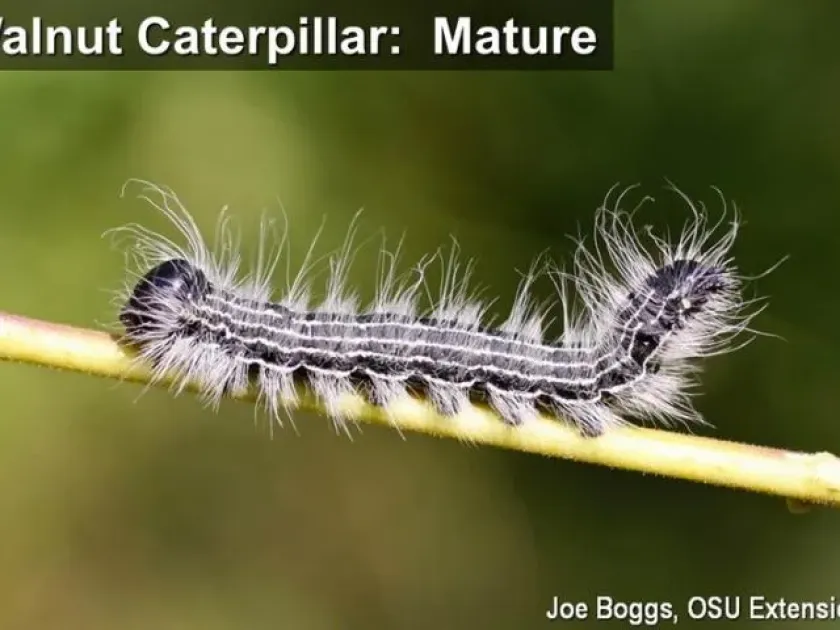
The larvae, or caterpillars, undergo significant physical changes throughout their development. Early instar larvae are yellowish with longitudinal stripes, while mature larvae develop a distinct black color covered with long, soft, white or gray hairs.
The life cycle encompasses four main stages: egg, larva, pupa, and adult. The insect typically has one generation per year, though in warmer climates, a partial second generation may emerge. They overwinter as pupae in the soil.
Adult moths emerge in early summer. Females deposit eggs in large, neat clusters on the underside of host leaves, ensuring that the young larvae have immediate access to food upon hatching.
These caterpillars are known for their social behavior. Throughout most of their larval stages, they remain in dense colonies, feeding and moving together, which makes them highly visible during the mid-to-late summer season.
What it damages
The primary hosts of the walnut caterpillar include walnut trees (Juglans spp.) and hickory (Carya spp.). They are specialized feeders that thrive on the foliage of these specific nut-bearing species.
The damage is caused entirely by the feeding larvae. They consume leaf tissue, often leaving only the midribs and main veins intact, which gives the leaves a skeletonized appearance before they eventually drop off completely.
Massive infestations often lead to complete defoliation of the entire tree. This early loss of foliage prevents the tree from performing photosynthesis, which is essential for nutrient storage and winter preparation.
The loss of energy reserves negatively impacts the tree's health for the following year. Nuts produced by stressed trees are typically smaller, lower in quality, and have a reduced market value due to poor kernel development.
Repeated yearly defoliation can kill young trees and cause significant dieback in mature trees. Weakened trees also become more susceptible to secondary pests and environmental stressors such as drought or disease.
When it appears
Walnut caterpillar activity is typically observed from June through August. This is when the larvae hatch, feed extensively, and reach their full growth before descending to the soil to pupate.
While most regions experience a single annual generation, variations in temperature can lead to a second cycle of development. The timing of larval activity is relatively predictable, aligning with the peak growth season of the host tree.
Larval feeding intensity reaches its peak during the mid-summer months. During this period, the caterpillars grow rapidly, transitioning from small, inconspicuous larvae to large, dense, and destructive colonies.
As autumn approaches, mature larvae crawl down the trunk and burrow into the soil. Here, they undergo pupation, remaining underground throughout the winter until the next adult flight period begins.
Monitoring should commence in early June. Orchard managers should inspect the undersides of leaves and monitor tree trunks for the presence of the characteristic caterpillar clusters to intervene before significant defoliation occurs.
Signs of infestation
The earliest sign of an infestation is the presence of egg clusters on the undersides of leaves. These look like small, organized rows of cream-colored eggs that are easily spotted upon close inspection.
Skeletonized leaves are a secondary sign. When colonies are present, they systematically strip branches of their foliage, creating localized areas of damage that are distinct from the grazing patterns of other pests.
The most undeniable sign is the presence of fuzzy, dark-colored caterpillars clumped together on branches or trunks. They often cluster in these groups when molting or resting, forming large, visible masses.
Fecal droppings on lower leaves or on the ground beneath the tree indicate an active colony feeding above. This "frass" accumulation is often a clear indicator of the intensity of the infestation in the canopy.
Empty exuviae, or cast skins, left behind after molting appear as whitish or silvery wisps on the bark. These skins are often stuck to the twigs, providing evidence of the caterpillars' recent developmental history on that specific limb.
Control measures
Mechanical removal is highly effective for smaller trees. Because the caterpillars feed in clusters, they can be pruned off along with the infested branch and destroyed, drastically reducing the local population.
Biological controls are highly recommended as an environmentally friendly alternative. Formulations containing Bacillus thuringiensis are effective against young larvae while preserving beneficial predatory insects in the orchard.
Chemical intervention may be necessary in commercial orchards where populations are high. Insecticides should be applied when larvae are in their early stages, as younger caterpillars are far more susceptible to control measures.
Soil cultivation beneath the tree canopy after the larvae have pupated can disrupt their life cycle. By disturbing the soil, you expose the pupae to cold weather and predators, which helps to limit the success of the next generation.
Encouraging natural enemies such as parasitic wasps and tachinid flies is a sustainable management strategy. Maintaining healthy biodiversity within the orchard helps keep walnut caterpillar populations below the economic injury level.
Taxonomy
- Latin name
- Datana integerrima
- Order
- Lepidoptera (butterflies)
- Family
- Notodontidae
- EPPO code
- DATAIN
Discussion
No discussions yet — be the first.