
Datana moth
Datana
Description
How to identify
The genus Datana belongs to the Notodontidae family (prominent moths). Adult moths are characterized by a medium size, generally ranging from 35 to 50 mm in wingspan, with brown or tan wings often marked by darker wavy bands.
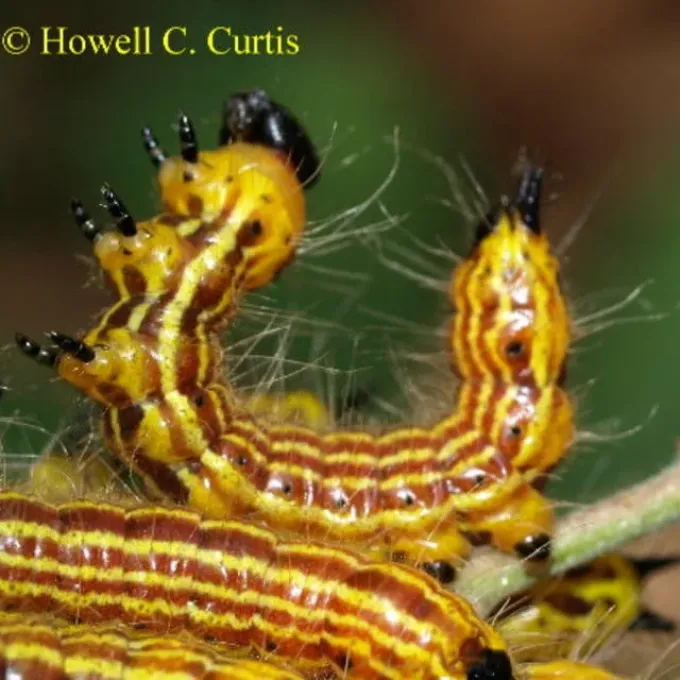
The larvae, known as Datana caterpillars, are notable for their distinct behavior and appearance. They are often marked with longitudinal stripes in white, yellow, or orange. When disturbed, they exhibit a defensive display by raising both ends of their bodies into an arch.
What it damages
These pests primarily target deciduous trees and shrubs. Common host plants include apple, pear, cherry, walnut, hickory, and various species of oak, making them significant pests in both home orchards and forests.
The damage is caused entirely by the larval stage, which feeds on the foliage. While young larvae may only skeletonize leaves, mature caterpillars consume entire leaves, often leaving only the midribs or leaf stalks behind.
When it appears
Datana moths typically produce one generation per year. Adult moths emerge in early summer, and females lay eggs in clusters on the undersides of leaves, which facilitates a synchronized hatch of the larvae.
Feeding activity is most intense from mid-to-late summer. Once the caterpillars have completed their development, they drop to the ground and pupate in the soil, where they remain in the pupal stage throughout the winter months.
Signs of infestation
The most visible sign of infestation is the presence of gregarious caterpillar colonies feeding in large groups on branches. This behavior often leads to localized but severe defoliation of specific tree limbs.
Homeowners can also identify infestations by looking for egg masses on the underside of leaves or by observing the dark frass (droppings) accumulating on the ground beneath the infested branches.
Control measures
Mechanical control is highly effective when infestations are caught early. Because these caterpillars feed in groups, gardeners can simply prune out the affected foliage or manually remove the cluster by hand.
For larger infestations, microbial insecticides like Bacillus thuringiensis are highly effective and target-specific. If chemical control is necessary, apply registered insecticides during the early larval stages when they are most vulnerable.
Taxonomy
- Latin name
- Datana
- Order
- Lepidoptera (butterflies)
- Family
- Notodontidae
- EPPO code
- DATASP
Discussion
No discussions yet — be the first.