
Oleander hawkmoth
Daphnis nerii
Description
How to identify
The Oleander hawkmoth (Daphnis nerii) is a large, migratory moth belonging to the family Sphingidae. The adult moth features an impressive wingspan of 100–130 mm, with a distinctive camouflage pattern consisting of olive-green, pink, and white bands.
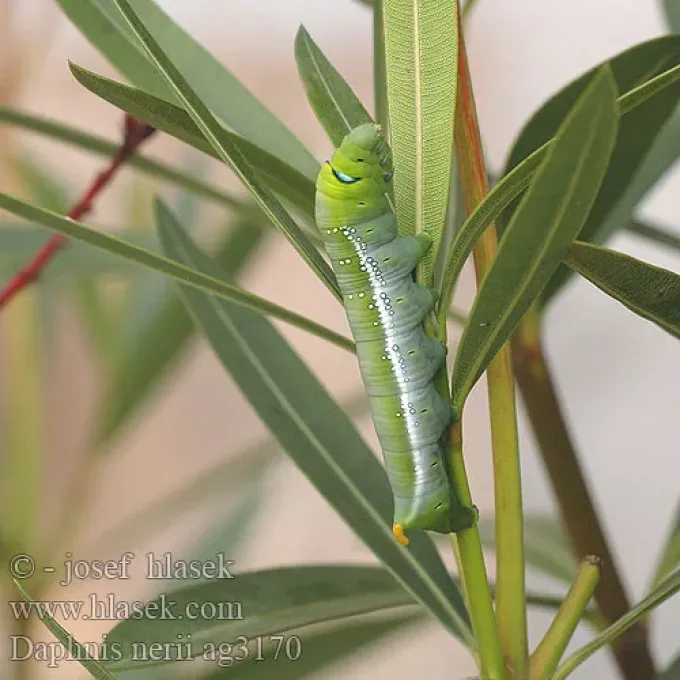
The larvae (caterpillars) progress through five instars. Early stages are bright green, while later stages may turn brownish. A key diagnostic feature is the prominent eye-like spot on the third thoracic segment and a curved, blue-tipped horn at the rear end of the body.
The life cycle involves complete metamorphosis: egg, larva, pupa, and imago. In tropical regions, the moth is active year-round, while in temperate zones, it is primarily a summer migrant that moves northward from warmer climates.
Pupation takes place in a loose silken cocoon, usually just below the soil surface or hidden amongst plant debris. The species does not typically overwinter in colder climates due to its high sensitivity to frost.
Biologically, the species is uniquely adapted to feeding on toxic plants of the Apocynaceae family. By consuming these tissues, the larvae sequester secondary metabolites, becoming unpalatable to many predators.
What it damages
The primary host plant is the common oleander (Nerium oleander), which is widely used for landscaping. The larvae are voracious feeders and can cause severe defoliation of these ornamental shrubs.
Besides oleander, the species is known to feed on plants such as Vinca, Tabernaemontana, and occasionally grapes or jasmine. Their host range is largely limited to members of the dogbane family.
The damage is caused exclusively by the larvae. Because of their large size and high metabolic rate, a single larva can consume entire leaves within hours, leaving only the midribs behind.
Heavy infestations can strip a large shrub bare, which significantly hampers the plant's ability to photosynthesize, leading to stunted growth, reduced blooming, and potential plant death if the infestation persists.
In ornamental nurseries, the presence of these caterpillars can result in significant economic loss, as the aesthetic value of the plants is completely ruined by the skeletonized leaves.
Signs of infestation
The most obvious indicator of a presence is the accumulation of frass (caterpillar droppings) on the ground beneath the host plant, which appears as large, cylindrical pellets.
Visually, the plant shows irregular feeding patterns along the leaf margins. As the caterpillars grow, they consume more leaf area, eventually causing the entire plant to look stripped or skeletal.
During the day, the caterpillars are often difficult to spot as they rest near the base of the stems or within the densest part of the foliage, utilizing their countershading for protection.
In cases of high population density, one may notice the loss of young tender shoots and flower buds, which are eaten when the primary leaf supply becomes exhausted.
Another sign is the physical discovery of the late-instar larvae, which are large, bulky, and feature the distinct eye-spot markings that are characteristic of this species.
Control measures
Manual removal is a practical solution for home gardens with only a few plants. Collecting the larvae in the early morning or evening hours is highly effective.
Biological control using Bacillus thuringiensis (Bt) is recommended for larger infestations. This bacterium is highly specific to lepidopteran larvae and has minimal impact on beneficial insects.
Chemical control with systemic insecticides is a last resort. Products containing acetamiprid or similar compounds can be applied if the infestation is widespread and threatens the survival of the plants.
- Monitor plants frequently during the summer months.
- Clean up leaf litter beneath shrubs to remove potential pupation sites.
- Use light traps to capture adult moths before they lay eggs.
Always exercise caution when handling the host plants, as oleander is toxic, and take appropriate safety measures when applying any form of pest control.
Taxonomy
- Latin name
- Daphnis nerii
- Order
- Lepidoptera (butterflies)
- Family
- Sphingidae
- EPPO code
- DEILNE
Discussion
No discussions yet — be the first.