
Daphnis hypothous
Daphnis hypothous
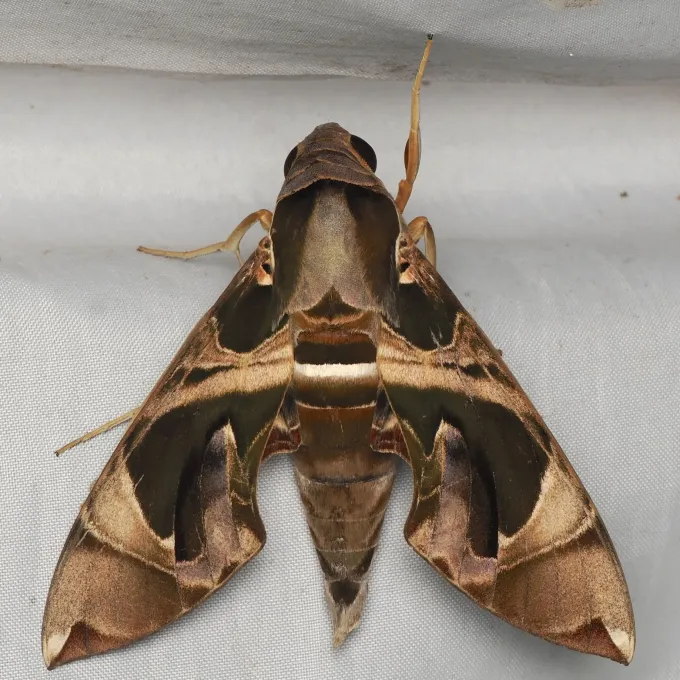
Description
How to identify
Daphnis hypothous, commonly known as a type of hawk moth, belongs to the family Sphingidae within the order Lepidoptera. These nocturnal moths are large, with wingspans reaching up to 10–12 cm, featuring intricate, camouflage-like patterns in brown, olive, and pink tones.
The larvae, or caterpillars, of this species are masters of mimicry. They shift their coloration from vibrant green to darker brown stages throughout their development, allowing them to remain effectively hidden among the foliage and branches of their host plants.
A distinctive physical feature of the larvae is a prominent horn-like projection at the rear of their bodies. This organ, often brightly colored, serves as a defensive signal to intimidate potential predators in their natural environment.
As adults, these moths are powerful fliers, active primarily during twilight and nighttime. They migrate significant distances to locate optimal host plants for oviposition, making them widespread in tropical and subtropical regions.
The lifecycle follows complete metamorphosis: egg, larva, pupa, and adult. Hibernation typically occurs during the pupal stage, buried within the soil or amidst plant debris, which necessitates careful soil management during the dormant season.
What it damages
The primary damage is inflicted by the larvae, which possess robust, chewing mouthparts. They feed voraciously on the leaves of various tropical and ornamental plants, including species within the Rubiaceae and Araceae families.
In nursery and horticultural settings, this pest can cause significant defoliation to coffee plants and various ornamental shrubs utilized in landscaping, leading to reduced plant vigor.
During outbreaks, a large population of caterpillars can strip a plant of its foliage in a matter of days. This rapid loss of leaves drastically impairs the plant’s ability to perform photosynthesis, stunting its growth.
Weakened plants become highly susceptible to secondary infections, fungal pathogens, and infestation by other opportunistic pests, which can lead to the long-term decline or death of the host.
Damage to the terminal buds or new shoots is particularly critical, as it often leads to malformed stems and irregular growth patterns that persist throughout the growing season.
Signs of infestation
The most immediate indicator of an infestation is the presence of large, pellet-like frass (excrement) scattered beneath the plant canopy directly under the areas where the larvae are feeding.
Typical damage manifests as extensive leaf skeletonization or complete irregular holes in the leaf blades. Caterpillars often begin feeding from the leaf margins, progressing inward toward the central midrib.
During the day, larvae are often found clinging to stems, where they remain motionless. Their color and shape allow them to blend in seamlessly with twigs, making visual inspection challenging for growers.
If the infestation is severe, one might notice wilting or premature leaf drop, which often indicates that the larvae have severely impacted the plant's vascular integrity or structural health.
- Jagged, irregular feeding holes on leaves.
- Accumulation of frass on lower leaves or soil.
- Presence of camouflaged larvae on branches.
- Stunted growth or loss of foliage.
Control measures
Manual removal of the larvae is highly effective for small-scale gardens. Inspection should be conducted early in the morning or late in the evening when the caterpillars are most active and visible.
Biological control methods, such as applying insecticides derived from Bacillus thuringiensis, are highly effective against younger larval stages and offer an environmentally friendly alternative to chemical pesticides.
For large-scale infestations, the use of systemic or contact insecticides may be necessary. Always ensure that the products used are appropriate for the specific crop and strictly adhere to pre-harvest intervals.
Cultural practices, such as autumn soil cultivation or tilling beneath infested trees, can help disrupt the life cycle by destroying pupae that are overwintering in the soil.
Deploying light traps during the adult moth flight period allows growers to monitor population levels and apply preventative treatments before eggs hatch and larvae begin their damage.
Taxonomy
- Latin name
- Daphnis hypothous
- Order
- Lepidoptera (butterflies)
- Family
- Sphingidae
- EPPO code
- DEILHY
Discussion
No discussions yet — be the first.