
Walnut sphinx
Cressonia juglandis
Description
How to identify
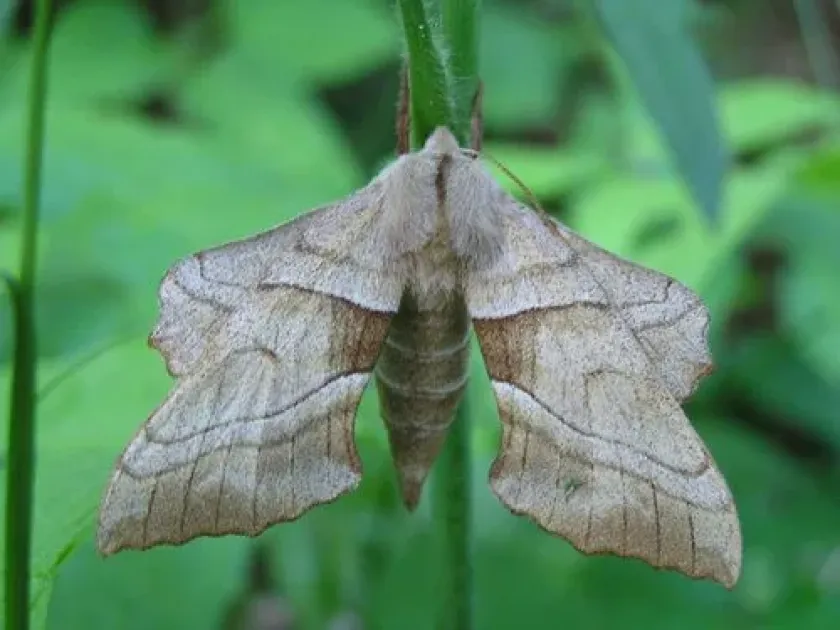
The walnut sphinx (Cressonia juglandis) is a large moth species belonging to the family Sphingidae. Adult moths have a wingspan typically ranging from 50 to 80 millimeters.
The forewings feature a distinctive pattern of wavy dark lines on a light brown to tan background, closely resembling the texture of bark or wood.
The larvae are bright green caterpillars that reach lengths of up to 5–7 cm, characterized by diagonal light-colored stripes along their sides.
A notable feature of the larva is the triangular shape of its head and a horn located at the posterior end of the body.
As members of the order Lepidoptera, these moths are masters of camouflage, often appearing like withered leaves to avoid predation during the day.
What it damages
The primary hosts for the walnut sphinx caterpillar are trees in the Juglandaceae family, most notably the walnut tree species.
While walnut is the main target, the caterpillars may also feed on the foliage of hickory and certain alder species when available.
Adult moths do not consume leaves; therefore, the economic impact is entirely attributed to the larval stage feeding on foliage.
Feeding larvae remove significant leaf surface area, which can hinder the tree's ability to photosynthesize effectively during the growing season.
Severe infestations can lead to partial or total defoliation of branches, which can stress the tree and potentially impact future fruit production.
When it appears
The walnut sphinx typically completes one or two generations per year, depending on the local climate and temperature conditions.
Adult moth emergence and flight generally occur from late spring through mid-summer, with peaks often observed in May and June.
After mating, females lay eggs individually or in small clusters on the underside of the host plant leaves.
Upon hatching, the larvae undergo several developmental stages while feeding intensely on the host plant throughout the summer months.
The species survives the winter in the pupal stage, typically buried in the soil or leaf litter beneath the host tree until spring arrives.
Signs of infestation
The most common sign of infestation is the presence of irregular leaf edges caused by larval feeding activities.
In cases of high population density, significant thinning of the canopy and exposed twigs become apparent across the affected trees.
Frass, or caterpillar droppings, appearing as small granular pellets beneath the tree canopy, is a strong indicator of active larval feeding above.
Caterpillars often rest along the midrib of the leaf, mimicking the appearance of the leaf structure, which makes them difficult to spot without close inspection.
Locating dark brown pupae while performing soil cultivation around the base of the trees during the off-season is another clear sign of their presence.
Control measures
Mechanical control, such as soil cultivation under the tree canopy in the fall, helps disturb and destroy the overwintering pupae in the soil.
Hand-picking caterpillars is a highly effective method for small-scale gardens or when infestations are limited to a few branches.
If population levels exceed economic thresholds, biological control agents such as microbial insecticides can be applied to target the larvae.
Chemical intervention should be considered a last resort and timed precisely with the early larval stages for maximum effectiveness.
Regular monitoring throughout the spring and summer allows growers to detect early signs of infestation and prevent large-scale damage to the trees.
Taxonomy
- Latin name
- Cressonia juglandis
- Order
- Lepidoptera (butterflies)
- Family
- Sphingidae
- EPPO code
- CRESJU
Discussion
No discussions yet — be the first.