
Hairy rove beetle
Creophilus maxillosus
Description
How to identify
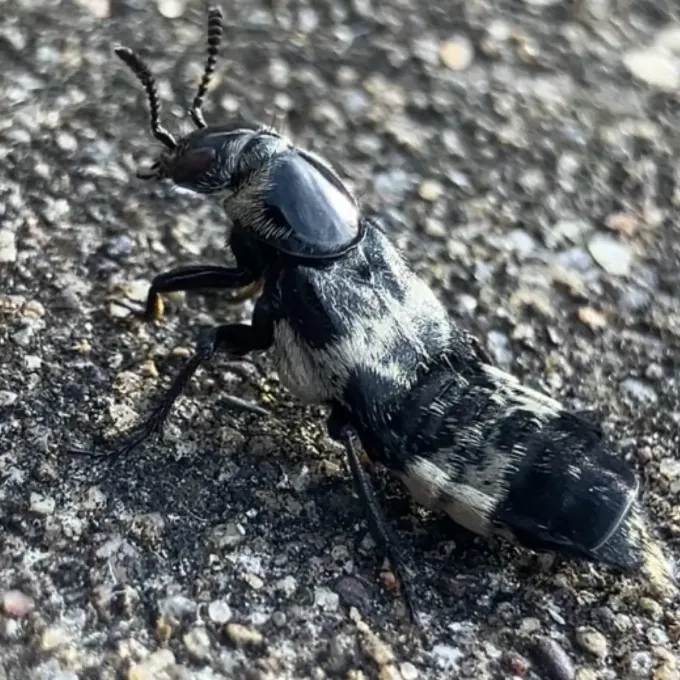
The Hairy rove beetle (Creophilus maxillosus) is a prominent member of the Staphylinidae family. It is easily identified by its elongated body, which typically measures between 12 and 18 millimeters in length, and its distinct black coloration.
These beetles feature shortened elytra that expose most of the abdomen, giving them a unique appearance. Their most striking feature is the pair of large, sickle-shaped mandibles, which are clear indicators of their predatory nature.
The larvae are highly mobile, dark-colored, and possess well-developed mouthparts designed for hunting. They are most commonly found in decaying organic matter, such as manure, compost, or under moist leaf litter.
Like all rove beetles, they undergo a complete metamorphosis including egg, larval, pupal, and adult stages. They are most active during the warmer seasons when their prey is abundant.
While their appearance might seem intimidating to some, they are non-toxic and do not possess stingers that could harm humans, making them safe to have around the farm or garden.
What it damages
Creophilus maxillosus is not a plant pest. In fact, it is classified as a beneficial insect and a natural predator, playing a crucial role in agricultural ecosystems by consuming other harmful insects.
Their diet consists primarily of small invertebrates, including larvae of various flies that are known to damage root crops and vegetable seedlings. By preying on these pests, they act as a form of natural biological control.
They do not damage crops, feed on plant tissue, or interfere with plant growth. Their presence is a sign of a healthy environment where natural pest regulation is occurring.
The economic value of these beetles is high, as they reduce the need for synthetic chemical insecticides by naturally suppressing the populations of flies and other small pests in the soil.
In many cases, people mistake them for pests because they are found in gardens, but they should be welcomed as allies rather than targeted as enemies.
Control measures
No control measures are needed for the Hairy rove beetle. As a beneficial predatory insect, it is recommended that farmers and gardeners protect and encourage its presence on their land.
Broad-spectrum insecticide use should be avoided to prevent the accidental killing of these valuable predators. Reducing chemical inputs helps maintain a healthy balance of natural enemies in the soil.
Providing habitats such as mulched soil, compost piles, or designated wild zones creates ideal conditions for these beetles to thrive and reproduce.
Integrated Pest Management (IPM) strategies emphasize the role of natural predators. By identifying and protecting beneficial species like the rove beetle, growers can rely on nature to help manage pest outbreaks.
If chemical pest control is absolutely necessary, choose selective pesticides that are least toxic to predatory insects, ensuring that natural allies like the Hairy rove beetle survive.
Taxonomy
- Latin name
- Creophilus maxillosus
- Order
- Coleoptera (beetles)
- Family
- Staphylinidae
- EPPO code
- CRPLMA
Discussion
No discussions yet — be the first.