
Red-headed rove beetle
Creophilus erythrocephalus
Description
How to identify
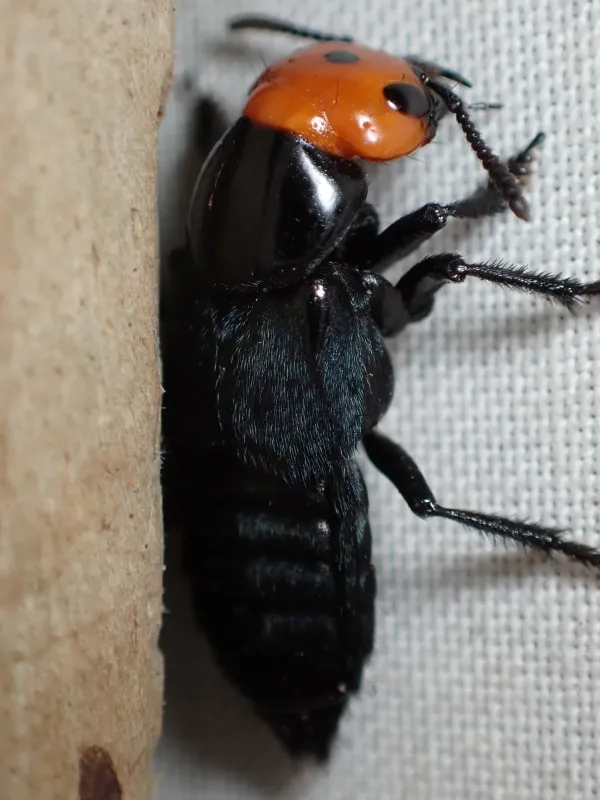
The red-headed rove beetle (Creophilus erythrocephalus) belongs to the family Staphylinidae. This species is easily identified by its black body contrastingly marked with a vibrant red head and pronotum.
Adult beetles typically measure between 12 and 18 mm. Like other members of the rove beetle family, they possess short elytra (wing covers) that do not cover the entire abdomen, yet they are highly mobile and capable of flight.
The larvae are campodeiform, highly active, and equipped with strong mandibles, which they use to hunt in soil environments or feed on organic debris.
They undergo complete metamorphosis: egg, larva, pupa, and adult. Their life cycle is heavily influenced by soil moisture and the presence of decomposing organic matter.
These insects are commonly found in agricultural landscapes where rich, moist, and organic-heavy soils provide an ideal habitat for both reproduction and hunting.
What it damages
While often regarded as beneficial predators, the red-headed rove beetle can occasionally exhibit pest-like behavior in agricultural settings when natural prey sources become scarce.
Seedlings of various vegetables and field crops are particularly vulnerable. The beetles may feed on the hypocotyl or root collar, leading to stunted growth or total plant loss.
Physical damage to the root system disrupts nutrient uptake, leaving the plant stressed and more susceptible to secondary fungal or bacterial infections.
Direct damage to fruits that are in contact with the ground is also possible, which results in surface scarring and subsequent rot, impacting the marketability of the harvest.
Damage is typically most severe in fields with significant residues, as this environment supports higher population densities of the beetle.
When it appears
Adult activity begins in early spring, as soon as soil temperatures reach approximately 8–10°C, and persists through the end of the autumn season.
Population peaks are generally observed in the first half of summer, coinciding with the peak egg-laying period and larval development cycles.
The time required for a full generation development ranges from 40 to 60 days, depending on climatic conditions, moisture availability, and food abundance.
During late summer and autumn, adults seek suitable overwintering sites, including deep soil layers, cracks, or thick organic mulch.
Overwintering is predominantly successful for adult beetles, allowing them to emerge quickly and resume activity at the start of the next season.
Signs of infestation
Visual identification of the beetles on the soil surface is the primary sign, especially during cool, damp mornings or late afternoons.
Observation of notched or girdled stems near the soil surface on young seedlings is a key diagnostic indicator of potential damage.
Yellowing or sudden wilting of previously healthy plants without obvious signs of common root rot often prompts an investigation into soil insect activity.
- Girdling damage at the base of young stems.
- Higher activity levels observed near piles of decomposing organic matter.
- Presence of the distinctive red-headed adults in soil samples or pitfall traps.
Entomological monitoring using pitfall traps is recommended to accurately estimate the population density and decide on intervention needs.
Control measures
Cultural control is the most effective strategy, starting with deep tillage or plowing, which disrupts the beetle's overwintering sites and reduces its population.
Proper sanitation, specifically the removal and destruction of crop residues, helps by eliminating the beetles' primary food sources and breeding grounds.
Implementing a robust crop rotation plan ensures that the soil environment is not permanently altered to favor the persistence of this specific insect species.
Chemical intervention should be restricted to instances where economic injury levels are exceeded, focusing on targeted soil treatments rather than broad spraying.
Biological control options, including the introduction of entomopathogenic nematodes or fungi, can provide a sustainable way to manage larval populations in the soil.
Taxonomy
- Latin name
- Creophilus erythrocephalus
- Order
- Coleoptera (beetles)
- Family
- Staphylinidae
- EPPO code
- CRPLER
Discussion
No discussions yet — be the first.