
Hairy rove beetle
Creophilus
Description
How to identify
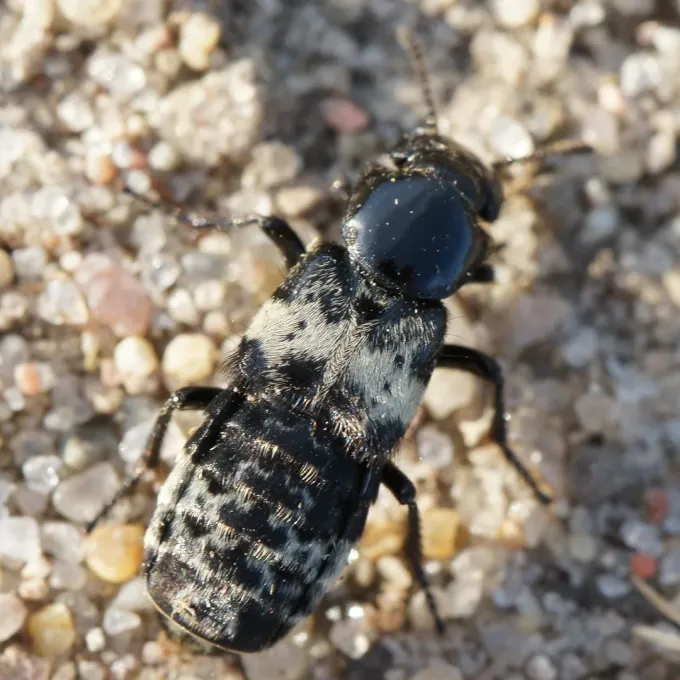
The hairy rove beetle (Creophilus maxillosus) belongs to the Staphylinidae family. These beetles typically reach 12–18 mm in length and are easily identified by their black bodies covered in distinctive grayish or golden patches of hair.
They possess elongated, flexible bodies and well-developed mandibles, which are specialized for capturing prey. Their structure allows them to move swiftly through complex soil environments and decaying organic matter.
The lifecycle consists of egg, three larval stages, pupa, and adult. They generally overwinter as adults in protected soil environments, emerging early in the spring to feed and reproduce.
The larvae, similar to adults, are agile predators equipped with sensory appendages, allowing them to track and consume small invertebrates within the soil surface layer.
These beetles are frequently found in habitats containing decaying materials, where they play a significant ecological role in nutrient cycling and pest suppression.
What it damages
The hairy rove beetle is primarily a predator and does not feed on plant tissues. Therefore, it is generally considered beneficial for agriculture rather than a direct crop pest.
In rare instances, high concentrations of beetles searching for prey near the root zone can cause minor mechanical damage to seedlings, but this is seldom of economic significance.
The beetles are often attracted to fields with poor management practices, such as large piles of uncomposted plant debris, which can lead to localized increases in their population density.
Because they hunt other larvae and small insects, they act as natural controllers of many common crop pests, providing valuable ecosystem services to farmers.
There is no evidence of significant yield loss attributed directly to this species, and they are typically welcomed in fields as part of the local predatory insect community.
Control measures
Active pest control measures against the hairy rove beetle are rarely necessary, as they are considered beneficial predators in most agricultural settings.
If population densities become problematic, standard agronomic practices such as deep plowing and thorough incorporation of crop residues into the soil are the most effective solutions.
Proper field hygiene, including the removal of rotting organic waste, naturally discourages the beetles from congregating in agricultural zones.
Integrated Pest Management (IPM) strategies emphasize preserving such predatory species, so the use of broad-spectrum insecticides should be avoided to maintain biological balance.
Farmers should focus on managing the primary pests the beetles feed upon, rather than attempting to eradicate the rove beetles themselves.
Taxonomy
- Latin name
- Creophilus
- Order
- Coleoptera (beetles)
- Family
- Staphylinidae
- EPPO code
- CRPLSP
Discussion
No discussions yet — be the first.