
Cork oak borer
Coraebus undatus
Description
How to identify
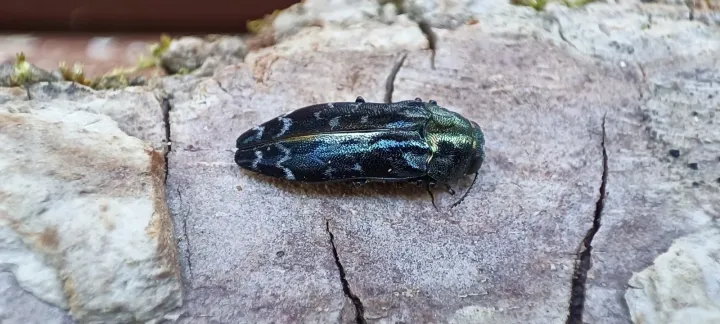
The cork oak borer (Latin Coraebus undatus) is a wood-boring beetle belonging to the Buprestidae family, order Coleoptera. Adult beetles are typically 10–15 mm in length with a slender, elongated body shape.
They exhibit a distinctive metallic luster, ranging from dark bronze to copper-brown. The elytra (wing covers) are adorned with light-colored scales forming wavy, irregular patterns that serve as camouflage.
Larvae are legless, creamy white, and characterized by a flattened, widened thoracic segment. They are specialized to tunnel within the bark of host trees, primarily the cork oak.
The morphological adaptation of the adults allows them to blend perfectly with the textured surface of cork oak bark during the breeding season.
Entomologists classify this species as a specialized pest that is highly adapted to the unique, thick-barked environment of Mediterranean oak ecosystems.
What it damages
The cork oak borer primarily infests the cork oak (Quercus suber). Its larvae feed within the cork layer, creating extensive galleries that destroy the integrity and quality of the raw material.
This economic damage is significant, as infested cork cannot be used for commercial production, such as the manufacture of wine stoppers, leading to direct financial losses for the industry.
Beyond the destruction of the cork, larvae disrupt the tree's vascular transport system. Repeated infestation weakens the tree, making it susceptible to secondary pathogens and drought stress.
In cases of severe outbreaks, the cumulative damage can lead to a drastic reduction in tree growth and overall vitality, potentially resulting in localized tree mortality.
The industrial relevance of this pest is high because the quality of the cork harvested is the main economic driver for cork oak forest management.
When it appears
Adult emergence generally occurs in late spring and early summer. This timing is critical as it aligns with the period of high tree physiological activity.
Females deposit eggs into crevices or existing cracks in the bark. The lifecycle is prolonged, with larvae spending multiple years developing under the thick cork layers before pupating.
The duration of the larval stage is highly dependent on ambient temperatures, with warmer regions facilitating a faster development cycle than cooler areas.
As summer temperatures peak, adults are active during the day, seeking suitable sites for mating and egg-laying on the bark surfaces.
The completion of the lifecycle involves the transformation from larva to pupa within the bark, followed by the adult beetle boring its way out to complete the cycle.
Signs of infestation
The most visible sign of infestation is the presence of small, oval-shaped exit holes on the surface of the cork, left behind by emerging adults.
Evidence of larval galleries can sometimes be detected by uneven, swollen, or deformed areas on the bark surface, reflecting the internal damage caused by the feeding larvae.
Frass (larval excrement) may accumulate within the tunnels, and occasionally, small amounts of wood dust or sawdust can be observed near the base of the tree or in bark crevices.
Canopy thinning, yellowing of leaves, and premature leaf drop are common indicators of trees suffering from long-term, high-density infestations.
Professional foresters often use bark removal, known as «sampling,» in suspicious areas to confirm the presence and population density of the borers.
Control measures
Effective management focuses on Integrated Pest Management (IPM) strategies to maintain tree health and reduce the borer population density.
Sanitary measures, such as the prompt removal and disposal of heavily infested trees, are essential to prevent the spread of the insect to healthy stands.
Silvicultural practices should prioritize minimizing mechanical damage during cork harvesting, as open wounds provide prime entry points for egg-laying females.
Chemical control is rarely effective for larvae protected deep within the cork, thus biological control methods and pheromone-based monitoring are preferred.
- Implementing regular forest health inspections.
- Removing and destroying highly infested bark or entire trees.
- Encouraging populations of natural predators like woodpeckers and parasitic wasps.
Taxonomy
- Latin name
- Coraebus undatus
- Order
- Coleoptera (beetles)
- Family
- Buprestidae
- EPPO code
- CORUUN
Discussion
No discussions yet — be the first.