
Coraebus fasciatus
Coraebus fasciatus
Description
How to identify
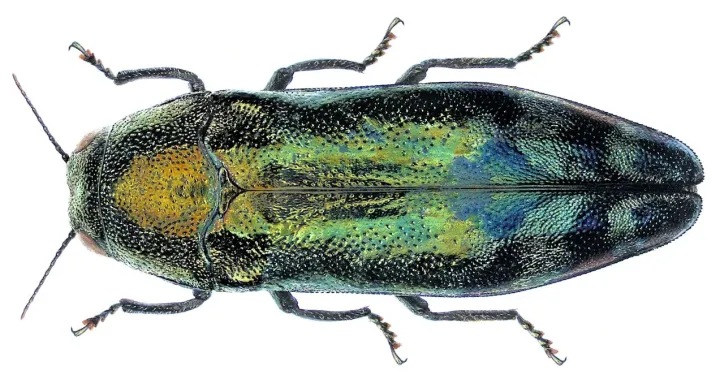
Coraebus fasciatus is a species of metallic wood-boring beetle belonging to the Buprestidae family. These insects are characterized by their elongated, flattened bodies that often exhibit a vibrant metallic luster.
The adult beetle possesses a distinctive color pattern on its elytra, which aids in camouflage when resting on the bark of host trees. Their flattened body shape is an evolutionary adaptation for sliding under bark crevices.
The larvae, often referred to as flat-headed borers, are legless and have a widened thoracic segment. This anatomical feature allows them to move efficiently through the subcortical layers of the tree.
The lifecycle consists of a complete metamorphosis. Eggs are laid on the bark, followed by larval development, pupation, and the emergence of adults, a process that can take one or more years depending on the environment.
Environmental factors, such as ambient temperature and moisture levels, play a crucial role in regulating the speed of larval development and the timing of beetle emergence.
What it damages
This pest primarily attacks various deciduous trees, with a preference for species within the Fagaceae family, including oaks, which can be found in both forests and managed landscapes.
Larval activity is the most destructive phase, as they carve winding galleries beneath the bark, disrupting the cambium layer and cutting off the supply of nutrients and water to the crown.
Severe infestations weaken the tree significantly, leading to canopy thinning, branch dieback, and in extreme cases, the total mortality of the infested plant.
While adult beetles contribute to damage by feeding on leaf edges, this impact is considered secondary compared to the extensive damage inflicted by the larvae feeding beneath the bark surface.
Trees already stressed by drought, competition, or mechanical damage are highly susceptible to becoming hosts for Coraebus fasciatus.
Signs of infestation
The most diagnostic sign of an infestation is the presence of small, oval-shaped exit holes left on the bark by emerging adult beetles after they complete their development.
By carefully removing a section of the bark, one can observe winding larval tunnels filled with sawdust-like frass, which confirm active feeding within the tree's conductive layers.
Visually, the presence of the beetle often manifests as yellowing leaves, unexpected drooping, or localized dieback of limbs that do not correlate with other known diseases or stressors.
In some cases, the bark at the infestation site may show signs of splitting or oozing, indicating that the tree's health has been severely compromised by the larval tunneling beneath.
A noticeable decrease in annual shoot growth is a common secondary symptom, as the tree struggles to maintain its normal physiological functions despite the damage.
Control measures
The primary control strategy involves rigorous sanitation, including the prompt removal and destruction of heavily infested trees to prevent the dispersal of beetles to healthy vegetation.
Maintaining optimal tree vigor through consistent watering and soil nutrition is essential, as healthy trees can better resist larval penetration attempts compared to stressed individuals.
In nurseries or high-value landscapes, targeted insecticidal sprays during the peak flight season can effectively manage adult populations before egg-laying occurs.
Monitoring using pheromone traps can provide valuable data on population density, allowing for more precise timing of protective interventions throughout the season.
- Regular inspections of tree bark for exit holes.
- Proper disposal of infested timber through burning or chipping.
- Promoting biodiversity to encourage natural predators of wood-boring beetles.
Taxonomy
- Latin name
- Coraebus fasciatus
- Order
- Coleoptera (beetles)
- Family
- Buprestidae
- EPPO code
- CORUFL
Discussion
No discussions yet — be the first.