
Coprophilus
Coprophilus
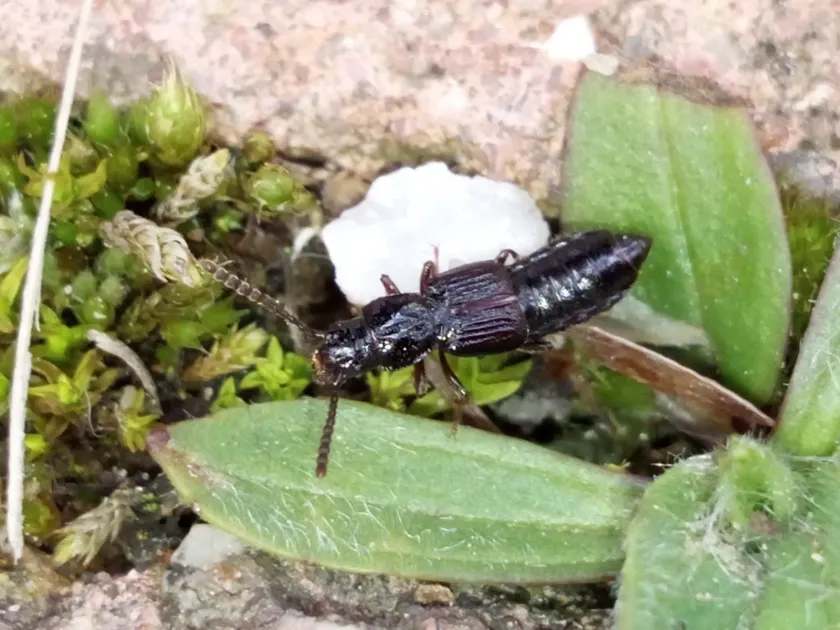
Description
How to identify
The genus Coprophilus belongs to the family Staphylinidae, part of the order Coleoptera. These beetles are characterized by their elongated, flattened bodies, which allow them to move easily through narrow gaps in soil or plant debris.
Adults typically have dark coloration, ranging from dark brown to black. They often possess a massive head with well-developed chewing mouthparts adapted for feeding on organic residues and plant tissues.
The larvae of these beetles are worm-like and develop primarily in organic-rich substrates. They are cryptic by nature, making them difficult to detect during the early stages of a site infestation.
These insects prefer moist environments, and their activity levels correlate strongly with irrigation and rainfall patterns. In their natural habitat, they are frequently found in decaying organic matter, but under unfavorable conditions, they can shift to feeding on living plant tissues.
Accurate species identification usually requires a study of genital structures or the use of a binocular microscope, as many staphylinid species appear externally similar.
What it damages
The primary damage caused by Coprophilus involves feeding on the root system and the root zone of young plants. Vegetable crops grown in greenhouses or in fields with heavy organic fertilization are most frequently affected.
The pest causes mechanical injury to stems and roots, creating entry points for secondary infections such as fungal and bacterial pathogens. This often leads to root rot and gradual wilting of the crop.
The greatest risk occurs during the seedling stage when plant tissues are succulent and lack mechanical toughness. Damaged seedlings often die or show significantly stunted growth.
In greenhouse settings, these beetles can damage seedlings, resulting in uneven plant stands across the beds, which negatively impacts yield projections and produce quality.
While adults may feed on decomposing matter, they will readily switch to weakened parts of agricultural plants when organic food sources are scarce, acting as full-fledged pests.
When it appears
The activity of Coprophilus is directly dependent on soil temperature and moisture. The period from late spring to mid-autumn provides the most favorable conditions for their reproduction.
In greenhouses, the life cycle can continue uninterrupted if consistent temperature and humidity levels are maintained, making this pest a year-round threat to indoor farming facilities.
Population peaks are typically observed during periods of intense rainfall when soil becomes excessively wet. High moisture promotes the decay of organic matter, which attracts beetles to the area.
Insects generally overwinter as adults or larvae deep in the soil or under plant cover. With the arrival of warmer spring days, they migrate toward areas with dense crop growth.
To forecast population surges, agronomists are advised to monitor compost heaps and soil moisture levels, as these locations serve as primary reservoirs for the pest.
Signs of infestation
The first sign of infestation is sudden wilting of individual plants, even when soil moisture is adequate. Inspecting the root zone may reveal signs of chewing or destruction of the stem epidermis.
Another manifestation is stunted seedling growth that cannot be explained by nutrient deficiencies. When affected plants are dug up, their root tips often appear nibbled or damaged.
The presence of large numbers of staphylinid beetles during soil excavations or sticky trap inspections is a clear signal to initiate protective measures. Also, watch for damage on organic fertilizer distributed across fields.
In greenhouses, the presence of adults is often detected on yellow or blue sticky traps placed near the soil surface.
A characteristic sign is the presence of secondary rot surrounding the damaged area. If you notice stem blackening near the base, this is a reliable indicator of soil pest activity, including representatives of Coprophilus.
Control measures
Effective control starts with cultural practices. Key methods include crop rotation and the timely removal of plant residues, which provide both food and shelter for the insects.
Excessive soil moisture and standing water must be avoided. Regulating irrigation regimes significantly reduces the appeal of the area to these staphylinid beetles.
Using balanced mineral fertilizers instead of excessive amounts of uncomposted manure reduces the risk of pest infestation. All organic fertilizers should be fully composted or disinfected before being added to the soil.
- Application of biological insecticides based on entomopathogenic fungi.
- Regular cultivation of inter-row spaces to disrupt the larval life cycle.
- Installation of mechanical barriers or sticky traps.
- Use of soil-applied insecticides if economic damage thresholds are exceeded.
Chemical protection should be used with caution, respecting ecological guidelines and pre-harvest intervals, especially for vegetable crops during the fruiting period.
Taxonomy
- Latin name
- Coprophilus
- Order
- Coleoptera (beetles)
- Family
- Staphylinidae
- EPPO code
- COPPSP
Discussion
No discussions yet — be the first.