
Ducal cone
Conus aulicus
Description
How to identify
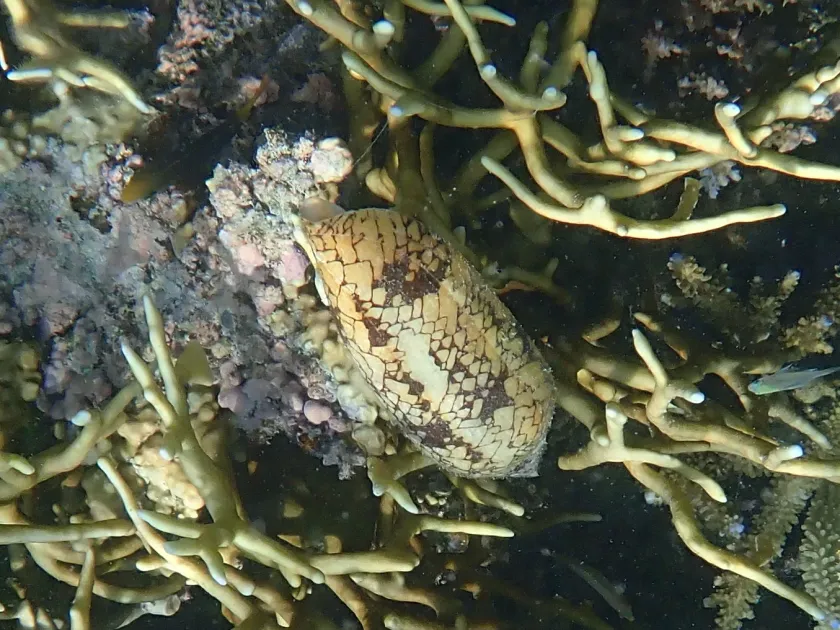
The Ducal cone (Conus aulicus) is a species of predatory sea snail belonging to the Conidae family and the order Neogastropoda. It is well-known for its elongated, intricately patterned shell.
This mollusk is native to the Indo-Pacific region, where it lives in tropical marine environments, often hiding under sand or coral rubble during daylight hours.
It is equipped with a specialized venom delivery system featuring a harpoon-like tooth used to immobilize its prey. This venom is highly complex and potent.
The shell can grow up to 15 cm in length and typically displays a glossy finish with reddish-brown to dark brown patterns against a lighter background.
Because these snails are venomous, they are subjects of study in toxicology and marine biology, requiring extreme caution during any interaction.
What it damages
It is critical to note that the Ducal cone (Conus aulicus) is not an agricultural pest. It has no impact on crops, orchards, or vegetable production.
The snail's diet is strictly carnivorous, primarily feeding on other marine gastropods. It does not consume plant tissues or damage soil health.
The geographical and ecological range of this species is confined to saltwater environments, keeping it completely separated from terrestrial agricultural systems.
Consequently, there is no economic loss associated with this species in the context of global or local agricultural production.
Farmers and agronomists do not need to implement any monitoring or mitigation strategies regarding this organism, as it poses no threat to food security.
Control measures
No agricultural control methods are required for Conus aulicus, as it occupies a niche far removed from farming practices.
Safety protocols apply exclusively to those working in marine environments, such as researchers, fishermen, or individuals engaged in aquaculture near reef zones.
The primary recommendation for safety is to refrain from touching or handling unidentified marine mollusks found in the wild to prevent accidental envenomation.
If an incident occurs, professional medical care must be sought immediately, as the venom contains neurotoxins that can severely impact human health.
Conservation efforts for this species are focused on maintaining the integrity of coral reef ecosystems rather than controlling its population.
Taxonomy
- Latin name
- Conus aulicus
- Order
- Molluscs
- Family
- Conidae
- EPPO code
- CONUAU
Discussion
No discussions yet — be the first.