
Pandora moth
Coloradia pandora
Description
How to identify
The Pandora moth (Coloradia pandora) is a member of the Saturniidae family, order Lepidoptera, and is recognized as a significant forest defoliator.
Adult moths are relatively large, with a wingspan ranging from 70 to 110 mm, and possess greyish-brown forewings that help them blend into the bark of coniferous trees.
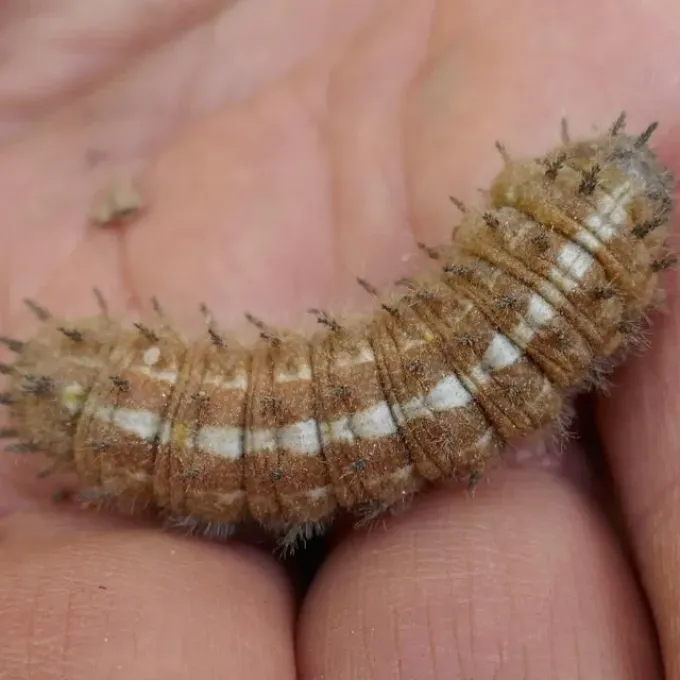
Larvae, or caterpillars, change color during their development, transitioning from black with yellow bristles in early stages to a brownish-green hue as they mature.
Pupae are large and dark-colored, typically overwintering deep in the soil beneath the host trees, which protects them from extreme weather conditions.
This species is native to western North America, where it primarily targets various pine species within high-elevation coniferous forest ecosystems.
What it damages
The primary hosts of the Pandora moth include the lodgepole pine (Pinus contorta) and the ponderosa pine (Pinus ponderosa), both vital forest resources.
Young larvae feed selectively on older needles, while mature caterpillars consume both old and current-year needles, causing severe canopy depletion.
Outbreaks of this moth result in massive defoliation, which severely reduces the tree's ability to photosynthesize and store essential nutrients for winter.
Repeated defoliation over consecutive seasons leads to significant growth loss and can cause widespread mortality within pine stands.
Stressed trees are highly susceptible to secondary attacks by bark beetles, which often kill the trees weakened by the initial moth defoliation.
When it appears
The Pandora moth exhibits a unique two-year life cycle, which is a critical factor for forest managers to consider when planning monitoring and intervention strategies.
Adult moths emerge in early summer, typically between June and July, to mate and deposit eggs in clusters on the pine needles or bark of the host trees.
After hatching, the larvae feed throughout the summer months before descending into the soil to hibernate as early-instar caterpillars for their first winter.
During the second year, the larvae emerge from the soil in spring to feed voraciously, reaching full maturity by late summer before pupating in the ground.
The pupal stage lasts until the next emergence cycle, meaning that major population peaks occur in specific predictable intervals across the affected landscape.
Signs of infestation
A primary indicator of a Pandora moth infestation is the visible thinning of the forest canopy, as the needles are consumed by the feeding larvae.
The accumulation of caterpillar frass, or droppings, on the forest floor is a significant sign, often covering the ground beneath infested trees in granular debris.
In cases of severe infestation, trees may appear yellowish or reddish-brown due to the stripping of the foliage, giving the forest a sickly, withered appearance.
During peak activity, the sound of thousands of larvae feeding on pine needles can actually be heard in quiet forest stands, indicating a large population.
Physical observation of the large caterpillars moving along branches or tree trunks is a definitive sign of an active infestation in the area.
Control measures
Natural control is often provided by the forest ecosystem itself, including various parasitoid wasps, flies, and naturally occurring viral pathogens that suppress moth populations.
Monitoring using pheromone traps is the most effective way to detect emerging outbreaks and estimate population density before damage becomes widespread.
Biological insecticides, such as formulations of Bacillus thuringiensis, are used when chemical intervention is necessary, providing targeted control with minimal environmental impact.
Management strategies focus on maintaining forest health and diversity, which naturally limits the potential for large-scale outbreaks of the Pandora moth.
- pheromone trap monitoring programs;
- application of biological control agents;
- preservation of natural parasitoid habitats;
- salvage logging in areas with extreme tree mortality.
Taxonomy
- Latin name
- Coloradia pandora
- Order
- Lepidoptera (butterflies)
- Family
- Saturniidae
- EPPO code
- COLRPA
Discussion
No discussions yet — be the first.