
Chocolate-tip
Clostera pigra
Description
How to identify
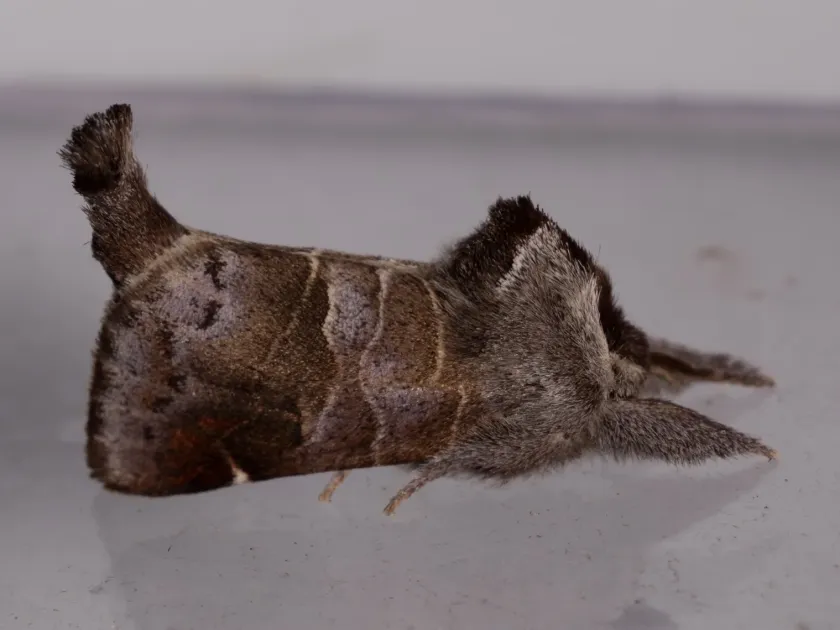
The Chocolate-tip moth (Clostera pigra) belongs to the Notodontidae family. The adult moth has a wingspan of 25-35 mm, with brownish-grey forewings characterized by a distinct chocolate-brown or silvery tip, which gives the species its common name.
The larvae, or caterpillars, reach up to 35 mm in length. They are typically greyish-green to reddish-brown with longitudinal light stripes and a prominent, conical projection at the end of the abdomen, making them relatively easy to distinguish.
Pupae are dark brown and develop within spun-together leaves or in silken cocoons among leaf litter. This stage is responsible for overwintering, typically taking place in the soil or protected crevices of the host plant.
Adult moths are nocturnal and are highly attracted to light sources. Females deposit eggs in clusters on the undersides of leaves of host plants, often hidden from casual inspection.
This species is recognized as a significant defoliator, capable of causing localized but severe damage to trees and shrubs when population levels fluctuate into mass outbreaks.
What it damages
The primary host plants for the Chocolate-tip moth are various species of Populus, particularly aspen, and Salix species. In some regions, they may also be found on birch trees.
Young caterpillars practice skeletonization, consuming the soft leaf tissue while leaving the tougher veins intact. Older larvae consume entire leaves, often leaving only the main stems or midribs.
Heavy infestations result in significant defoliation, which causes the tree to lose leaf mass prematurely. This disrupts the tree's photosynthetic capability and stresses the plant during the growing season.
In nurseries and young forest plantations, significant damage can retard growth rates and reduce the overall health and ornamental value of the trees, making them less marketable or viable.
Physiologically stressed trees caused by repeated defoliation are also more susceptible to opportunistic pathogens and secondary infestations by wood-boring insects.
When it appears
The life cycle of the Chocolate-tip moth typically involves one or two generations per year, depending on the latitude and climate conditions. Adults of the first generation generally emerge in late spring.
Larval feeding occurs throughout the summer months. The first generation larvae develop rapidly, entering the pupal stage by mid-summer, which then produces a second generation of moths.
The second generation of larvae feeds throughout late summer, preparing to enter the pupal stage for overwintering by autumn. The timing of these cycles is heavily influenced by ambient temperatures.
Optimal conditions for outbreaks include long, warm summers with moderate rainfall, which help support high survival rates of egg clusters and developing caterpillars.
Monitoring should be most intensive from late spring through early autumn, as the presence of multiple overlapping generations can lead to persistent feeding activity.
Signs of infestation
The most diagnostic sign of an infestation is the presence of rolled or folded leaves held together by silk webbing. These structures serve as daytime shelters for the larvae.
Accumulation of frass (caterpillar excrement) on leaves below feeding sites or on the ground at the base of the tree is a clear indicator of active larval presence in the canopy.
Visible patches of bare branches, known as "thinning," indicate that the larval population has caused significant leaf loss, necessitating an immediate assessment of the damage.
Attraction of adults to light traps at night is a primary method for detecting the onset of an infestation before the larvae cause extensive visual damage to the foliage.
Searching for pupae in bark crevices or among fallen leaves in late autumn provides a way to estimate the potential pest pressure for the following spring season.
Control measures
Biological control, specifically the use of formulations containing Bacillus thuringiensis (Bt), is highly effective against early-instar larvae while remaining safe for beneficial insects.
In forest nurseries or commercial settings, the use of registered insecticides may be required if larval populations reach or exceed predefined economic threshold levels.
Cultural control practices, such as the removal and destruction of leaf litter and debris, can significantly reduce the number of overwintering pupae near valuable plantings.
Encouraging biodiversity by providing habitats for birds and parasitic wasps helps to maintain a natural balance, keeping the population of the Chocolate-tip moth in check.
- Monitor leaf canopy for rolled foliage.
- Manual removal of larval nests on small trees.
- Use light traps for adult population management.
- Apply biological insecticides early in the larval stage.
Taxonomy
- Latin name
- Clostera pigra
- Order
- Lepidoptera (butterflies)
- Family
- Notodontidae
- EPPO code
- CLOSPI
Discussion
No discussions yet — be the first.