
Prominent moth
Clostera
Description
How to identify
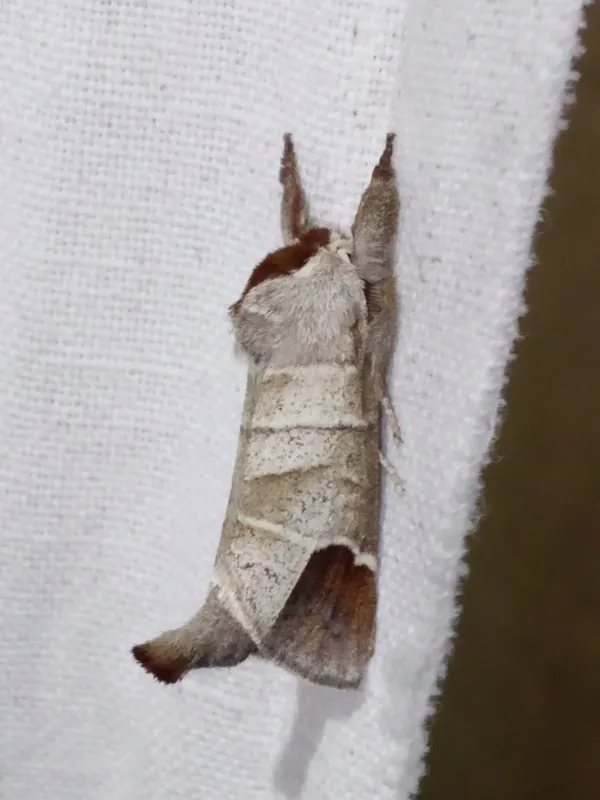
The genus Clostera, belonging to the Notodontidae family, is commonly known as prominent moths. These nocturnal insects have a wingspan ranging from 30 to 45 mm, typically featuring greyish-brown patterns with transverse lines on their forewings.
The larvae, or caterpillars, are distinguished by characteristic dorsal humps or tubercles on the fourth and eleventh segments of their body, which serve as a primary diagnostic feature.
Their coloration is cryptic, ranging from green to brown with longitudinal stripes, allowing them to blend seamlessly with the foliage of host trees.
Their life cycle consists of the egg, larval (caterpillar), pupal, and adult stages. They typically overwinter as pupae within dense cocoons hidden in bark crevices or leaf litter.
Adult moths are nocturnal and are attracted to light, depositing their eggs in clusters on the undersides of host leaves.
What it damages
Prominent moths primarily feed on members of the Salicaceae family, specifically poplars, aspens, and various species of willows.
Mass outbreaks of these larvae can result in severe defoliation, which negatively impacts tree health in forests, parks, and urban landscapes.
Early-instar caterpillars skeletonize the foliage, consuming the soft tissue while leaving the veins intact, while later instars consume the entire leaf blade.
Heavy defoliation reduces the tree's photosynthetic capacity, leading to weakened immune systems and diminished wood production.
Stressed trees are significantly more susceptible to secondary infestations by wood-boring insects and pathogenic fungi.
When it appears
The first flight of adults usually occurs in spring, typically around May, marking the beginning of the breeding season.
Depending on the climatic zone and temperature, Clostera species can complete two or three generations within a single growing season.
Larval feeding intensity peaks during the mid-summer months, corresponding with the period of greatest vegetative growth for the host trees.
Successive generations of moths continue the cycle, ensuring a sustained threat to the foliage throughout the warmer months of the year.
Pupation occurs as late summer transitions to autumn, with the insects entering diapause to survive the winter temperatures.
Signs of infestation
One of the most apparent signs of infestation is the presence of webbed leaf nests where young larvae congregate during their early development.
Characteristic skeletonization of leaves, where only the leaf vein structure remains, is a classic indication of Clostera caterpillar activity.
The accumulation of larval frass (excrement) on the ground beneath the canopy often signals a significant population density in the upper branches.
Leaf curling and the binding of leaves with silk threads are common nesting behaviors that help protect the larvae from predators.
Early leaf drop and signs of branch dieback in the middle of the season are often the culmination of long-term infestation by this pest.
Control measures
Monitoring population levels using pheromone traps is an essential strategy for timing insecticide applications accurately.
Biological control, particularly the use of Bacillus thuringiensis-based products, provides an effective and environmentally friendly management option.
Chemical control involving systemic or contact-stomach insecticides is recommended when infestation levels threaten the health of the host trees.
Maintaining ecological diversity in plantations helps attract natural predators such as parasitic wasps and insectivorous birds.
Cultural practices like removing and disposing of leaf litter in autumn can significantly reduce the overwintering pupal population near the tree base.
Taxonomy
- Latin name
- Clostera
- Order
- Lepidoptera (butterflies)
- Family
- Notodontidae
- EPPO code
- CLOSSP
Discussion
No discussions yet — be the first.